Playbooks · 5 min read
Post-Purchase Follow-Up: You Cannot Send It, So Invite It

Somebody buys. Three days later you want to send them a message: has it arrived, are you getting on with it, here is how to use the thing properly.
You cannot send it. Not because we have not built it, but because there is nowhere to send it to. A customer who ordered on your website, or over the phone, or across the counter, has not messaged your Instagram account. There is no thread, no window, and no permission on the official API to open one. If they did message you at some point, the twenty-four hour DM window closed a day after their last message, and nothing you do reopens it — the reasoning is set out in full elsewhere and this post is not going to re-argue it.
We also do not receive order events. No Shopify connection, no webhook, no payment data. We could not know that a purchase happened even if there were somewhere to send the message.
So the whole post-purchase automation category, as normally sold, is unavailable here. What is available is the other half of the same job, and it is genuinely worth doing.
You cannot open the conversation. You can make opening it the easiest thing your customer does that day.
The customer wants to ask anyway
Post-purchase messages exist because customers have post-purchase questions. Where is it. How do I wash it. Kitne din mein aayega. It came in the wrong size. Is there a warranty.
They are going to ask those questions somewhere. If asking is easy they ask you, and you get a conversation with an open twenty-four hour window and a customer who is currently thinking about your product. If asking is hard they ask nobody, and the answer arrives as a return, a bad review, or silence.
So the design problem inverts. Instead of scheduling an outbound message, you are removing friction from an inbound one.
Put the invitation where the purchase already is
The invitation has to live outside Instagram, because that is where the purchase happened. Every one of these is a place a real business already has:
- The packing slip or the box. One line, handwritten or printed. "Koi bhi doubt ho toh Instagram pe DM kar dijiye @yourhandle — hum wahi reply karte hain." Include the handle, not just the logo.
- The order confirmation email. The one channel where you genuinely may send unsolicited messages, because they gave you the address. Put the DM invitation in it.
- The thank-you page after checkout. The highest-attention screen in the entire purchase and the one most shops waste on a tick mark.
- The counter, out loud. For anyone with a physical shop this outperforms all three. People do what they were asked to do by a person.
The four automations that cover most of it
Once customers start writing in, the post-purchase inbox is remarkably repetitive. Build these on the message trigger and they will handle a large share of it without any credit being spent, because a templated reply is free and unlimited.
- Order status.
order,tracking,kahan hai,dispatch,delivery. The reply cannot look anything up — we have no order data — so it should ask for the one thing that lets a human look it up. "Order number bhej dijiye, main abhi check karta hoon." - Care and usage.
wash,care,how to use,instructions,kaise. This one can be a complete answer. It is the same answer every time and it never changes. - Returns and exchange.
return,exchange,size wrong,damaged. Answer with the actual policy and the actual next step. Never with "our team will get back to you". - Something is wrong. Keep this one thin on purpose. An angry customer should reach a person in one turn, not be routed.
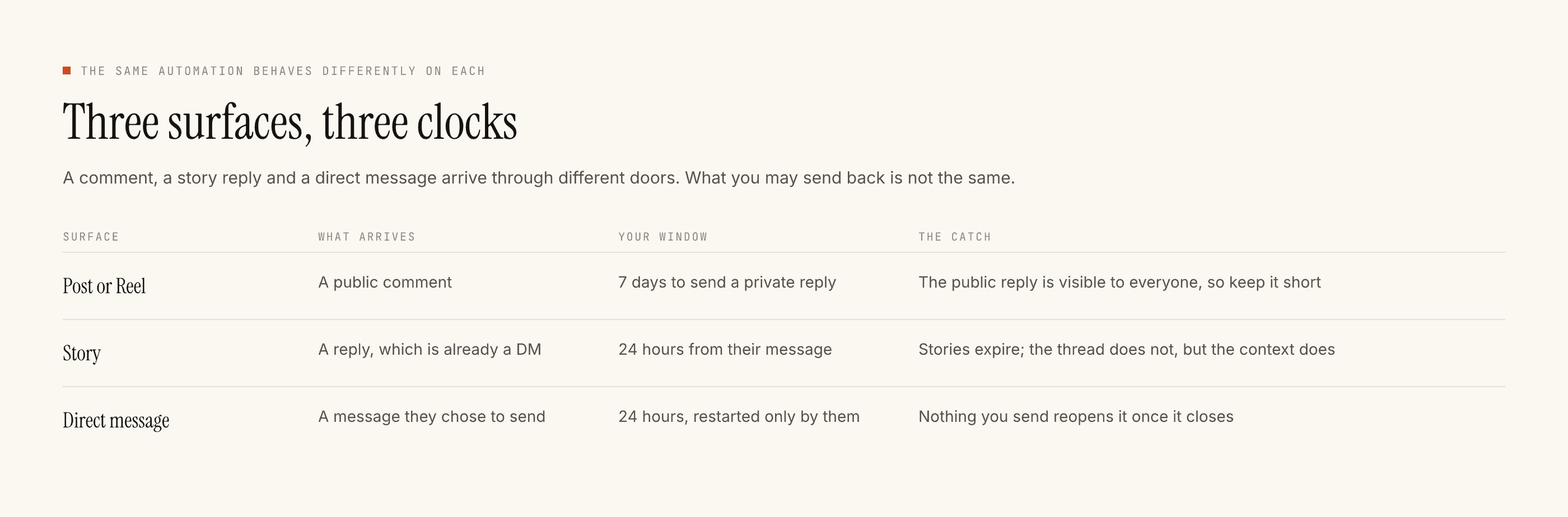
Order status is the trap
The order-status automation is the one that goes wrong, and it goes wrong in a specific way: it replies instantly with something that is not an answer, which spends the turn and starts a clock.
Remember which clock. The twenty-four hours runs from their message, not from your reply. If they wrote at 9am and your automation said "checking!" at 9.01, you have until 9am tomorrow to come back with the real answer — and the automated holding message bought you exactly none of it. The cost of deferring is the whole subject of a separate post, and post-purchase is where accounts pay it most often.
The fix is to make the automated reply do work: ask for the order number in the same breath, so their answer both gives you the input and restarts the window.
Takeover is the handoff, and it is automatic
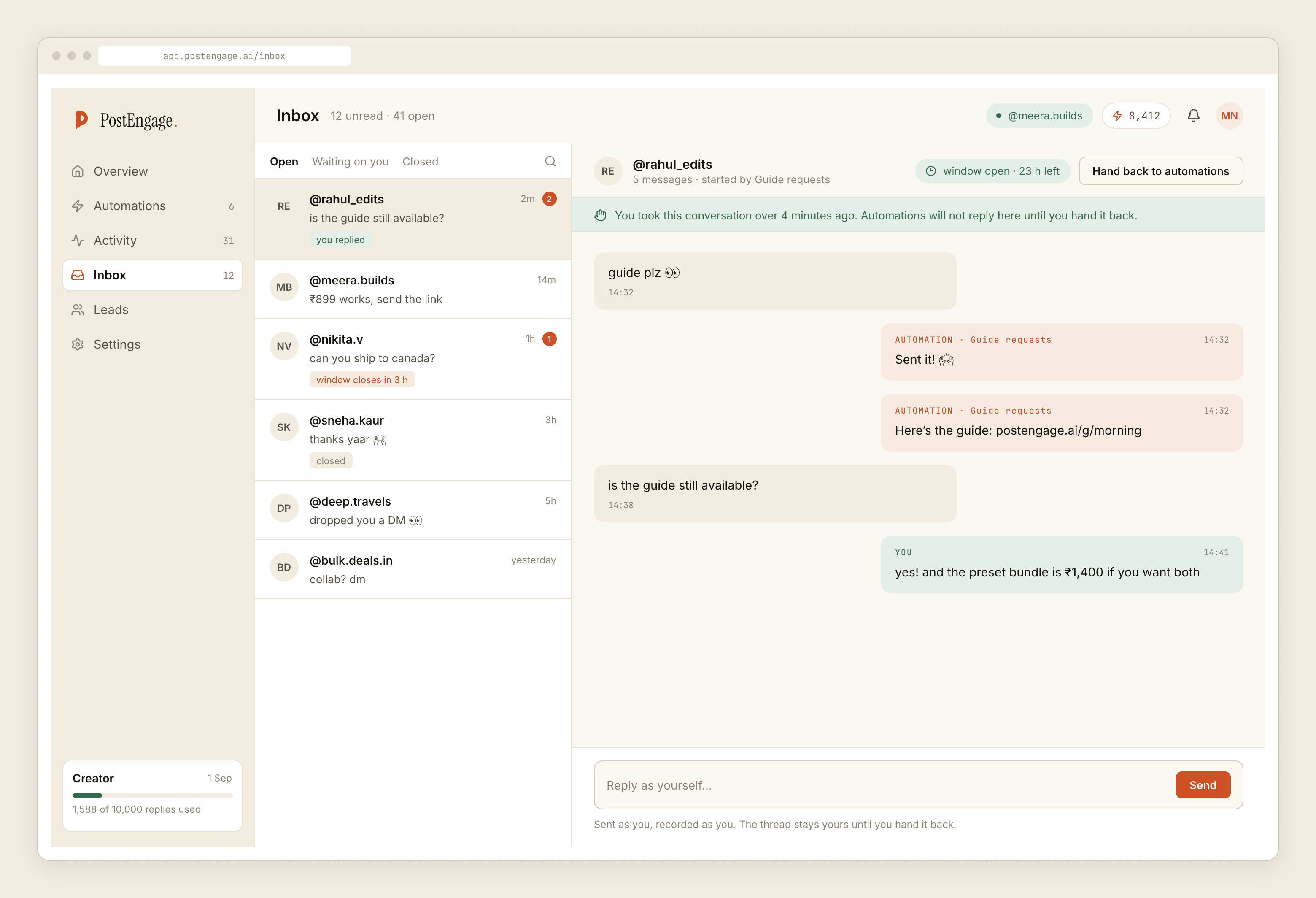
Post-purchase conversations turn into human conversations faster than sales ones do, because the second turn is usually specific to one person. That handoff needs no button. The moment someone on your team replies by hand in a thread, automation stands down there for good.
What about reviews, and repeat orders
Both are the same shape as everything above: you cannot go and ask, so you have to be asked. A review request belongs on the packing slip and in the confirmation email. A repeat order happens when the customer comes back on their own and finds you ready — which is a records problem more than an automation one.
What you are building, in the end, is not a follow-up sequence. It is an account where the post-purchase question is easy to ask, answered in seconds, and answered by somebody who does not sound like a form. That covers most of what the sequence was ever supposed to buy, inside rules you are not fighting. If you want the same thinking applied to the first hours after a signup rather than a purchase, onboarding has its own version.