Playbooks · 5 min read
The Only Follow-Up You Can Send Is One You Set Up Earlier

There are no sequences in this product. No drip, no multi-step nurture, no scheduled second message, no flow canvas. That ground is covered properly in the post on designing the one reply, and this page is not going to argue it again.
What this page is about is the narrower word. "Follow-up" is not a synonym for "sequence", and when you separate the three things people mean by it, one of them turns out to be entirely real, common, and badly handled by most accounts.
Three different messages, one word
- The scheduled nudge. Day three, "just checking in". This cannot be sent. The twenty-four hour DM window is restarted only by their message, and nothing you do reopens it. Not a missing feature — a message that does not exist.
- The reply to their reply. They answered, the clock restarted, you answer again. This is not a follow-up, it is a conversation, and automations handle it fine.
- The message you owe them. You said you would check the stock, ask the tailor, confirm the dates. That is a real follow-up with a real deadline, and it is what the rest of this post is about.
The most expensive sentence in an Instagram inbox
"Let me check and get back to you."
It reads like good service and it does two damaging things at once. It spends your one guaranteed turn without answering anything, and it starts a countdown you now have to beat.
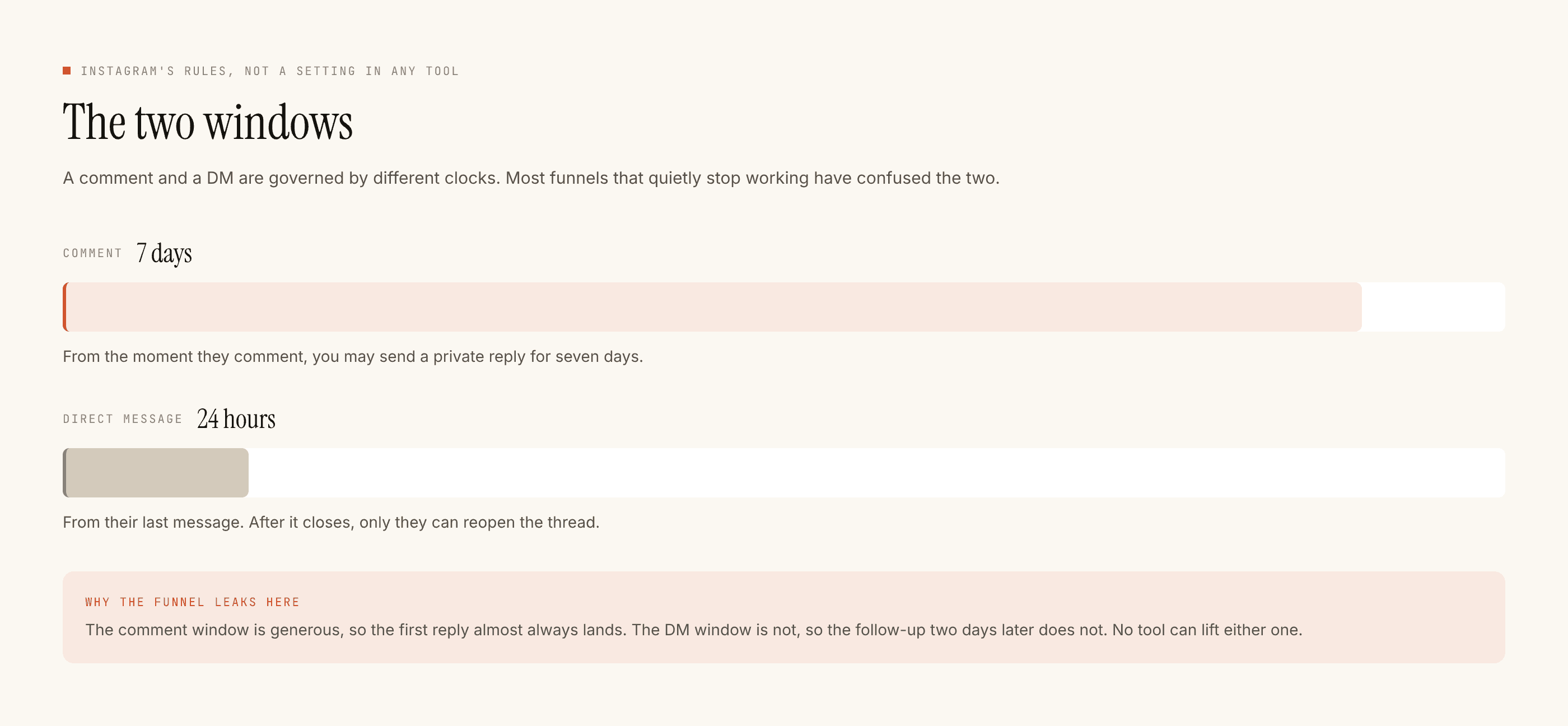
The countdown is the part people get wrong. The window runs twenty-four hours from their last message, not from yours. Sending a holding reply does not push the deadline back by a minute. So the moment you defer, you have twenty-four hours minus however long you already took to respond, and if you took six hours to say "let me check", you have eighteen left to actually check.
Three ways to owe nothing
The fix is almost always in reply one, and it is a writing decision rather than a settings one.
Answer the range instead of the exact. "2-3 din mein pahunch jayega" is a true answer you can give immediately. "Let me confirm the exact date" is a debt. Most deferrals are precision nobody asked for.
Move the uncertainty to them. If the thing you would have gone away to check depends on an answer you do not have — size, city, which variant — ask for it. Their reply gives you the input and restarts the clock. One question does both jobs, which is why the question is the load-bearing part of any reply here.
Hand over a next step that does not route through you. A link, an address, a phone number, an order form. The person who can proceed without you does not need a follow-up at all.
Every deferral converts a conversation you control into a deadline you might miss.
When you genuinely do have to go and check
Sometimes the answer really is not available and the honest reply is that you will find out. Fine. Then treat it as an operational task with a timestamp.
Note when their last message arrived. That is the deadline. Come back inside it with the actual answer, and lead with the answer rather than an apology for the delay.
There is a detail worth knowing here that catches people out. Takeover means automation stands down the moment a human replies by hand in a thread. So if you typed that holding message yourself, that conversation is no longer one your automations touch. The follow-up is yours, by hand, and nothing is waiting in the background to cover for you if you forget.
If you miss it, write one line in the lead record — what they asked, what you were checking — and let it go. When they write again in June, you open the row, read the line, and answer as somebody who remembers. That is the whole recovery path, and the nurturing post is where the record-keeping habit is argued in full.
The follow-up you can prepare for
Here is the version that is genuinely automatable, and it is prepared rather than scheduled.
Your reply ends with a question. You know roughly what the answers will look like, because you wrote the question. So build an automation on the message trigger keyed to exactly those answers, before you ever send it.
Reply one ends M ya L? — build an automation on m, l, medium, large, mediam. Reply one ends "COD or UPI?" — build one on cod, cash, upi, online. The instant they answer, the follow-up is already there, sent inside a window their own message just reopened, faster than you could have typed it.
That is the entire trick, and it inverts how people think about follow-up. You are not scheduling a message into the future. You are pre-positioning a reply for a turn you invited.
What none of this becomes
It does not become a drip. There is still no way to message somebody who has gone quiet, no re-engagement flow, no win-back, no way to start a conversation with anybody at all.
What it becomes is an account where deferrals are rare, the ones that happen have a deadline somebody is watching, and the predictable next turn is answered in seconds rather than hours. That covers most of what a follow-up sequence was ever supposed to buy you, and it does it inside rules you are not fighting.
If reply speed is the part you want to work on, that has its own post.