Playbooks · 5 min read
Personal Trainers Sell Hours, So Qualify Before You Reply

Count your sellable hours. Not the hours you work — the hours somebody can actually buy from you, standing in a gym, one at a time. Take out the ones nobody wants, take out travel between clients, take out the sessions already booked by people who have been with you two years.
Whatever number is left is your entire inventory, and it does not grow when your reach does.
That is the fact almost every automation guide written for fitness ignores. They optimise for volume of enquiries, because volume is what a funnel measures. A trainer with eleven open hours does not have a volume problem. They have a matching problem, and it gets worse as volume goes up.
More DMs is not the win here
An extra thirty enquiries a week is thirty conversations, most of which end with a time you cannot offer or a format you do not sell. Each one costs you fifteen minutes and a small amount of goodwill, and the ones you eventually convert would mostly have converted anyway.
When your stock is your own weekday mornings, the job of the first reply is to lose the wrong people politely and quickly.
So the automation is a filter. Which is an unusual brief, because most people build these to open doors, and it changes what goes in the template: constraints go in early rather than being revealed on message four.
The three facts that decide whether an enquiry is real
- When they can actually train. Not "when suits you" — the honest question. Most enquiries die here and they should die here, before either of you spends a week discovering that the only slot they can do is one you sold in March.
- Where, and whether they will travel. Your gym, their society gym, their home, or online. These are four different products with four different prices and a lot of people assume you do all of them.
- One-to-one, a pair, or online. Two friends wanting to split a session is a different job. Somebody who actually wants an online plan is a much better fit for something that is not an hour of your time.
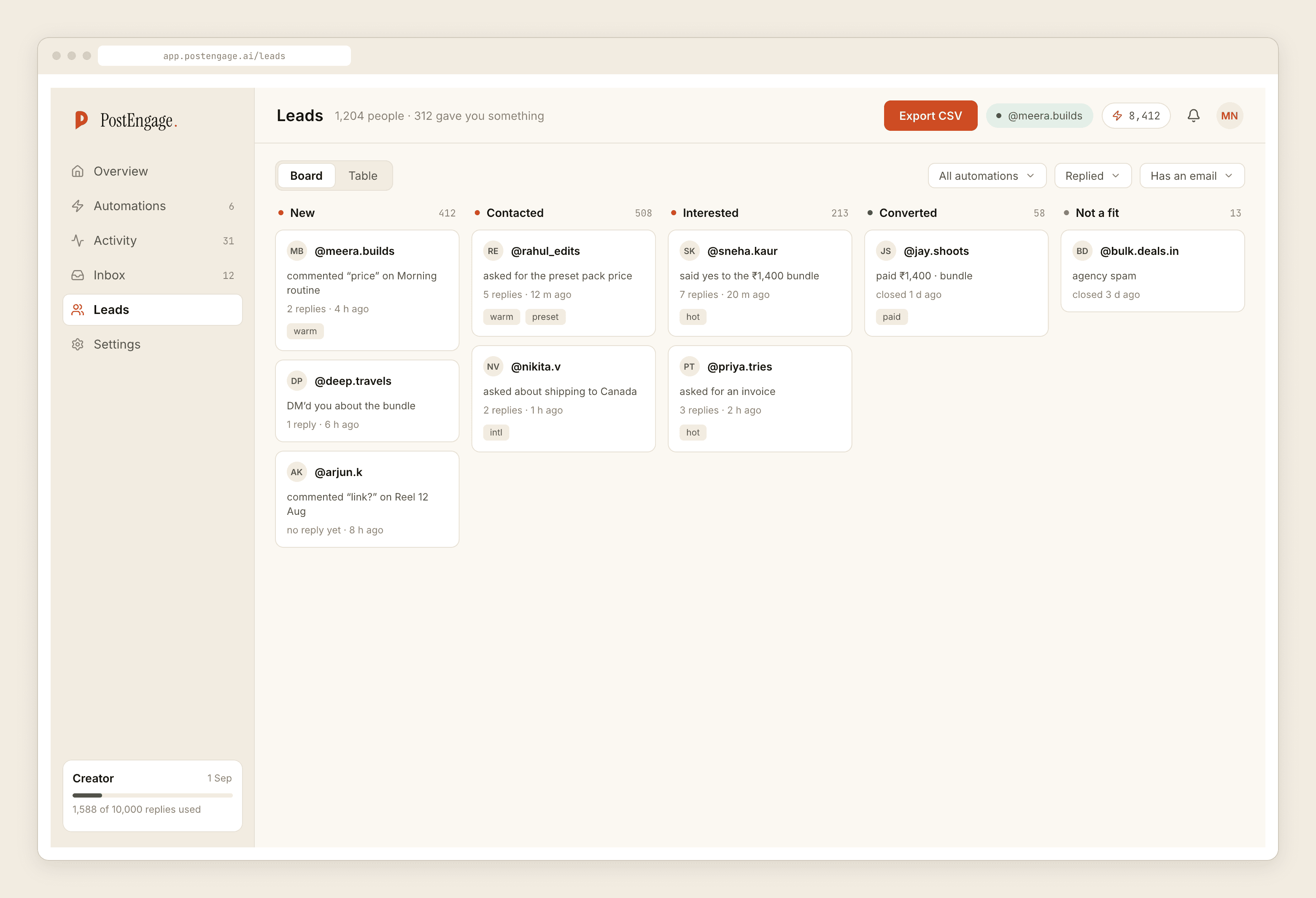
Three questions, one short human message, answers captured to Leads. That is the whole intake. It is deliberately not five questions, because you are filtering, not building a profile.
State your constraints in the template
This is the part trainers resist and the part that works.
If you have no morning slots until August, the template should say so. If you only take clients within a certain area, say the area. If you do not do home visits, say it in the first reply rather than in the fourth.
It feels like turning away business. What it actually does is turn away the enquiries that were never business, at the only point in the conversation where doing so costs you nothing — before either person has invested anything. The people who read that and continue are, by definition, people whose situation fits, and they arrive already knowing it.
Recurring slots, not a single appointment
Here is the availability problem that is specific to one-to-one training and does not apply to a salon or a clinic.
You are not selling the 7am on the 14th. You are selling the 7am on Tuesdays and Thursdays, indefinitely. Which means saying yes to somebody is a decision about the next several months of your week, not about one hour, and it is a decision you cannot delegate to software that has no idea what you already agreed to.
The automation has no calendar. No diary sync, no booking, no hold. It should therefore never confirm a slot — but the deeper reason here is not that it might double-book you on a Tuesday. It is that a recurring slot is close to a contract, and those get agreed by two people who have spoken.
What the automation can do is establish whether the shape fits before you speak: they want two mornings a week, they can only do after 8pm, they want weekends. That is a yes-or-no you can make instantly and it saves the call entirely when the answer is no.
The part that is not yours to automate
A trainer's inbox also carries messages that are about a person rather than a schedule — bodies, numbers, diagnoses, things people have not told their family. Those must reach you, not a template, and they need a different set of rules from the ones in this post. The coaching inbox post covers that properly and it is the more important read of the two if you are starting from zero.
The short version: negative keywords on medical vocabulary and on outcome questions — injury, disc, surgery, thyroid, PCOS, pregnant, medication, doctor, and kitna weight, guarantee, by when, how fast. No template of yours should ever contain a promised result.
Cost, which is unusually favourable for a one-person business
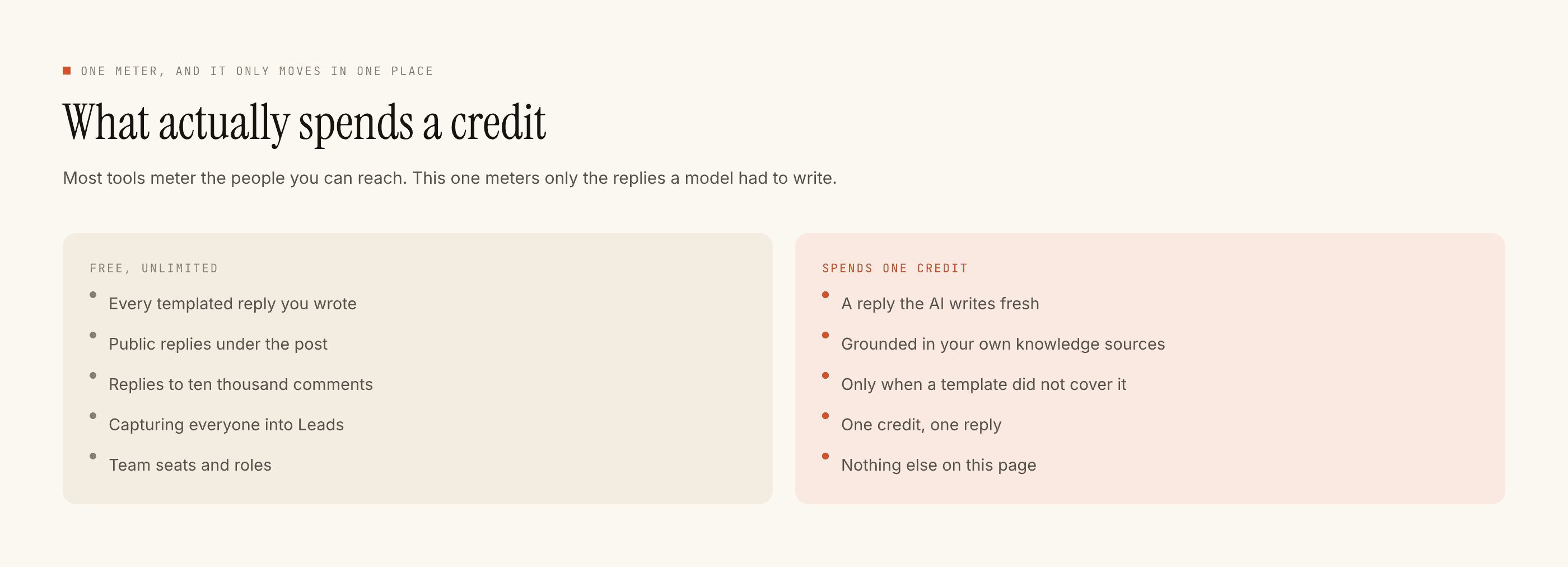
Templated replies are free and unlimited. A credit is spent only when the AI writes a new reply, one credit per reply.
Map that onto a trainer's actual inbox. The repeating questions — where you train, what a session costs, whether you do online, whether there is a trial, whether you take beginners — are templates, so they cost nothing forever. The genuinely unusual messages are exactly the ones you should be answering yourself anyway. Which leaves a small middle band where the AI writes something new, and the free tier of 100 credits with no card lasts a long time against it. Packs start at ₹499 when you need one.
Clocks and limits
Official Graph API. A comment can be replied to for seven days; a DM thread for twenty-four hours from their last message, restarted only when they write again. Deciding to hire a trainer takes people days — they ask on Sunday, think, come back Wednesday — and your side of the thread closed on Monday. There are no sequences, no scheduled follow-ups, no broadcasts. Put the price page and your number in the first reply.
It cannot book, hold, take payment, or message anyone who has not messaged you first. It does not post, caption or schedule. It does not do WhatsApp. Leads leave as a CSV and sync to nothing.
Build the three-question intake, put your constraints in it, and read what got blocked after a week.