Playbooks · 5 min read
Fitness Coaches: When the DM Is Not a Lead, It Is a Confession

Somebody watches your reel at 1am, screenshots nothing, and types: "sir main 96kg hu, do saal se try kar raha hu, kuch kaam nahi karta. aapka program kaam karega kya?"
Every lead-generation framework ever written would call that a hot lead and tell you to send the price and a booking link. That is the wrong reply, and if it goes out automatically it is wrong in a way that is hard to recover from.
The inbox is emotional, and that is the design constraint
This is the thing that makes coaching different from every other vertical people write automation guides for.
Nobody tells a restaurant their weight. Nobody sends an accountant a photograph of their stomach. A fitness coach's DMs contain disclosures people have not made to their own family — about their body, a diagnosis, a failed attempt, sometimes something considerably heavier than any of that.
An automated reply to a message like that is not merely unhelpful. It reads as though the person you were writing to was never there. And because they were building up to sending it, the read is unusually harsh: I finally said this out loud and got a form letter.
The messages that matter most in a coaching inbox are exactly the ones that look, to a keyword matcher, like every other message.
So the split you need is not by topic. It is by whether the message contains a person or a question.
Answer automatically
Hand to a human, always
What the automation must refuse to prescribe
The other half of the constraint is that a coaching DM constantly invites a health judgement, and neither you nor a language model should be making one in a text box.
"I have a slipped disc, can I do your program?" "Meri thyroid hai, diet chalegi?" "Can I do this while pregnant?" "How many kg will I lose by March?"
Those are not sales objections. The first three are medical questions, and the fourth is a request for a promised outcome that nobody can honestly make. An AI writing a new reply will answer all four smoothly, because it has read a great deal of confident fitness content on the internet, most of which was written by people with no obligation to be right.
And keep guarantees out of your templates entirely. Not because a rule somewhere forbids it, but because a promised result sent automatically to a stranger whose situation you have not seen is a claim you will have to stand behind at some point.
Speed still matters, just later in the conversation
None of the above means slow is fine. A person who writes at 1am has decided something and will lose the decision by Thursday.
The version that works is a short, human, non-committal first reply that goes out immediately — acknowledging them, not pitching, and offering a real next step — followed by you, actually you, in the morning. That is the whole play. The automation holds the door; it does not have the conversation.
Which puts unusual weight on how those first thirty words sound.
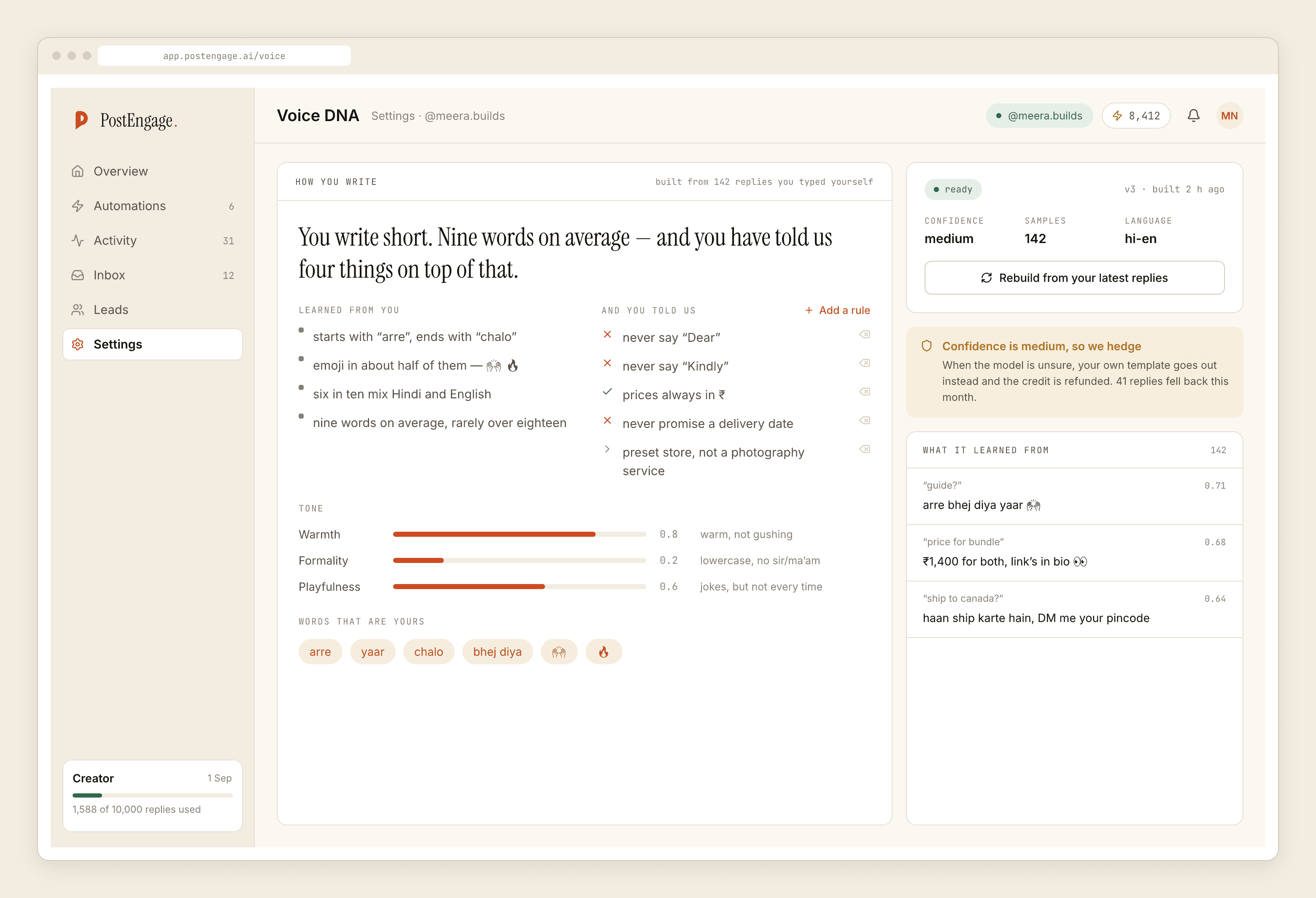
Voice DNA is built from replies you genuinely wrote, not from a tone slider. That matters here more than in any other vertical on this blog, because your client is buying you specifically — the longer version of how that gets trained is worth reading before you write a single template.
The clocks, and the coaching-specific problem with them
Official Instagram API, so: seven days to reply to a comment, twenty-four hours to reply inside a DM thread.
The twenty-four hours is the awkward one for coaches, because deciding to hire a coach is not a same-day decision. Somebody writes on Sunday night, thinks about it for four days, and comes back on Thursday — by which point your side of the thread is outside the window until they message again.
The practical consequence: whatever you want them to have, get it into the first reply. A link they can open on Thursday, a page that answers the price question, a booking calendar. Do not design a five-step drip that assumes you can keep talking on your own schedule, because you cannot.
Cost, and what it will not do
Templated replies are free and unlimited. A credit is spent only when the AI writes something new. For a coach that maps neatly onto the split above: the logistics questions are templates and cost nothing, and the messages that genuinely differ are mostly the ones you want to answer personally anyway. Free tier is 100 credits, no card; packs start at ₹499.
It will not message people who have not messaged you first. It will not post, schedule, or comment on other accounts. It does not do WhatsApp. It cannot assess anybody's health, and everything above is arranged so it never gets the chance to try.
If you are setting up, build the two refusal lists first, then one comment-to-DM automation on your best-performing reel, then read what got blocked after a week. The paced setup guide is the right order for everything else.