Comparison · 5 min read
The DM and the Link in Bio Do Two Different Jobs

Somebody is watching your reel at eleven at night and decides they want to know what the thing costs. There are two ways that ends. They go to your profile, tap the link, and arrive on a page. Or they type a word in the comments and a message appears in their inbox.
Those are usually presented as the same funnel with different plumbing. They are not. They put the person in two different rooms, and the rooms have different exits.
What actually happens at the tap
The bio link is one tap from the post, which is the argument for it, and it is also one tap from every other thing on the phone. The person leaves Instagram. A browser opens. Something loads, probably over a mobile connection, probably slower than the app they just left. Then a page appears that was written for everybody, and they have to find the part that answers the question they had four seconds ago.
Every one of those transitions costs you people. Not because anyone is lazy — because the intention that started the tap was small, and it was competing with a notification, a message, and whatever they were watching before.
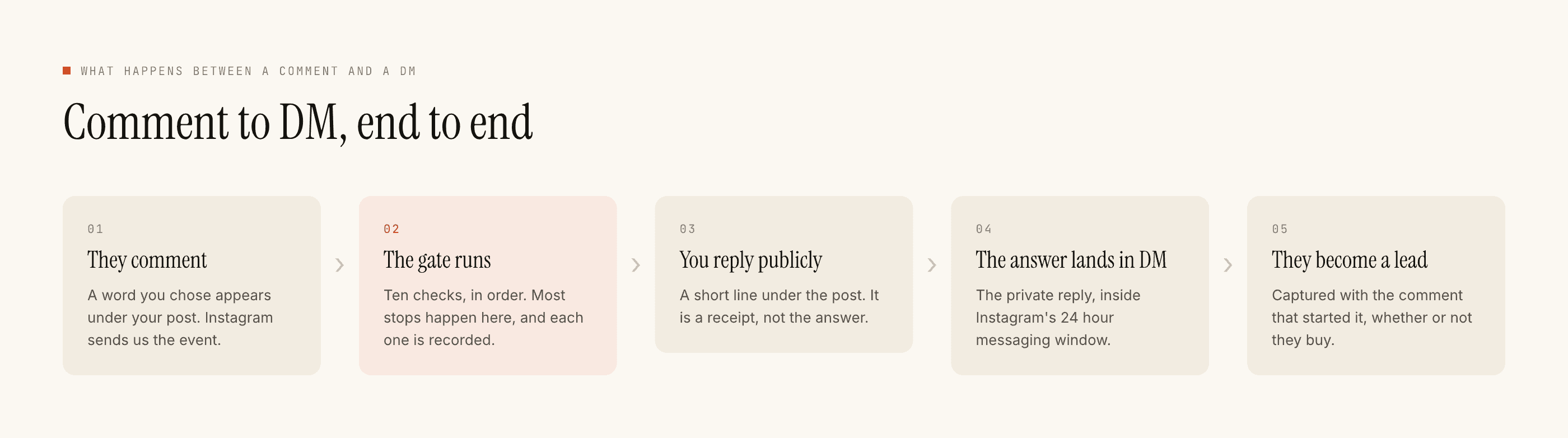
The DM route is fewer moving parts. They type a word, they stay in the app, and a message arrives in the place they already check. Nothing loads. Nothing switches. The answer is in the same interface they were in, and if it is wrong or incomplete they can say so immediately, in the same thread.
What the DM route costs you, honestly
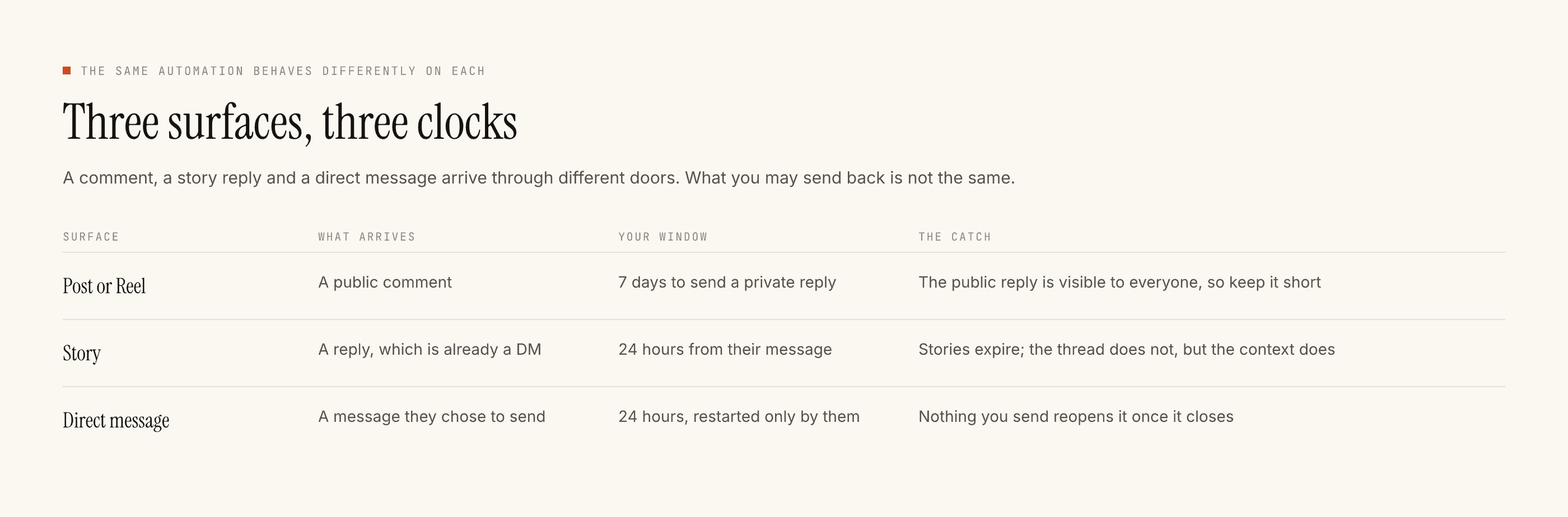
It has a clock. Once that private reply goes out, you have twenty-four hours from their last message, and only their next message restarts it. If they read your reply and do nothing, that conversation is over from your side, permanently. A bio link has no clock. The page sits there.
It has no numbers. You cannot see how many people tapped, bounced, or scrolled halfway. There is no click tracking here, no attribution, no analytics product. A landing page gives you a number, and the number is real even if it is shallow.
And it needs the ask to exist in the caption. A bio link works passively, for anybody who happens to visit your profile. A comment trigger only fires if you told people what to type. That is content work, not software work, and it is the step where most of these funnels actually fail.
The link is always there and rarely used. The DM is only there when you asked for it, and it gets used.
The thing nobody mentions: a link inside the reply
The instinct, once the DM lands, is to put the link in it. Answer the question with a URL and let the page do the rest.
Two problems with that, and the second one is the one people are surprised by.
The first is the obvious one. A link is an exit. You spent the whole comment-to-DM mechanic keeping the person on-platform, and then the first thing your message does is send them off it. Worse, a message that is only a link reads as a broadcast. There is nothing to reply to, so nobody replies, so the window closes.
The second is that Instagram is not neutral about links. Replies that exist mainly to push people off the platform tend to do worse than replies that do not — in reach, in how the conversation is treated, in whether people mark it as unwanted. Nobody publishes a rule about this and I am not going to invent a figure for it. But the direction is consistent enough that it should change how you write: the link is not the message, and if it appears at all it appears in the middle, with a question after it.
Which one for which job
They are not competitors. They fail in different places, so most accounts should run both and stop treating it as a decision.
Link in bio earns its place
DM earns its place
The mistake is using the bio link for the second column. "Link in bio for prices" answers a question the person already asked, by making them go and find it. They asked because they wanted the answer, not the directory.
What we do and do not do here
We reply to people. There is no link-in-bio page builder here, no short links, no click tracking, no landing pages, no analytics. If you want a bio link, you build it somewhere else, and nothing about that touches this product.
What this does is the other column: a comment on a post matches a keyword, a public reply goes under it, a private reply goes to the inbox, and the person is written into your leads list with what they typed and which post caught them. Leads leave as a CSV. Templated replies are free and unlimited; a credit is spent only when the AI writes something new, one credit per reply. Free tier is 100 credits with no card and packs start at ₹499.
Where to start if you currently only have the bio link
Take the single question your bio link exists to answer, and check whether people are asking it in your comments anyway. They usually are. That question is your first automation, and the link stays exactly where it is for everybody who never asks.
Keeping the answer on-platform is the broader version of this argument, and the funnel itself, with the places it leaks, is the mechanical companion. If what you actually want is a list you own rather than a thread you borrow, that goes through email and is worth reading before you build either.