Lead generation · 5 min read
The AI in Your Instagram Sales Funnel Writes One Reply
On this page

Draw the sale honestly and it is short. Somebody comments a word. A public reply appears under the comment. A private reply appears in their inbox. Then nothing happens until they write back, because the twenty-four hour window belongs to them and only their message restarts it. If they do write back, a second reply goes out. After that, in any sale worth having, it is you typing.
Two automated messages. That is the entire surface where software puts words in your name, and the interesting question is not how many stages to draw — that argument has its own post — but which of those two messages the model should be writing at all.
Moment one: the reply to a keyword. Not the model's job.
Somebody typed PRICE. You know what they want. There is nothing to interpret, nothing to compose, and no ambiguity for a model to resolve.
Use a template. Three reasons, and the third is the one that matters.
It is free — templated replies are free and unlimited, and this is the highest-volume message in the whole flow. It is consistent, so everybody who asked the same question gets the same answer rather than four variations of it. And it is the only kind of message you have read in full before a stranger did.
That last property is worth stopping on. A template is a sentence you approved. A generated reply is a sentence that goes out on your behalf without anybody having seen it. For the message that hundreds of people receive, in response to a question you already know the answer to, there is no argument for the second kind.
Moment two: they wrote something specific. This is what a credit is for.
"Do you have this in the green, and can it reach Pune before the 14th?"
No template anticipated that. The options are: ignore it until you get to it, answer it with a template that partially fits and reads like it, or have a reply composed in your register that addresses what they actually asked.
The third is what the AI is for. One credit, one reply. The voice it writes in is built from replies the account owner actually wrote, which is why it inherits your habits rather than a tone setting picked off a menu — the mechanics of that are here.
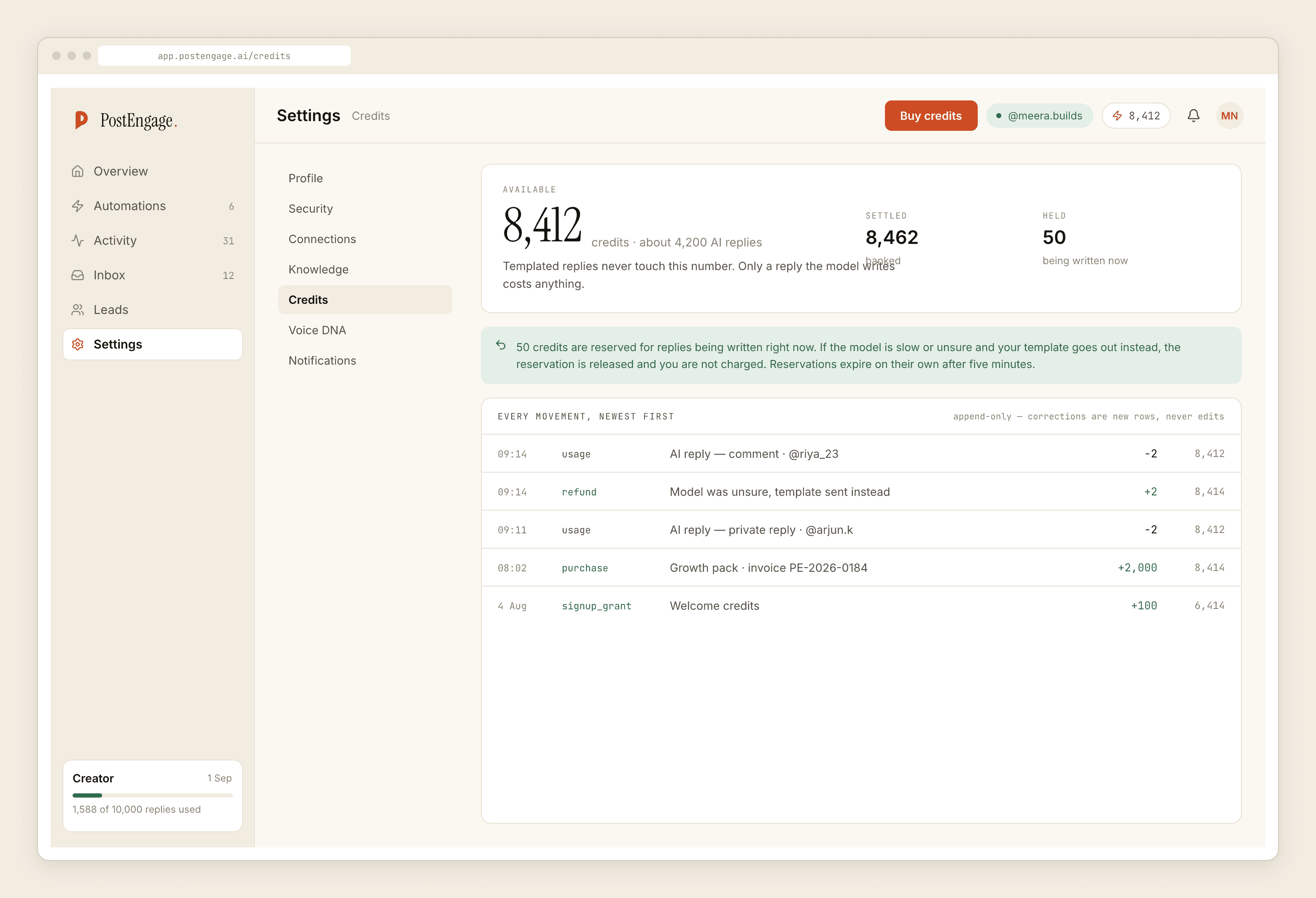
Free tier is 100 credits with no card, which is enough to find out whether the generated half is doing anything you value. Packs start at ₹499.
The rule that should govern every generated sentence
A generated reply must never contain a commitment.
No price. No stock claim. No delivery date. No discount. No refund promise. No "yes we can do that by Friday".
The reasoning is not about model quality, so it does not go away as models improve. A commitment made in your name binds you commercially — the customer read it, believed it, and is entitled to hold you to it. Any sentence with that property should be one a person wrote and approved, once, in advance.
Which means the design falls out cleanly:
Belongs in a template
Safe to generate
The practical version: the model's job in the funnel is to be a good conversational bridge to answers you have already written, not to be the source of the answers.
What the AI is not doing anywhere in this funnel
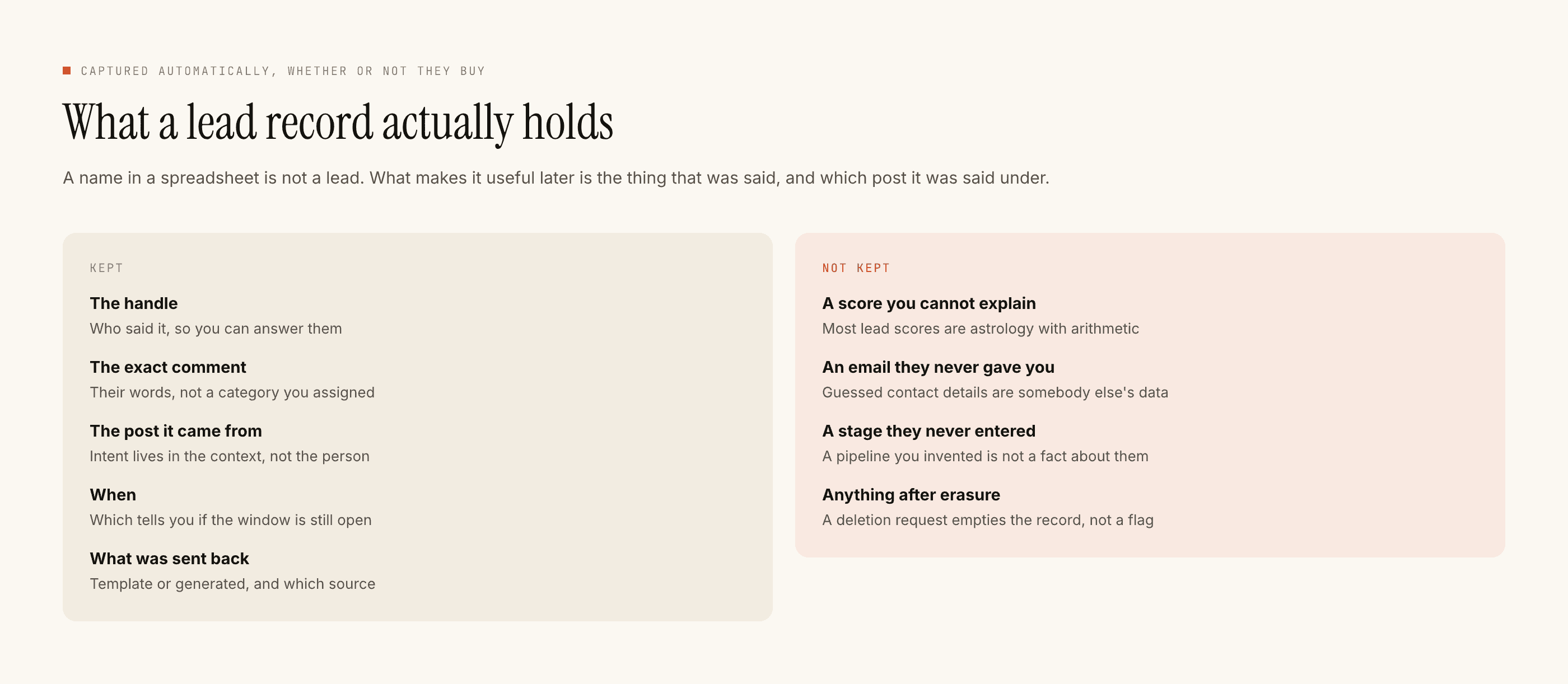
It is not qualifying anybody. A keyword match tells you which word somebody typed, and nothing here infers budget, intent, seriousness or fit. There is no scoring model that knows a nine-person agency in Indore is worth your afternoon.
It is not deciding who gets answered. That is your trigger and your negative keyword list, both of which you wrote.
It is not negotiating, discounting, or closing. It is not following up — there is no sequence, no day-three message, no cart chase, because all of those require a window that has closed.
And it is not watching the outcome. There is no attribution, no click tracking, no revenue reporting. What happens after somebody leaves the thread is invisible here, and any product that claims otherwise on this channel has built a model and called it a measurement.
Where the sale actually happens
On the second or third human turn, and there is no way around that on high-consideration purchases. Somebody spending real money asks a question that reveals what they are actually worried about, and answering that well is judgement, not composition. The high-ticket version of this goes further into what those turns look like.
Which makes the honest job description for the automated half quite modest. It answers the question that was always going to be answered the same way, instantly, at midnight, without you. It captures the handle so nothing is lost. And it hands you a conversation that is already warm, already specific, and still inside a window — because their reply restarted it.
Takeover is what makes the handover clean. The moment you type in a thread, automation stands down in that thread. You do not switch anything off and nothing lands on top of you mid-sentence.
The setup that follows from all of this
Write templates for every question whose answer is a fact about your business, and keep them current — those are your commitments and they should be the most-read sentences you own. Let the model handle everything else, in your voice, one credit at a time. Read the ledger occasionally, and every time you find the same thing being written fresh, turn it into a template.
Then spend your attention on the turn after the automation stops, which is the only part of this that was ever going to decide whether somebody buys.