Lead generation · 5 min read
Course Sales in the DMs: One Reply Has to Do the Closing

A course inbox holds two populations — people deciding and people already enrolled — and the automation cannot tell which one just messaged you. That problem is real and it has its own post, which is where the support-routing work is set out. Build that first.
This one assumes it is done, and looks only at the other population: the person who has not bought yet and has just typed something. The sale itself.
You get one turn, and you do not choose when the second one happens
Everything about how you write a sales reply here follows from one mechanic. The DM window is twenty-four hours and is restarted only by their message. Not by yours. There is no scheduled follow-up, no drip, no cart-closing reminder, no way to message someone who went quiet.
So the reply you send is, by default, the entire sales conversation. Anything you leave out is left out permanently unless the person chooses to write again.
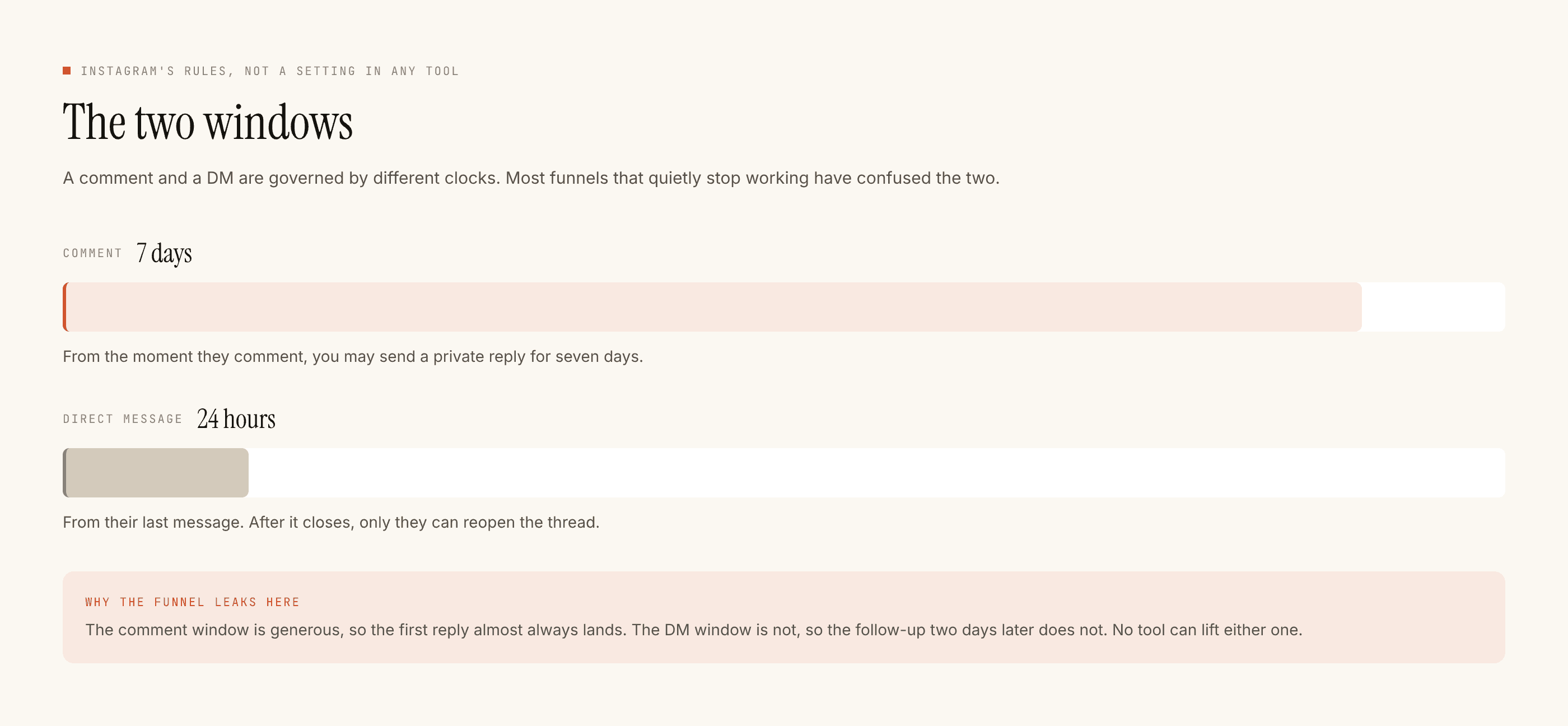
This is why "let me send you the details" is the most expensive sentence in a course inbox. It spends the one guaranteed turn saying nothing, and the countdown was already running before you typed it.
Say the price
The single most common self-inflicted wound: somebody asks what it costs and the reply says "DM me for details" or "our team will share the fee structure".
They already did DM you. That is what this is.
Put the number in the template. If there are tiers, put the range and the tiers. If there is an EMI or a part-payment option, put that too, because "kitne ka hai" and "EMI hai kya" are the same conversation and answering both in one message saves a turn you may not get.
Making somebody ask twice for a price does not build desire. It builds the impression that the price is bad.
Four objections, and what a template can honestly do with each
Course buying hesitation sorts into four piles. Each is templatable, because the answer does not change between people.
- Cost. Answer with the number, the payment options and what is included. Do not answer with a discount. A discount offered before anyone asked for one tells the buyer the price was made up.
- Time. "Kitna time lagega har week." Give a real figure you actually know — hours per week, number of sessions, whether recordings exist for the ones they miss. This objection is usually resolved by the recordings answer alone.
- Self-doubt. "Will I be able to do this, I'm a complete beginner." The template that works here names who the course is not for. Counter-intuitive and reliable: a course that admits an exclusion is a course whose inclusion claim is believable.
- Trust. "Is this legit." Answer with things a stranger can check: how long you have been teaching, where the course is hosted, what your refund policy is as a written policy. Never with an invented statistic and never with pressure.
Four templates. Templated replies are free and unlimited, so the objection inbox costs nothing to run however many people ask. A credit is spent only when the AI writes something new, one credit per reply — which is what should happen for the genuinely unusual question, not for the price question. Free tier is 100 credits, no card; packs from ₹499.
The close is a next step and a closed question
Every sales reply here should end with two things and no more.
One next step. The enrolment page, the form, the number to call. One. Two next steps is zero next steps.
One closed question. This is the only mechanism that exists for getting a second turn, because their answer restarts the twenty-four hours and nothing else does. Make it genuinely easy to answer: "Weekend batch ya weekday?" gets a reply. "Let me know if you have any questions" does not.
Then, because you know roughly what the answers to your own question will be, build an automation on the message trigger keyed to exactly those answers. weekend, weekday, saturday, sunday. When they reply, the next answer is already there, inside a window they just reopened. That is the whole of what a "sequence" can honestly be here, and it is argued in full in the sequence post.
The cart deadline
Course launches run on a closing date, and the message every launch playbook tells you to send — the night-before reminder — is one you cannot send. Not a missing feature. There is no broadcast and no scheduled message on the official API.
So the deadline goes in the first reply, in checkable form: "Enrolment closes 12th November, 11:59pm." Assume it is the only time you will get to say it.
And then delete it. A dated template attached to a reel that keeps getting found will still be announcing a November deadline in March. Put the campaign wording in its own automation, scoped to the launch posts, and switch the whole automation off on the day the cart closes.
When the sale is large, hand it over early
For a high-ticket programme the template's job is not to close. It is to answer the first question well and get the person to a conversation with you. Takeover means the automation stands down for a thread permanently the moment you reply by hand, so there is no risk of a template landing on top of a real negotiation. The high-ticket post goes further into where that handoff belongs.
What this does not do
It does not create your content, your captions or your launch calendar. It does not schedule or publish. It does not track a click, attribute a sale, or tell you which reel produced revenue — there is no analytics product here. It does not message anyone who has not messaged you first, and there is no WhatsApp.
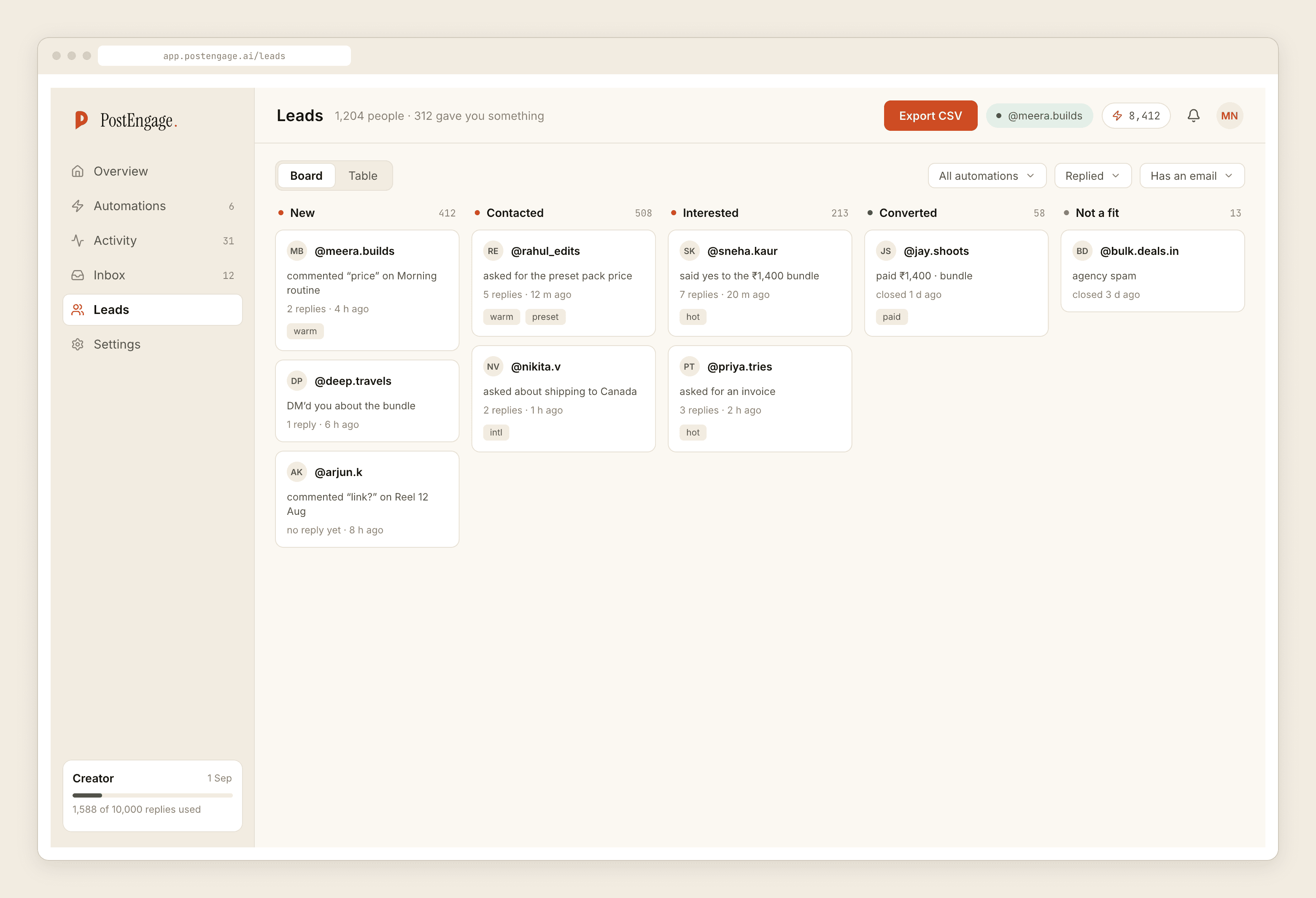
What it does is answer the four objections in seconds, at any hour, for free, and write down everyone who asked. For a launch week that is most of the job.