Voice DNA · 6 min read
What a Voice Profile Records, and What It Cannot Know

Every tool that writes replies on your behalf starts from the same handicap. It has never read a single thing you wrote, so it writes the average of everything it has read instead. That average has a recognisable sound: full sentences, a greeting followed by a comma, an exclamation mark on the second line, and somewhere in there, the word "absolutely".
A voice profile is the fix for that, and it is a much narrower object than the word "AI" suggests. It is a record of how one specific person writes, assembled from replies that person actually sent. Not a dial. Not a personality. A record.
The input is your own outbox, and nothing else
The profile is built from replies the account owner wrote themselves. That constraint is doing more work than it looks like.
It rules out the obvious shortcuts. Your website copy is not eligible, because nobody writes a DM the way they write an About page. Captions are not eligible either — captions are performance, DMs are conversation. A tone guide, a competitor's replies, a paragraph describing yourself as "warm but professional": none of those are evidence of how you actually type at 11pm.
What is eligible is unglamorous. The replies you already sent, in the register you sent them.
What actually ends up in the record
Read a month of your own sent replies as though somebody else wrote them and you will start seeing the patterns yourself. They are mostly small and mostly mechanical.
- How you open. Some people never greet at all and go straight to the answer. Some open with "hey!" every single time. Some mirror whatever the other person opened with. This is the single most identifying thing in a reply and it is the first thing a generic model gets wrong.
- How long a reply runs. Not an average — a relationship. Most people match length to the question, so a one-word question gets a one-line answer. Some people are long regardless. That habit is visible in the text.
- How you mix languages. "Haan ji available hai" and "Yes, this is in stock" are the same fact in two registers, and which one you use, with whom, is a pattern in your replies rather than a setting you chose.
- Your punctuation tells. Whether you use full stops in short replies. Whether emoji arrive at the end or never. Whether you use a dash where other people use a comma.
- How you say no. The hardest register to fake and the most revealing. "Sorry, that one's gone" and "Unfortunately this product is currently unavailable" belong to two different businesses.
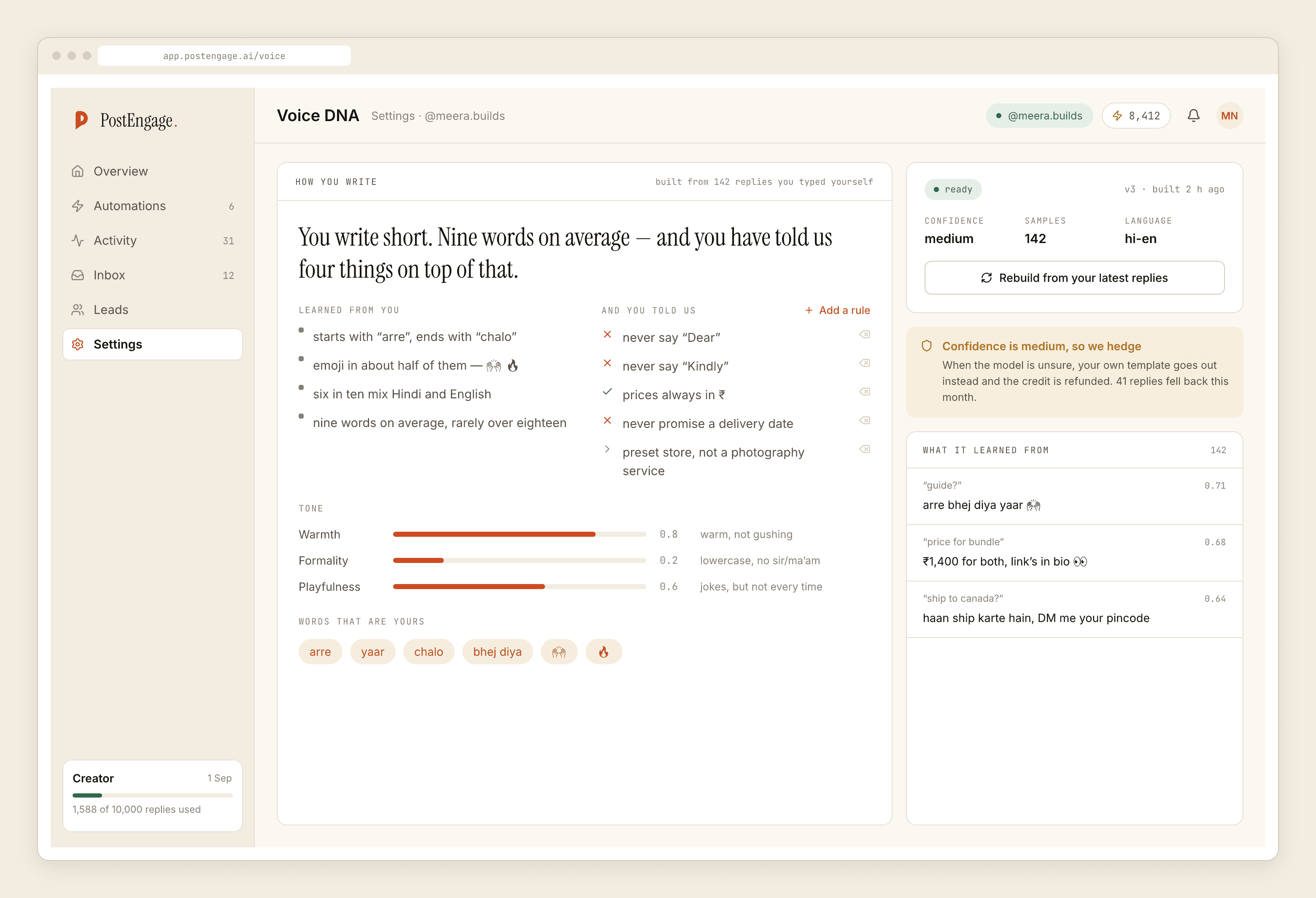
None of that is personality. It is closer to handwriting — a set of habits you did not decide on and cannot easily describe, which are nonetheless obvious in every line you type.
What the record cannot know
This is the part worth being blunt about, because most of the disappointment with voice features lives here.
It does not know facts. A voice profile is a description of style. It has no opinion about your prices, your stock, or your delivery times, and it will happily write a wrong number in exactly your register. Style and correctness are separate systems and should stay separate in your head.
It does not know anything you never typed. If you have never written a reply to an angry customer, there is no record of how you handle one. The profile will produce something in your usual register, which is precisely the wrong register for that message.
It does not know your judgement. You decide, in the moment, that this particular enquiry is worth ten minutes and that one is worth a line. That decision is invisible in the finished text. What the record sees is the output, not the reasoning.
A voice profile makes replies recognisable. It does not make them right. Those are different problems with different solutions.
Why a record and not a slider
Tone dropdowns fail for a structural reason rather than a quality reason: "friendly" is not a specification. It is an instruction to produce the median of everything the model has seen labelled friendly, which is why every tool with a tone dropdown produces text that sounds like every other tool with a tone dropdown.
A record fails differently, and better. Its worst case is a flattened version of you — your habits present, your sharpest lines missing. That is a real limitation and it is still recognisably yours. The chatbot post takes this comparison further in the context of which questions are safe to hand over at all.
The record does not get to decide whether to send
Worth separating clearly: the profile shapes how a reply reads. It has no say in whether the reply goes out.
Ten checks run in a fixed order before any send, and content_safety is the last of them. A reply that is perfectly in your voice and trips that check does not go out. Replies the system is not confident about go to a review queue instead of to the customer.
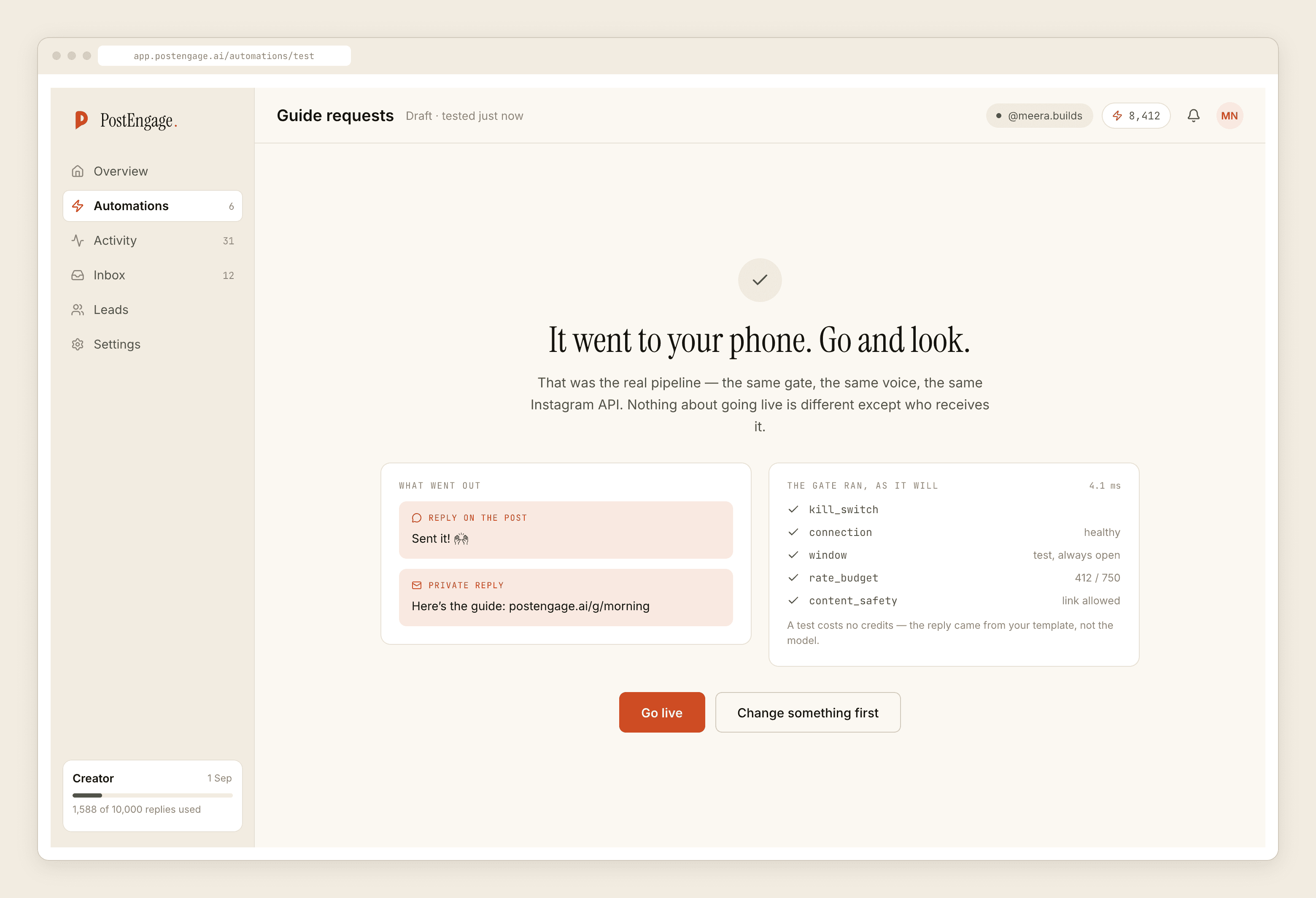
Judge the voice by receiving it, not by reading it in the builder. Text you wrote reads correctly to you in a way it will not read to a stranger.
What it costs to use
Templated replies are free and unlimited. A credit is spent only when the AI writes a new reply — one credit, one reply. The free tier is 100 credits with no card, and packs start at ₹499.
The practical implication: your four most common questions should be templates you typed yourself. Those cost nothing forever and they are, by definition, perfectly in voice. Save the generated replies for the messages that genuinely need composing.
The honest ceiling
A voice profile gets you to "this sounds like the person who runs this account". It does not get you to "this is indistinguishable from them", and anybody promising that is selling the tone dropdown with better copy.
The gap shows up on the hard messages — the ones needing judgement, or a fact nobody wrote down, or a decision. Those were always going to be yours. What the record buys you is that the ordinary ones no longer read as though a stranger answered on your behalf.
If you want to see what changes in the replies themselves once a profile exists, the before-and-after is here. If you want the practical side — what to feed it and what to do when it gets you wrong — start there instead.