Lead generation · 5 min read
Lead Nurturing When You Cannot Send the Second Message

Nurturing, as the word is normally sold, means you decide when the next message goes out. Day one the welcome, day three the case study, day seven the offer. The whole discipline assumes a channel where the sender holds the initiative.
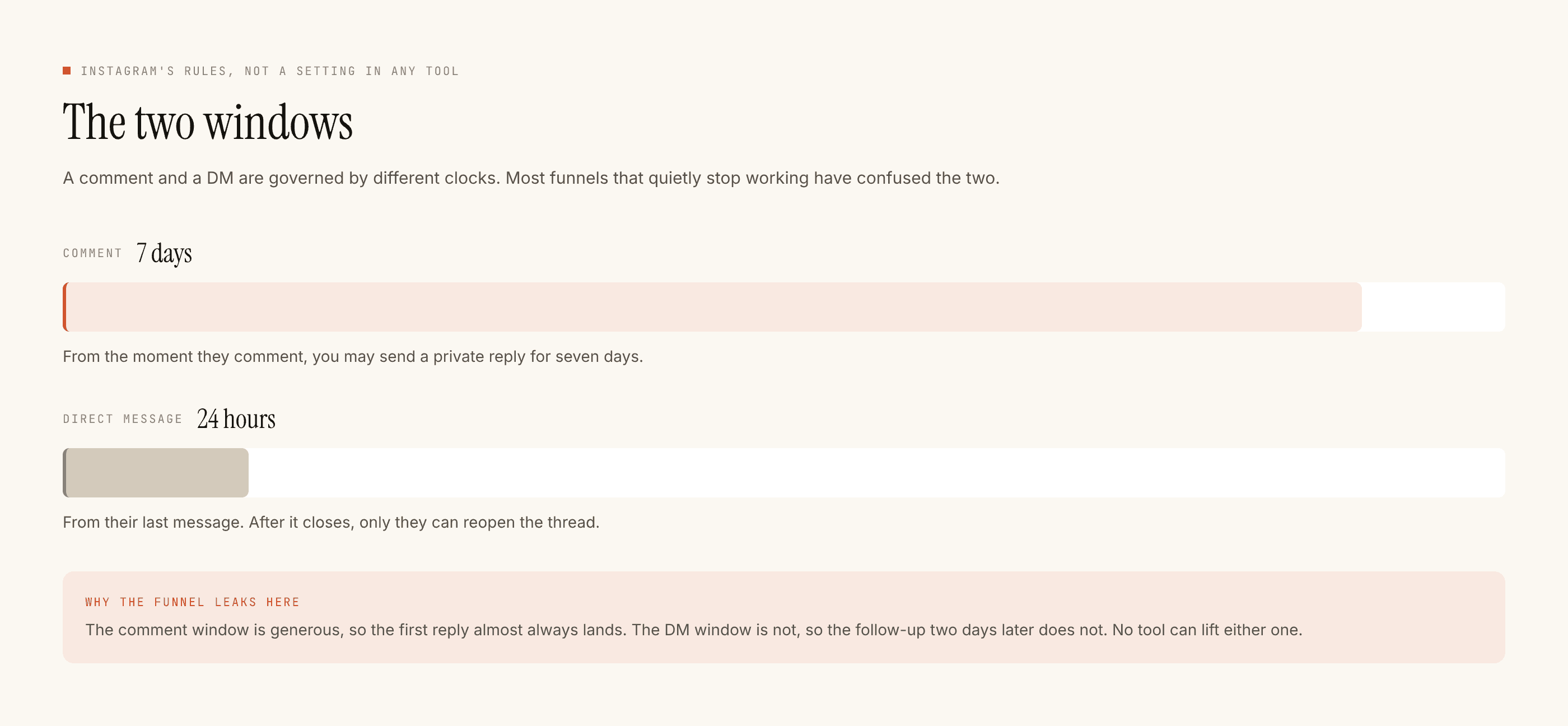
Instagram DMs are not that channel, and this product does not pretend otherwise. There are no sequences, no drips, no broadcasts, no scheduled follow-ups. The twenty-four hour messaging window is restarted by one thing only: a message from them. If they go quiet, it closes, and there is no plan, setting or workaround that reopens it.
So the honest position is that lead nurturing in the standard sense is not available here. What follows is what is left, which turns out to be more useful than it sounds.
Strip the delivery mechanism and see what nurturing actually was
Take away the ability to schedule sends and three things remain that were doing the real work all along.
- Staying in memory. A person who does not think of you cannot buy from you. The mechanism for this on Instagram is posting, not messaging, and it always was.
- Continuity. The second conversation should not start from zero. If you remember what they asked in April, they feel known; if you do not, they are a stranger again and so are you.
- Lowering the cost of the next move. Nurture emails are mostly a reminder that the door is open. On Instagram the door has to be visibly open from the outside, in your captions and your replies.
None of those require a scheduled message. Two of them are content and one is record keeping.
What legitimately happens inside an open window
This is the part worth being precise about, because "no sequences" gets misread as "one message only".
While the window is open you can hold a genuine conversation. They write, you reply, they write again, and each of their messages restarts the twenty-four hours. A conversation spread over three days is completely normal and completely compliant, as long as every stretch of it is anchored to something they sent.
What does not work is treating an open window as a drip slot. Sending four messages back to back because you technically can is not nurturing, it is a monologue delivered to someone who asked one question. The reader experiences it as spam even though every message was permitted.
The anatomy of that single reply — what goes in it, what to leave out, where to put the question — is covered properly in its own post and this one will not repeat it.
The record between conversations is the nurture
Here is the substitution that actually works. In an email world, nurturing is a sequence you send. Here, it is a note you keep so that the next inbound conversation starts warm.
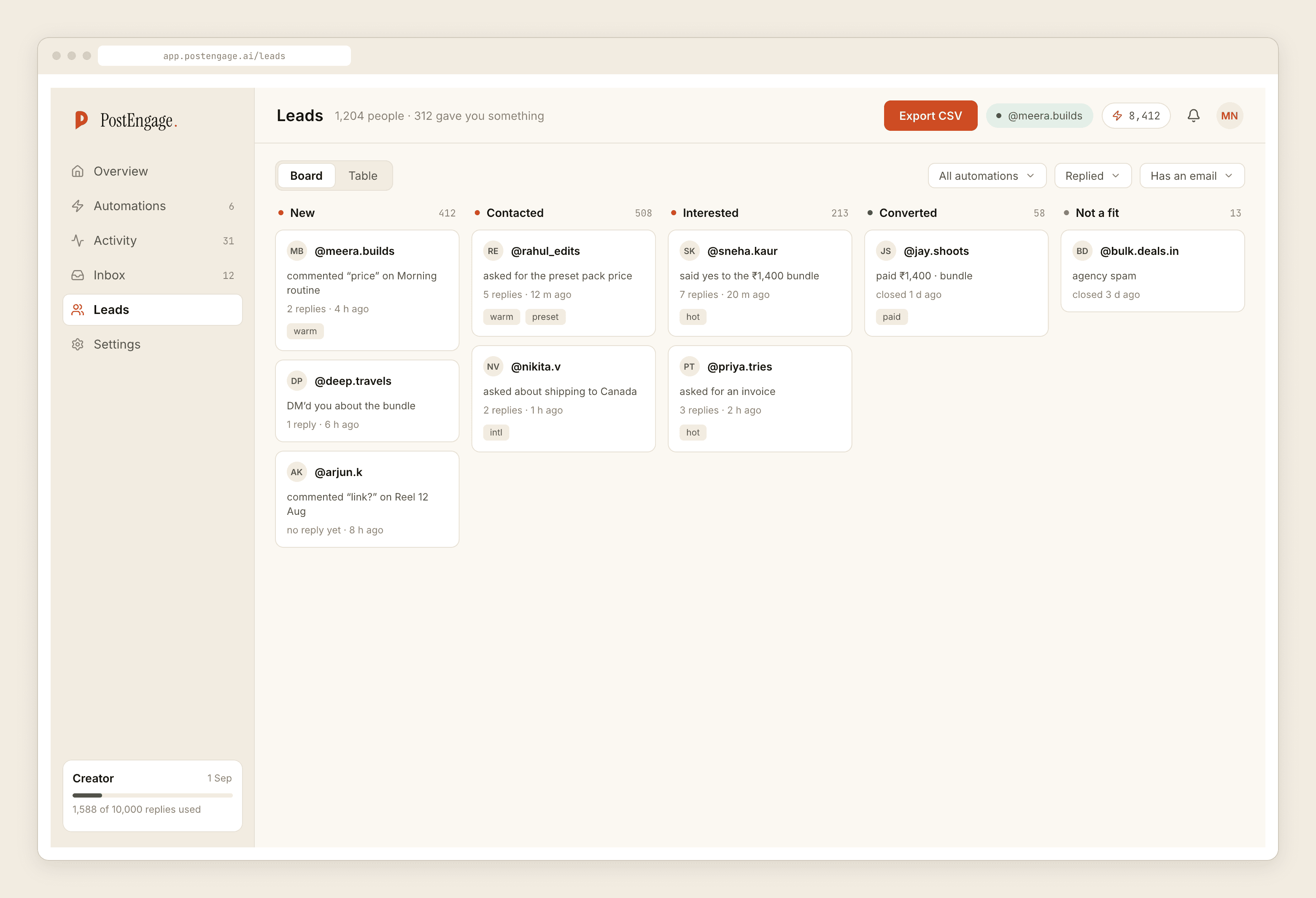
The lead record holds a stage, tags, a replied flag, interaction counts and notes. None of it is clever and none of it is automatic beyond the capture itself. The value is entirely in the habit: when a conversation ends, spend fifteen seconds writing what happened in plain language. "Wanted the Goa dates, budget felt tight." "Asked about EMI, said she would talk to her husband."
Six weeks later that person writes again, out of nowhere, with no context and no reference to the earlier chat. You open the row, read one line, and reply as somebody who remembers. That is the entire mechanism, and it beats a five-email drip in the only way that matters, which is that the person is currently holding their phone.
Your re-entry points, and the one long clock
You have exactly two ways a cold lead comes back into an open window, and both start with them.
The first is a new post. Somebody who half-decided in March sees a reel in June, comments the word, and you are in a fresh conversation with the seven-day comment clock running. Your posting schedule is your nurture schedule. That sounds like a slogan and it is just a description of the mechanics.
The second is the comment window itself, which is the more generous of the two and the one people underuse. Seven days from the comment, not from the post. A comment left on Tuesday's reel is still answerable the following Monday, so the person who engaged while you were busy is not lost the way a missed DM is.
Your content is the only outbound you have. Everything else in this product is a reply.
Sorting the list you cannot send to
If you cannot message the list, the list is only useful as a reading order. Two signals do most of the work: how much of the window is left, and whether they ever replied. Sort by those and work down.
Anything more structured than that is a real decision with real maintenance cost, and it is not worth it below a certain inbox size.
The plain list of what is not here
No sequences. No broadcasts. No scheduled messages. No re-engagement campaign. No win-back flow. No WhatsApp, no email sending, no SMS. No way to start a conversation with anybody, ever — the wall around outbound is a hard one, and every nurture feature people ask for is a version of wanting to cross it.
What you get instead is a fast, honest reply to every person who chose to write, and a record good enough that the second time they write, they are not starting over. Run that for six months and it does the thing the drip was supposed to do.