Playbooks · 5 min read
Unbundling an Onboarding Sequence for a Channel Without One
An onboarding sequence is five or six messages spread over two weeks, each timed to arrive just before the customer needs it. Day zero the access details, day two the first thing to try, day five the feature people miss, day ten a nudge if they have gone quiet.
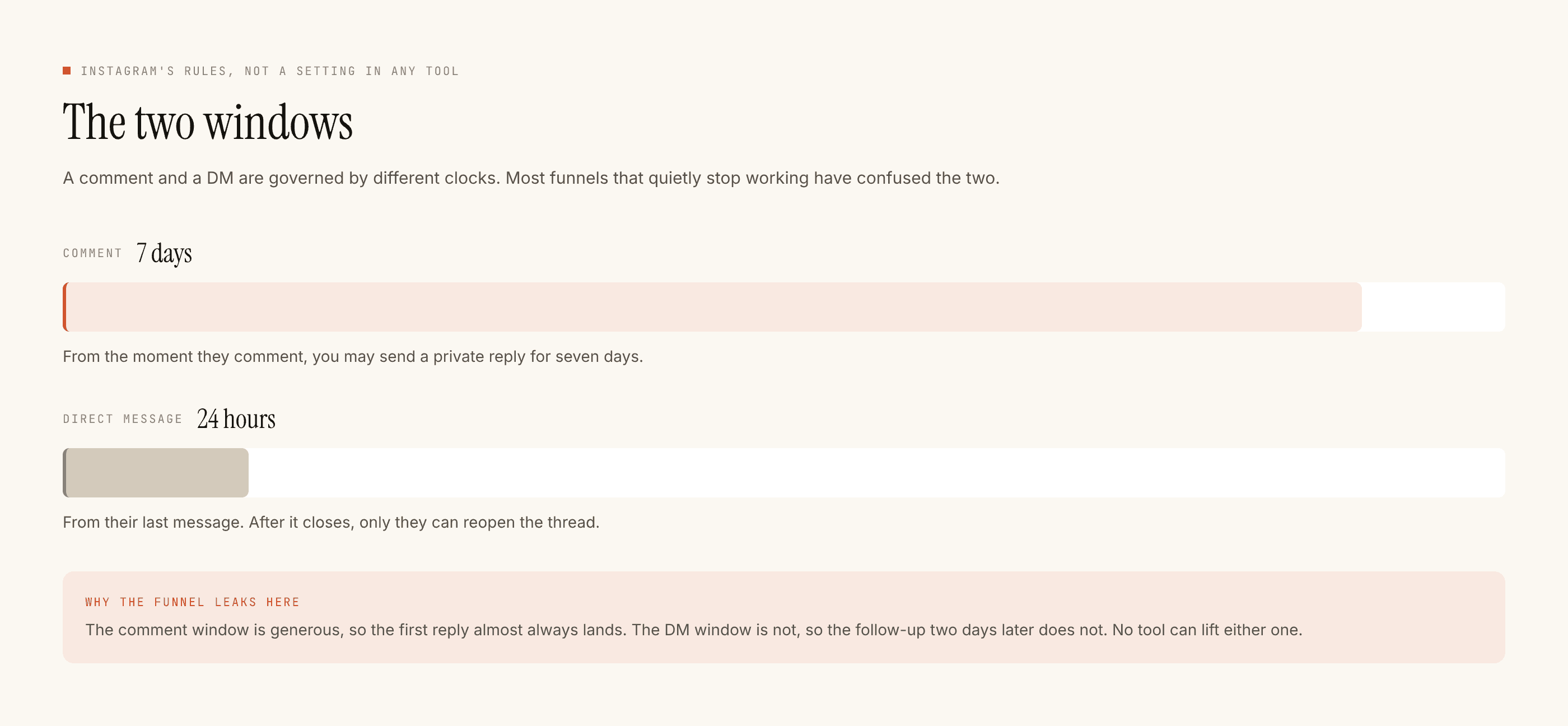
None of that is possible here. There are no sequences, no scheduled sends, no drips. The twenty-four hour messaging window is restarted only by a message from them, so every message after the first depends on the customer choosing to write. A day-five nudge to somebody who has been silent since day zero cannot be sent at all.
So the question is not how to build the sequence. It is what happens to the six things the sequence was carrying when you take the sequence away.
Sort the items, not the schedule
Open whatever onboarding emails you currently send — or, if there are none, write the six things a new customer needs to know. Then put each item into one of three buckets. The bucket determines where it lives, and only one of them is a DM.
- Must know now. They cannot proceed without it, and getting it wrong costs money or trust. Access details. What happens next and by when. Where to reach a human. This bucket is small — usually three lines — and it is the only bucket that belongs in the arrival message.
- Can be looked up. How to change a size, what the syllabus covers, the return policy, the class timings, what to bring. Anything a person will want at an unpredictable moment. This does not belong in a DM at all, because a DM scrolls away and is unsearchable by the customer. It belongs in a pinned post, a highlight, a page on your site, or the order email your store already sends.
- Needs a human. Something went wrong, or they are confused in a way you cannot anticipate. This bucket cannot be prewritten. What it needs is a route in and somebody at the other end.
Most onboarding sequences are overwhelmingly bucket two delivered as bucket one, which is why they are so widely ignored. Being sent reference material on a schedule chosen by the sender is the least useful way to receive it.
The arrival message
Whatever route brings the customer into your DMs after buying — and manufacturing that inbound honestly is its own problem — the message they get should do four things and stop.
Confirm what they bought, in their words rather than your SKU. Say what happens next and by when, with a real date if you have one. Point at the one place where everything else lives. Name the way to reach a person.
That is it. The instinct is to be thorough, and thoroughness here reads as a wall of text on a phone screen, which gets skimmed and then re-asked as a question two days later anyway.
Write it as a template. Templated replies are free and unlimited, this message is the same every time, and it is a message about money and commitments — exactly the kind you do not want a model composing fresh.
Turn your day-three check-in into their day-three message
The nudge you cannot send has one legitimate substitute, and it is to hand the customer a cheap way to start the conversation themselves.
A word does this. "If anything is unclear, reply STUCK and I will come back to you." That single line converts a message you are not allowed to send into one they can send whenever they actually need it, which is better timing than any schedule you would have guessed. Their message restarts the window, so the conversation that follows is real and unhurried.
What takeover is for here
Post-purchase conversations go wrong faster than pre-purchase ones. Somebody who paid and is confused is not a lead, they are a customer with a grievance forming, and the worst thing they can receive is a cheerful automated line.
Takeover is third in the fixed order of checks, ahead of the window and everything after it. The moment you reply by hand, the automation stands down for that conversation and stays down. In practice that means your support keyword should route to you rather than answer, and your job is to be the human quickly.
Negative keywords do the rest: refund, cancel, not working, wrong item, late, complaint. None of those should meet a template written in a calm moment three months ago.
Before the sale, a bad automated reply costs you a lead. After it, it costs you the customer you already had.
The plain list of what is not here
No sequences, no scheduling, no timed follow-ups. No order data — the DM does not know they bought anything, and nothing in your store talks to this. No purchase events, no webhooks, no Shopify or WooCommerce connection. No email sending, no WhatsApp, no SMS. No usage tracking, no onboarding completion rate, no dashboard.
Leads export as CSV, and that is the whole of the handoff.
What you get is one very good arrival message, a keyword that lets a stuck customer reach you without hunting for the button, and a record of who asked what. Run alongside a pinned highlight that answers the looked-up bucket properly, that covers most of what a six-email sequence was doing, minus the five emails nobody read.
If the reason you want onboarding automation is that customers keep drifting away in month two, the mechanics of noticing that are a different problem and mostly not a messaging one. And the same window logic applied to leads before they buy is set out here, which is a different post because the failure modes are not the same.