Lead generation · 5 min read
The Dark Funnel Is Real. Attributing It Is the Mistake

The dark funnel is a real thing with a silly name. It is the part of a buying decision that happens where nothing is watching: a screenshot forwarded into a family WhatsApp group, a friend saying "unhi se le lo", a comment thread on somebody else's Reel, a podcast heard in a car, a colleague's recommendation in a lift.
We do no attribution. No UTM handling, no source tracking, no first-touch or last-touch model, no multi-touch weighting, no revenue reporting, no channel report of any kind. That is not a gap this post is going to talk around. It is the reason the post exists, because the honest position on the dark funnel is that you cannot light it up, and the tools that claim to are selling you a model dressed as a measurement.
DMs are the dark funnel, not a way out of it
Here is the part people get backwards. A DM conversation is not the instrument that finally reveals the dark funnel. It is the densest room inside it.
Someone arrives in your inbox already carrying everything that persuaded them. By the time they type "price?", the work is done — by a friend, by a group chat, by three months of scrolling. What you can observe is the last thirty seconds of a journey you were absent for.
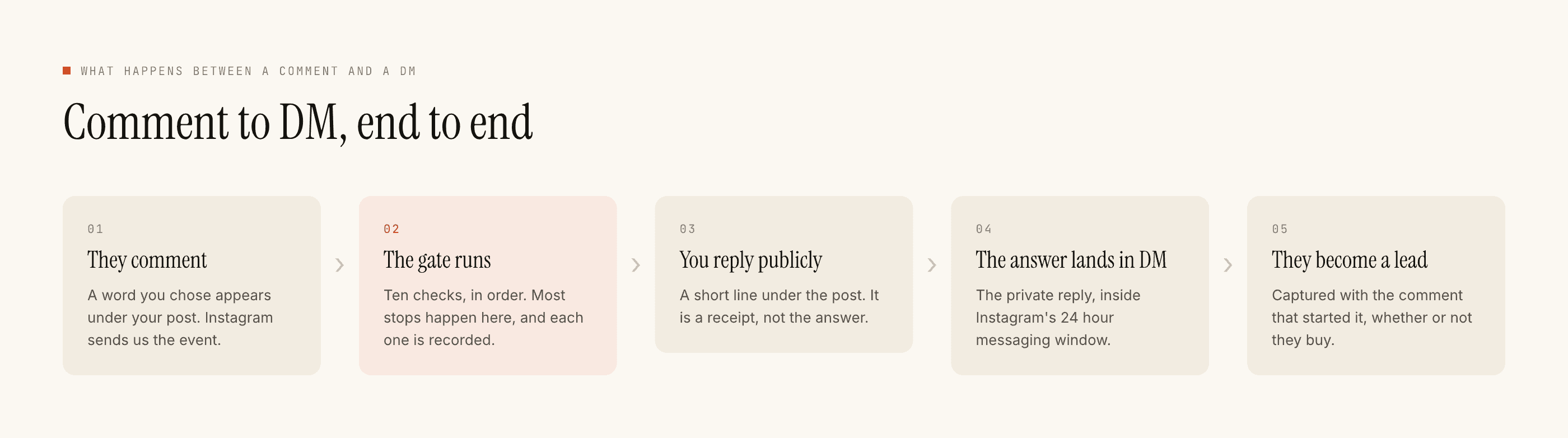
An attribution model would take that visible arc and assign it credit for the whole thing. The comment becomes "the source". The post becomes "the campaign that drove revenue". Neither claim survives contact with the customer, who would tell you their cousin sent them the link.
Attribution does not discover where a customer came from. It picks whichever touchpoint happened to be instrumented and calls that the cause.
Why we are not going to bolt one on
We could write a report that says the September Reel produced eleven leads and, assuming an average order value you typed in yourself, a rupee figure. It would render nicely. It would be wrong in a specific way that is worse than being absent.
The wrongness is double counting. The same customer is claimed by your ad platform, your link-in-bio tool, your email tool and your DM tool, because each one saw a touch and each one is configured to take credit for a touch. Add the four reports together and you have sold the order four times. Every one of those numbers is defensible on its own and the set of them is nonsense.
A number that survives a meeting is not the same as a number that is true, and an invented one survives meetings very well. That is exactly why we will not generate it.
Ask, because you are in a conversation
Here is what a DM has that a dashboard does not: a person on the other end who can answer questions.
Self-reported attribution is the only kind that reaches into the dark funnel at all, and the only channel where asking is natural is one where you were already talking. Nobody fills in a survey. Plenty of people answer a friendly one-liner in a thread they are already in.
- Answer their question first, completely. The price, the size, the availability. An attribution question asked before you have been useful reads as a toll gate and it is one.
- Then ask once, casually, in your own register. "Ek baat — aap tak kaise pahuncha, kisi ne bataya ya feed pe dikha?" Not "How did you hear about us?", which reads as a form.
- Accept a vague answer as an answer. "Friend ne bheja" is more information than any model would have produced, and it is the whole finding.
- Never gate anything behind it. No discount for replying, no "answer this to continue". Incentives buy you the answer people think you want.
- Let it land in the lead record. If capture-to-Leads is on, what they typed is what gets stored, so the answer travels with the rest of the context rather than living in your memory.
What the answers are worth
Less than a tracking system would claim, and considerably more than nothing.
They are biased towards whatever the person remembers most recently, which is usually the last thing they saw rather than the thing that convinced them. They are inconsistent. Half your customers will not answer at all.
What they do is name channels you would never have guessed existed. A reseller group you did not know about. A creator who mentioned you without tagging. A WhatsApp forward from a customer who now functions as a distributor. None of those appear in any report, and thirty freeform answers will surface all three.
That is the actual output: a list of places to go and look, not a table of weighted credit.
Two ledgers, kept apart
The workable arrangement is to stop trying to reconcile these and just run them separately.
Decisions about where to spend
Decisions about the conversation
The second ledger is the one this product serves and it is the one you can act on. The operational data has its own routine, and it is deliberately not a marketing report.
For the first, the discipline is to stop asking software a question only a customer can answer. And if you find yourself wanting a revenue figure attached to your DMs, the case study we refused to invent explains what that figure would actually be made of.