Playbooks · 4 min read
Wedding Planning on WhatsApp: Where Automation Stops Being Useful

We do not ship WhatsApp, so this is not a description of a feature. It is about a trade where automation has an unusually narrow useful band, and where crossing out of it costs a booking worth more than a year of most other customers.
Two facts shape everything. Every enquiry is genuinely bespoke — nobody has the same date, budget, guest count and venue. And the person writing is anxious in a way that customers of most businesses are not, because the thing they are buying happens exactly once.
What the first message is really doing
It is not qualifying. It is deciding whether you seem like somebody who will answer when something goes wrong at 11pm three days before.
That is an unfair amount of weight for one reply to carry, and it is why the usual template — cheerful, generic, ending in "let me know if you have any questions" — performs so badly here. It reads as a form letter at the exact moment the reader is trying to work out whether you are a person.
They are not asking what you charge. They are asking whether you will pick up.
The narrow band
Safe to send instantly
Needs you
The left column is four or five messages, they repeat constantly, and answering them in a minute rather than a day is the whole competitive advantage available here. The right column is the business.
The message that loses the booking
Three patterns, all common, all avoidable.
Deflecting the price. "Every wedding is unique, let's hop on a call!" is true and reads as evasion. A range plus the two things that move it earns more calls than withholding it, because the reader is trying to find out whether talking to you is worth their evening.
Answering a category instead of the question. They asked about February. The reply describes your packages.
Three lines of warmth before any information. In a trade built on personal service this feels correct and reads as padding on a phone screen.
After the booking, automation gets worse not better
This is the part most tools get backwards. Once somebody has paid, the messages they send become more specific, more urgent and more emotionally loaded — the florist changed, the venue moved a timing, their mother has opinions.
None of that is automatable, and the tool that was helping in week one becomes a liability in week twelve if a template is still firing at a client mid-crisis. The cleanest rule: automation runs on the enquiry inbox only, and stops entirely the moment a contract exists.
How the same shape works on Instagram
PostEngage answers Instagram comments and DMs, which is where most of this trade's enquiries actually start — a comment under a shoot, asking about a date.
The relevant behaviour is takeover: the moment you reply by hand in a thread, the automation stands down in it and stays down. That is what makes "automate the enquiry, never the client" enforceable rather than aspirational.
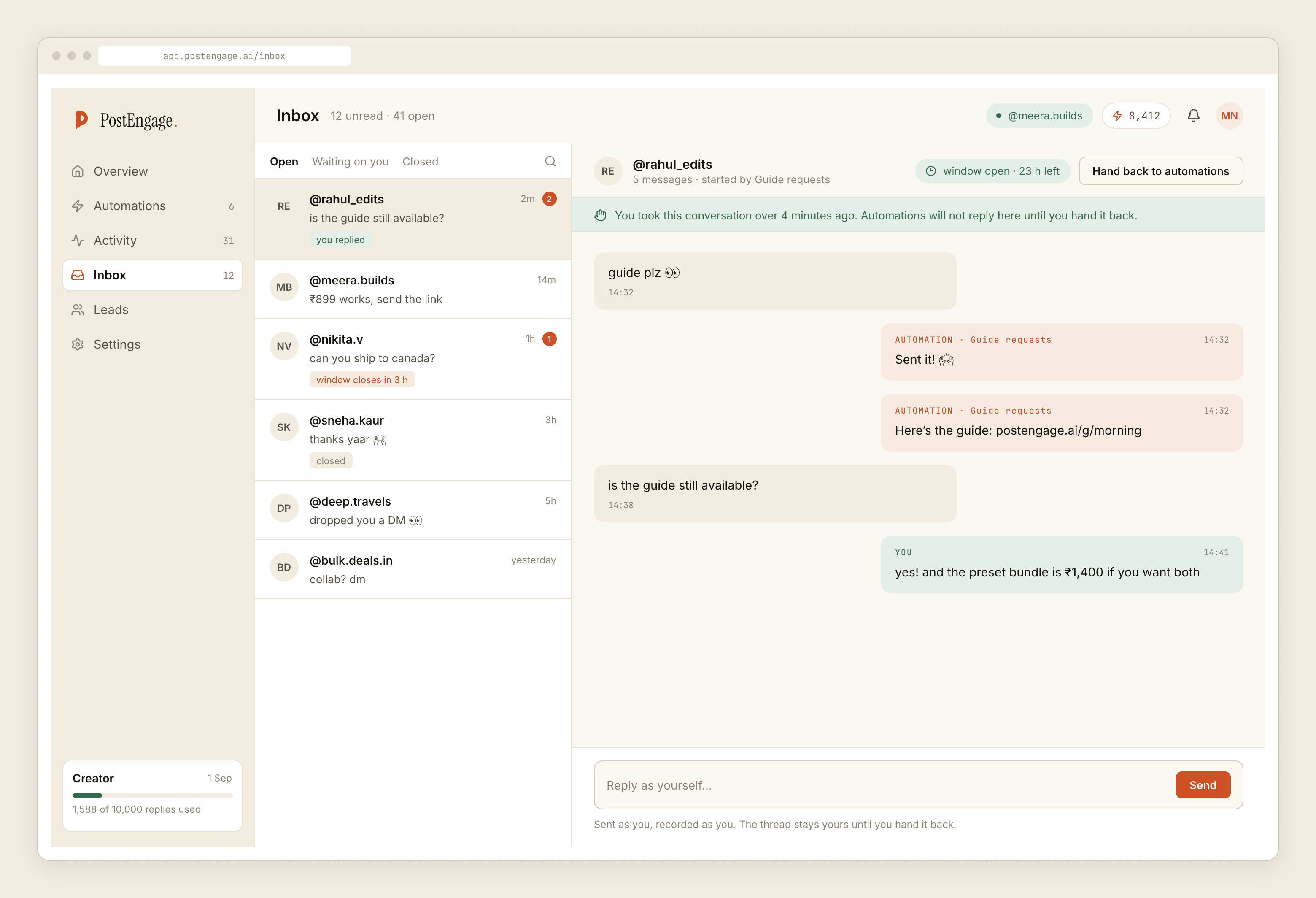
The other useful piece is capture. A comment asking about a date becomes a Leads record with the handle, the exact words, the post it came from and the time — which is the context you want in front of you before replying properly, and which is otherwise lost by the time you get to it.
Seasonality breaks most setups
Worth planning for, because it is specific to this trade and it catches people out every year.
Enquiry volume is not evenly spread. It arrives in bursts tied to engagement season and to whenever a venue opens a calendar, and a business that answers everything comfortably in September can be three days behind in January without anything having gone wrong.
That is the argument for automating the four repeating questions even if you would rather answer everything yourself. Not because the automated answer is better — it is not — but because the alternative in a busy month is that the bespoke replies arrive late too, and lateness costs more here than a template does.
The corollary: build it before the season, not during. A rule written in a panic is a rule with an ambiguous keyword in it.
The one number worth watching
Not response rate. The share of enquiries where a person replied within the day — because in this trade the automated reply is a holding pattern and the real conversation is the product.
If that number falls while your automation volume rises, the tool is doing harm and it will show up in bookings a month later.
Where to read more
For the craft of the reply itself, the DM script post is the closest fit. For the Instagram version of this trade, start here, and for event work more broadly there is a post on that.