Playbooks · 5 min read
AI Auto-Reply on WhatsApp: Where It Helps, Where It Cannot

There is a fact about AI on WhatsApp that almost no vendor page leads with, and it is the first thing you should know: a language model cannot write your outbound messages.
Outside the 24-hour customer service window, the only thing that may be sent is a pre-approved template. A template is text Meta has already reviewed, with placeholders you fill in. You can put a customer's name and an order number into it. You cannot have a model compose a fresh, contextual sentence, because the sentence was never approved.
So AI on WhatsApp lives entirely inside one box: the conversation a customer started, for the 24 hours it stays open. That box is genuinely valuable. It is also much smaller than the marketing suggests.
Templates are the outbound channel and they are fixed text. AI is an inbound capability, not a broadcasting one.
What AI is actually good at here
Inside the window, free-form replies are allowed, and this is where a model earns its place:
- Understanding phrasing you never planned for. Keyword rules break on "bhaiya ye wala available hai kya", "kimat kya h", and every other spelling of the same question. A model does not.
- Answering from your own material. Grounded in a price list, a policy page, an order record, it can answer specifically rather than generically. Ungrounded, it will produce a confident sentence about your refund policy that you have never agreed to.
- Holding a short thread. Two or three turns of clarification before an answer, which a menu tree handles badly.
- Drafting for a human. The underrated one. The model writes, a person glances and sends. All of the speed, none of the exposure.
Grounding is the whole safety story
An AI reply is only as trustworthy as what it was given to work from. The difference between a useful assistant and a liability is not the model — it is whether the answer had a source.
Practical version: give it your real price list, your real policies, the real order status. Give it an explicit way to say it does not know. Then read a sample of what it sends every week for the first month, because the failures are not random — they cluster around a few topics and you can fix those with better source material.
Voice, and why it is not a slider
Most tools offer tone settings: friendly, professional, casual. They produce writing that sounds like a tone setting.
The approach that works better is to derive voice from replies the account owner actually wrote. Real replies carry things a slider cannot: the specific way you say no, whether you use "ji", how short you get when you are busy, the phrases you repeat. That is what we built Voice DNA from on Instagram — it is trained on replies the owner genuinely sent, not on an adjective.
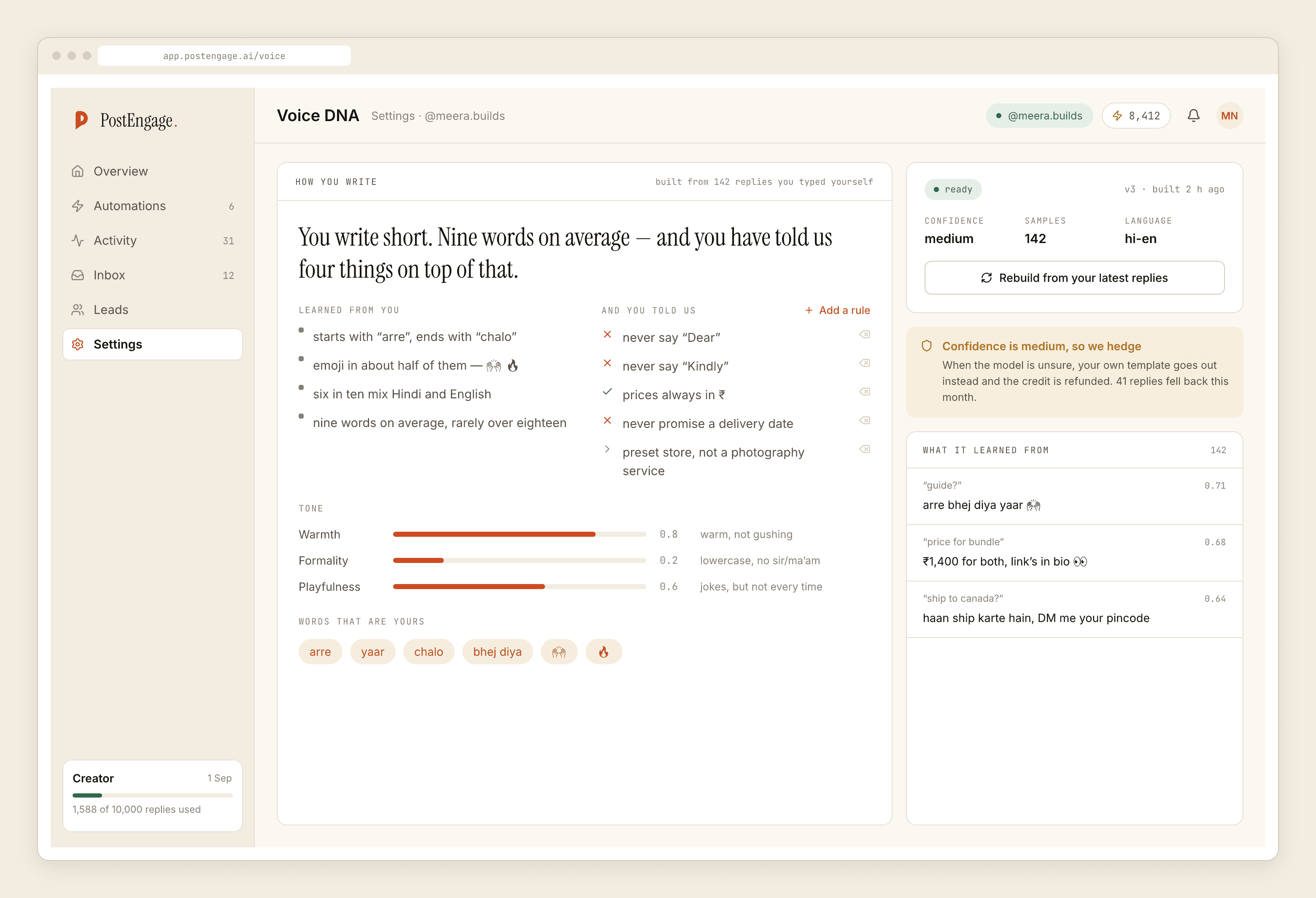
The Hinglish point deserves its own line. If you normally write "haan available hai, kal tak aa jayega", a model told to be "professional" will write "Yes, this item is currently available and will arrive by tomorrow" and it will read like a different business. Voice is not decoration on an Indian number. It is the thing that makes an automated reply survive being read.
What to automate, and what to never automate
Safe for AI
Send to a human
The second column is not a limitation to engineer around. It is the list of conversations where being wrong is expensive, and it should stay a list of conversations where a person is accountable.
The two guardrails that matter most
Confidence and review. Route low-confidence answers to a queue rather than to the customer. A human clearing that queue in the morning is a far better system than a model guessing at midnight.
Human takeover. The moment someone from your team replies by hand, the automation stops for that thread. On Instagram this is a hard gate in our reply pipeline and it fires before anything else can send. Any WhatsApp setup should have the same rule, because a bot talking over your own staff is the specific failure customers screenshot.
The cost angle, briefly
On WhatsApp, Meta charges per conversation regardless of who or what wrote the reply. AI does not add a Meta charge; it adds a model charge, and the two are separate lines.
Contrast with Instagram, where Meta bills nothing per message. That is exactly why we can make templated replies free and unlimited and spend a credit only when the AI writes a genuinely new reply — one credit, one reply, 100 credits free with no card, packs from ₹499. The full cost model for WhatsApp is here, and it works on a different axis entirely.
A sane place to start
Pick the four or five questions that make up most of your inbox. Answer those with fixed text, because fixed text is predictable, auditable and free to run. Put the model behind them, for the tail, grounded in real material, with a handoff it is allowed to use.
That ordering — templates first, model second — is not a cost-saving trick. It is the arrangement that fails least often. More on the routing layer, and on designing the conversation itself.