Playbooks · 4 min read
There Is No ROI Calculator, and Here Is the Arithmetic Instead
We do not have an ROI calculator, and this post is not going to become one.
Calculators in this category are almost always a lead-capture form with a multiplication behind it. You enter numbers you are guessing at, the tool multiplies them by an assumption the vendor chose, and it returns a figure large enough to justify the purchase. The output is a restatement of your own optimism with a currency symbol on it.
The arithmetic underneath is genuinely simple, though, and you can do it in about twenty minutes with numbers you actually have.
The four numbers
- Messages that repeat. Read the last hundred messages in your inbox and count how many are one of your top four questions. Not an estimate — a count.
- Minutes each one costs now. Include the context switch, not just the typing. Most people undercount this by half because the typing is the visible part.
- What the tooling costs. The vendor's charge, plus — on WhatsApp specifically — whatever Meta charges for the message categories you would use. Two meters, and a pricing page usually shows only one.
- What a lost conversation is worth. Your average order value, or the value of a booking. One number, from your own records.
The first three give you a cost comparison. The fourth is the one that usually dominates, and it is the one calculators leave out.
The two sums
The time sum. Repeating messages, times minutes each, minus the same messages answered automatically. That is hours saved, and it is the number calculators lead with because it is the flattering one.
It is also the weaker argument. Hours saved by a small business owner are frequently reinvested rather than banked, so the saving is real but does not show up anywhere you can point at.
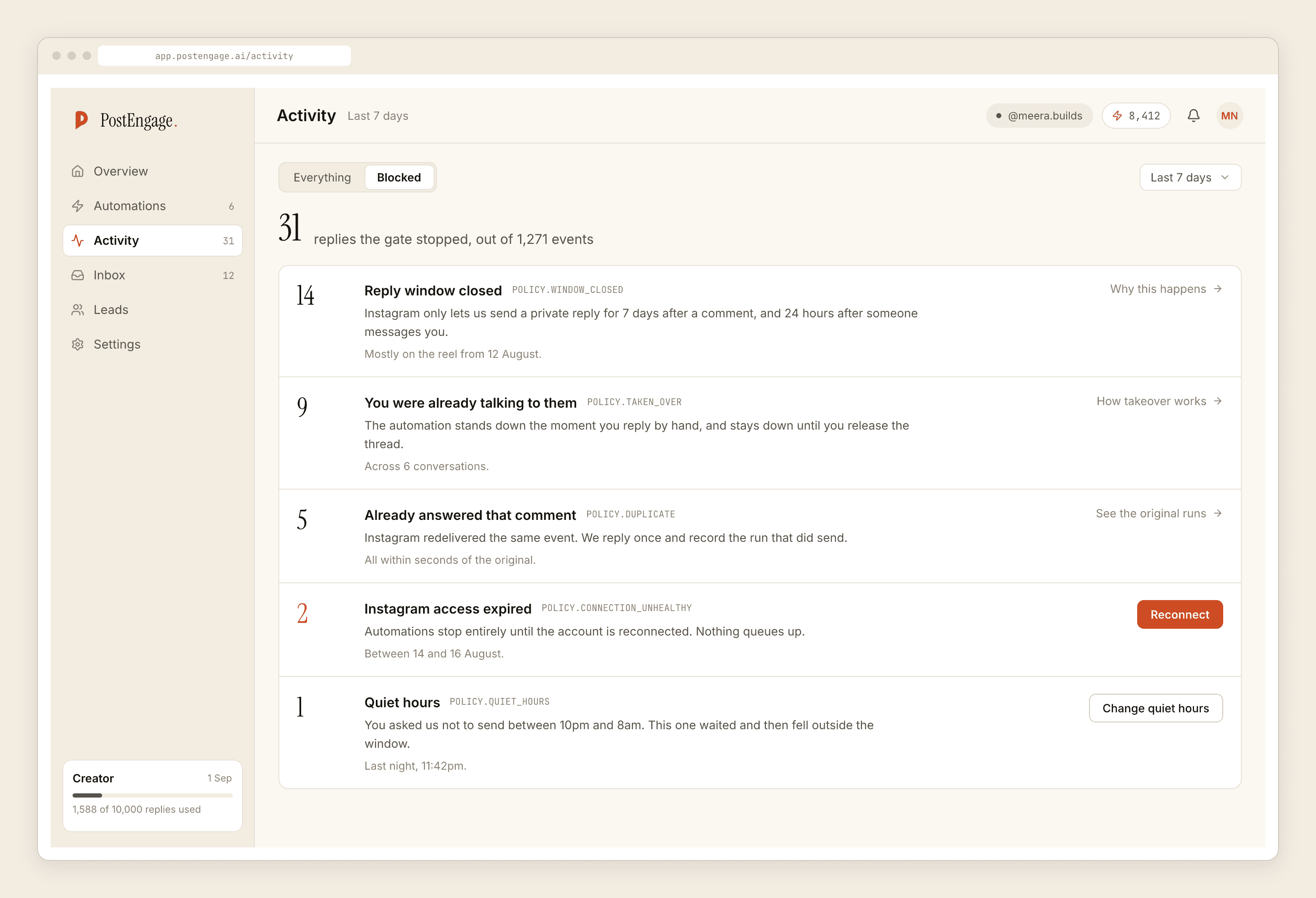
The loss sum. The number of conversations that expired unanswered, times what one is worth to you. This is the number that matters, and you can get it directly: it is the count of sends refused because a window had closed.
Time saved is a comfort. Conversations that expired are a bill you were already paying without an invoice.
What makes the second number knowable
Because a refusal is recorded with a reason, "how many did we lose to the clock" is a count rather than a guess. That is unusual — most businesses have no way to see the customers they lost by being slow, because nothing writes them down.
The cost side, honestly
On Instagram, where the product actually runs: templated replies are free and unlimited, and a credit is spent only when the model composes something new. The free tier is 100 credits with no card, and packs start at ₹499.
The consequence for the arithmetic is that the cost side depends on how unusual your inbox is rather than how large. An account whose top four questions cover most of its messages runs close to free. An account where every enquiry is genuinely different pays per reply, and should know that before committing rather than after.
On WhatsApp the shape differs, because Meta charges for certain message categories independently of any vendor. The specifics change and vary by country, so take them from Meta's own documentation on the day you build the model — not from a blog post, including this one.
A worked shape, with your numbers not ours
Take your hundred messages. Say sixty are one of four questions. Say each costs you three minutes including the interruption — that is three hours a month back, which is worth something but is not the argument.
Now take the refused-window count. If that is near zero, the case is weak and you should say so out loud. If it is meaningful, multiply it by your average order value and compare that to the cost side. That comparison usually settles it in one direction or the other within a minute.
We are deliberately not filling in the numbers. Any figures we invented would be the same trick the calculators play.
When the answer is no
If your inbox is small, if you already answer everything quickly, or if every message genuinely needs a person, the arithmetic says do not buy this. That is a legitimate outcome and it is worth reaching it deliberately, before a subscription rather than after.
Where we actually are
PostEngage answers Instagram comments and DMs. There is no WhatsApp in the product and no analytics on any channel — the counts above are yours to tally.
For the Instagram version of the measurement question, there are two posts on it, and the reporting one covers what is countable.