Playbooks · 5 min read
Story Link Sticker or a DM: What Each One Actually Costs

The link sticker is the most obviously useful thing on a story frame and the most over-recommended. It works. It also has a price that nobody mentions, and the price is not paid in clicks.
Start with what is true on our side: we do not post stories, we do not put stickers on them, and we have no link tool. We reply to messages people send you. So this is not a pitch for one path over the other — it is the comparison I would want before deciding which frame to design.
What a link tap actually is
A tap on a link sticker opens a browser and moves the person out of Instagram. From your side, nothing happens. No message arrives, no event fires, no conversation opens. You know a tap occurred because the app counts it, and that is the entire extent of what you learn.
This matters more than it sounds. A person who tapped and then closed the browser is indistinguishable from a person who tapped and bought, unless your site tells you, and you cannot write to either of them. There is no follow-up available, because a tap is not a message and no permission was created.
Link sticker
Reply in the DM
The case for the link, made properly
There is a real one, and it is stronger than DM-first advice usually admits.
When the destination is unambiguous and the person has no question — a checkout page for one product, a ticket page for one event, a form with three fields — sending them out of the app is the shortest honest path. Making somebody type a word so you can send them the same link one message later is friction you added for your own convenience, and a share of them will not bother.
The test is whether a question exists. If the natural next thought in the viewer's head is how much or which size or is it available in my city, the link is answering a question they did not ask and skipping the one they did.
The case for keeping it in the DM
When there is a question, the DM path is not slower. It is the only path where the question gets answered.
- You find out what they wanted. In their words, unprompted. A frame that asks people to reply with their city produces a segmented list nobody had to build, and it is the same effort for them as tapping.
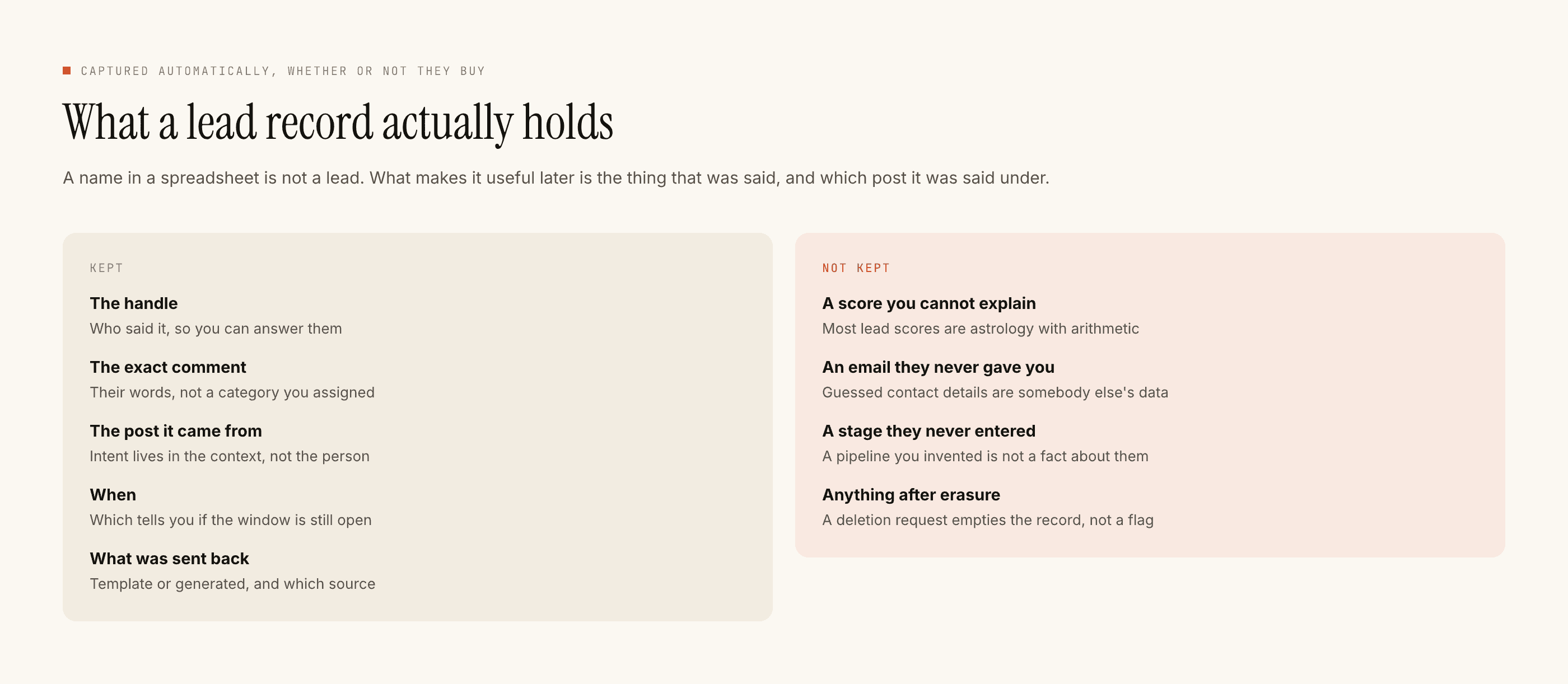
- You get a lead record. Their handle, what they said, when. It sits in Leads and it leaves as CSV. There are no one-click integrations here — the export is a file, and it is honest to say so.
- You get a thread. Twenty-four hours from their message, restarted only by their next one. Nothing you send extends it. That is short, and it is infinitely more than a tap gives you.
- They never left. The conversation stays on the surface where their attention already is, which is most of the reason DM-first works at all.
The reach caution, which belongs to comments
While we are being honest about links: on the comment surface, putting a link in your public reply may reduce how far the post travels. I would not state that as a mechanism I can prove, and I would design as though it were true, because the public reply is doing a different job anyway.
The public reply is a receipt. Two or three words, human, readable on its own. The link belongs in the private message where it can be explained, not under the post where it competes with the post.
The public reply is a shopfront sign. Nobody puts the whole catalogue on the sign.
Using both, which is what most accounts should do
They are not exclusive and the sequencing matters more than the choice.
Frame one carries the story and the ask. If the offer has a question attached — price, fit, availability, dates — the ask is a reply, and the link comes later inside the conversation once you know which link is the right one for that person. If the offer has no question attached, the link sticker goes on the frame and you stop there.
The failure mode is putting both on the same frame. A frame with a link sticker and a request to reply asks for two actions, gets neither reliably, and the reply you do get is from somebody who was confused about which one you wanted.
What to do with the replies once they arrive
A story reply is already a DM, so there is no public step and no seven-day cushion — it is twenty-four hours from the moment it lands. Quiet hours matter here more than anywhere, because stories are watched late and an automated answer at 1am reads as a machine.
Templated replies are free and unlimited, so the acknowledgement costs nothing. A credit is spent only when the AI writes something new, which on this surface is usually the second turn, where somebody has asked a question no template anticipated. One credit, one reply, and the free tier is 100 credits with no card.
The private reply should end with one closed question, because their answer is the only thing that restarts the clock. Then the link, if a link is what they need — sent to a person who has told you which one they need.
Where this leaves the sticker
Use it when there is nothing to ask. Use the reply box when there is. The mistake is not choosing wrong on any single frame; it is defaulting to the link forever because it feels like the low-friction option, and then wondering why an audience that taps a lot never talks to you.
If you want the full surface-by-surface reference for what a story can and cannot produce, it is here. And if you are weighing this against the profile link generally, that argument is its own post.