Playbooks · 5 min read
Stories Are Where You Find the Words a Trigger Needs

Two posts on this blog already cover the story surface properly. What a story reply actually is and the three kinds you receive is the mechanics. Why the story funnel has half the steps of the comment one is the structural argument. If you are setting this up, read those.
This is a third thing, and it is the use that gets ignored because it does not look like conversion. Stories are the cheapest way to find out what words your audience actually uses — and those words are the ones that decide whether every other automation you own ever fires.
Every keyword you have ever chosen was a guess
Think about how a trigger word gets picked. You sit down, you decide the word is PRICE, you write it in the caption, and you find out whether that was right by watching a month of comments.
That is an expensive way to learn something, and it only tells you about the people who complied. It tells you nothing about the person who typed rate kya hai under the same post and got nothing back, because your keyword list did not contain the words they reached for.
A trigger fires on words you guessed in advance. Stories are the only place you can collect those words before you have to guess.
A question sticker fixes this in about a day. A typed answer to a question sticker arrives as a real direct message, threaded under the story, exactly like any other DM. So if you put up a sticker asking "what do you want to know about this before you buy?", you get back a pile of messages containing your customers' vocabulary, in their spelling, in whichever script they type in.
That pile is a keyword list. It is a better one than you would have written, because it includes the phrasings you would never have thought of and the ones you would have dismissed.
The loop, which takes about a week
- Ask one narrow question on a story. Narrow gets answers. "What do you want to know about the new batch?" gets typed replies; "thoughts?" gets nothing. One question per frame, and make replying the easiest thing on the screen.
- Reply with a template and move on. Acknowledging costs nothing and keeps people answering next time. The reply is not the point here; the collection is.
- Read the whole pile at the end of the week, not each message as it lands. Individually they are unremarkable. Together they show you a shape.
- Pull out the repeated nouns, not the sentences. If eleven people used the word
feesand nobody usedpricing, you have just learned which word goes in your caption. - Put those words into the post automation, all the spellings included. Matching folds case and punctuation, so
Fees?andfeesare one thing. It does not forgive a different word.
The output of the loop is not a story funnel. It is a better comment automation on your next reel, which is the surface where the volume actually is.
Three surfaces, three registers, one mistake
The reason this is worth doing deliberately is that people build one automation and point it at everything, and the surfaces are not interchangeable.
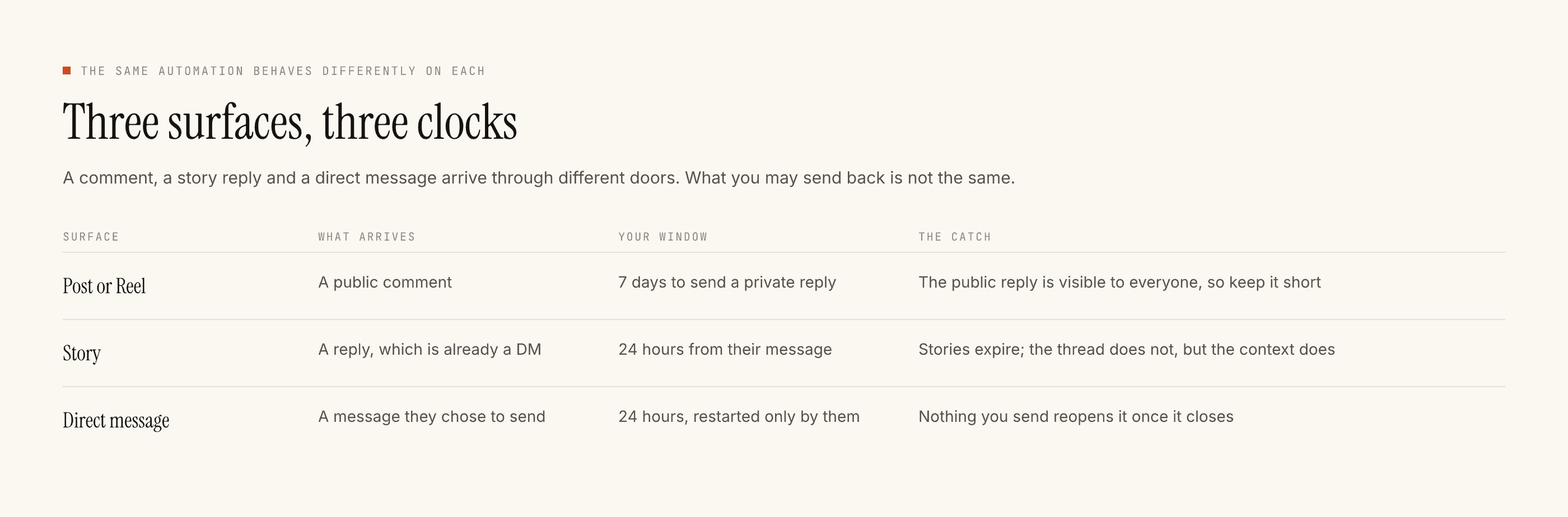
A comment reply is a public performance. Hundreds of people read it, including everybody else deciding whether to ask, so it is short and it is written for the audience rather than the asker. A story reply is a private message from someone who chose not to ask in public, and a reply written for an audience lands badly there because there is no audience.
The mixing failure is usually one automation with one template covering both. It reads slightly wrong in both places and it is very hard to notice from inside the builder, because the builder shows you the words and not the context they arrive in.
The clock is not the story timer
The other thing worth separating, because it produces the wrong panic.
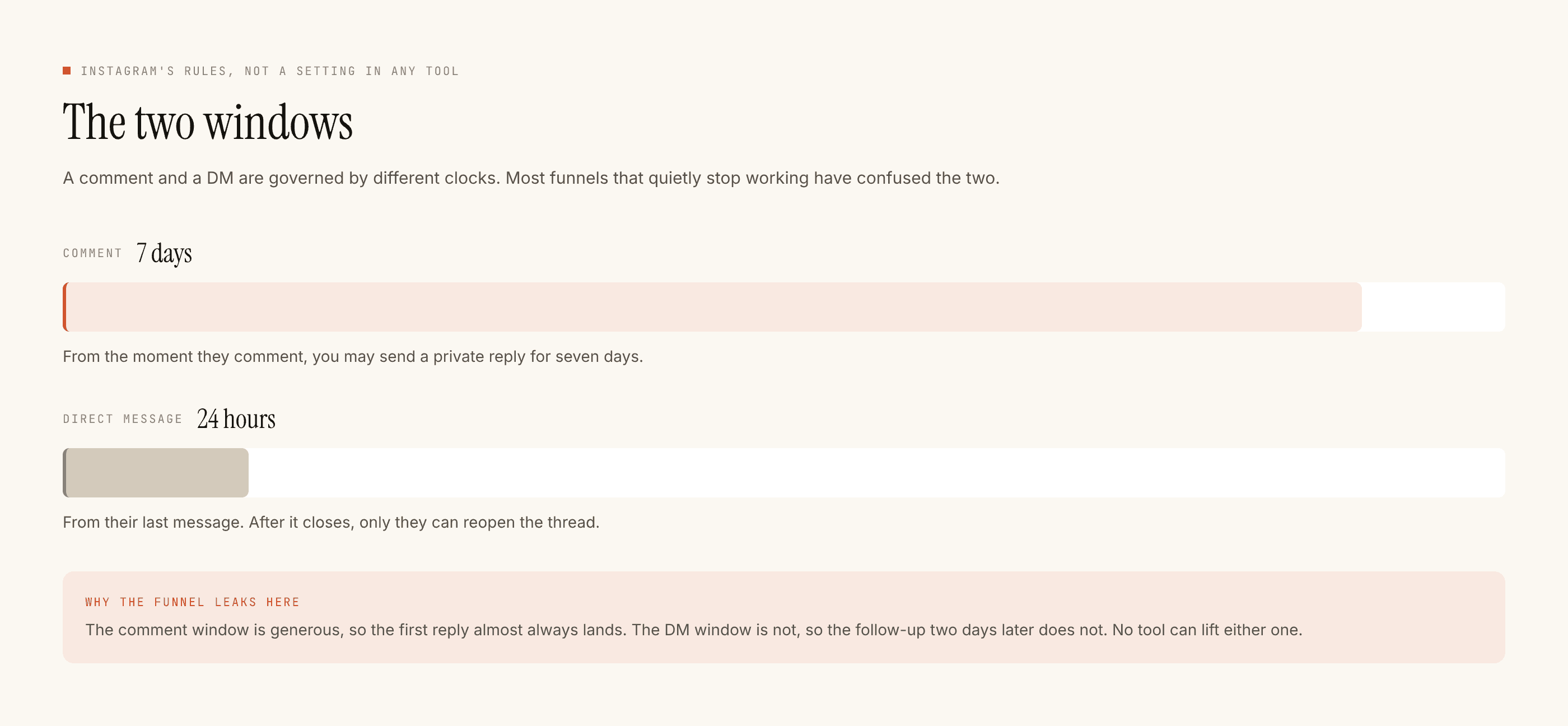
A story is visible for twenty-four hours. Your permission to reply is also twenty-four hours, but it is counted from their message, not from your post, and it restarts only when they write again. So somebody who replies just before a story expires has given you until roughly that time tomorrow. The story disappearing changes nothing about the conversation.
Comments run on the other clock — seven days, counted from the comment. That is why the research belongs on stories and the volume belongs on posts: the post keeps working long after the story is gone.
What this costs and what it cannot do
Templated replies are free and unlimited, so running a question sticker every day for a fortnight and acknowledging every answer spends nothing at all. A credit is spent only when the AI writes a new reply, one credit per reply, which on this surface is the genuine question you could not have anticipated. Free tier is 100 credits with no card, packs start at ₹499.
It cannot start a conversation. Somebody who watched every frame and said nothing is out of reach, permanently, and no setting changes that. It cannot see the story a person is reacting to and reason about what was in it. It does not publish or schedule stories, has no story analytics, and will not tell you which frame people dropped on.
And it will not rescue a story that gave people nothing to reply to. Everything above is downstream of the ask, and the ask is the part that is genuinely your job. Once you have the words, choosing the trigger is the decision the whole build turns on.