Playbooks · 5 min read
Selling on a Live: The Offer, and the Inbox Afterwards
The mistake is thinking the Live is the sale. It almost never is. The Live is where the offer gets made, and the buying happens over the following hours in the inbox, conducted by people who were half-listening while cooking dinner.
Which means the thing to design carefully is not the broadcast. It is what arrives afterwards, from people who remember an offer approximately.
If you are wondering what can be automated during a broadcast, the honest answer has caveats and it is set out separately. This post assumes you have taken the safe route there and are building around posts rather than the comment stream.
What imperfect recall looks like in your inbox
Somebody watched twenty minutes of a Live three hours ago. They now want the thing. What they type is not your keyword.
They type the name of the offer wrong. They type the price they thought they heard. They type "the one you showed after the blue one". They type "the bundle" when you called it a kit. They type your competitor's product name because that is what they were comparing it to. And a good number of them just type "hi".
This is not carelessness. It is what a spoken offer becomes after a few hours, and a keyword list written from the script rather than from the audience will miss most of it.
Give the offer a typeable name and say it too many times
The single highest-leverage thing you do on air is repeat a short, spellable name for the thing you are selling.
Short, because it will be typed with one thumb. Spellable, because it will be typed from memory by someone who heard it rather than read it. Distinct, because it has to be a keyword that does not collide with your other automations.
Say it at the top, say it when you demonstrate the thing, say it at the end, and put it on screen. Viewers arrive throughout a Live rather than at the start, so a name said once has been heard by a fraction of the people who watched.
The landing pad post
Publish a post or clip that carries the offer, before the Live or immediately after it, and put the automation on that. It gives the people who arrive late somewhere to go, it gives you a comment surface with a seven-day window per comment, and it keeps working for weeks after the broadcast is forgotten.
On air, point at it by name. "It is in the pinned post, comment KIT under it." That sentence converts a scrolling stream into an instruction landing on a surface that behaves predictably.
The first reply, and what it has to contain
Someone who watched a Live has more context than a stranger from the recommendation feed and less than you assume. They know your face. They may not know your prices, your delivery areas, or which of the three things you showed is the one they want.
So the private reply is: one clause of orientation, the specific thing they asked about, and one closed question. The closed question is not a flourish — their answer is the only thing that restarts your twenty-four hours. Nothing you send extends it.
A Live buys you warmth and costs you precision. The first DM has to trade some of the warmth back for a specific question.
Templated replies are free and unlimited, so the acknowledgement and the standard answer cost nothing. A credit is spent only when the AI writes a new reply, one credit per reply — which after a Live is exactly the right split, because the second turn is where people ask the thing no template anticipated. The free tier is 100 credits with no card, and packs start at ₹499.
The line automation does not cross
Everything about money that has already moved goes to a person. Payments, refunds, order status, whether the transfer landed, whether they are in the last three slots. These are the questions a Live produces most and the ones an automated reply is least equipped for, because being wrong about them is not a bad reply — it is a broken promise with a receipt attached.
Put those words on the negative keyword list before the broadcast: paid, payment, refund, order, delivery, whatever your business actually gets asked. And anything you cannot verify at the moment of sending, which for most businesses includes stock and dates.
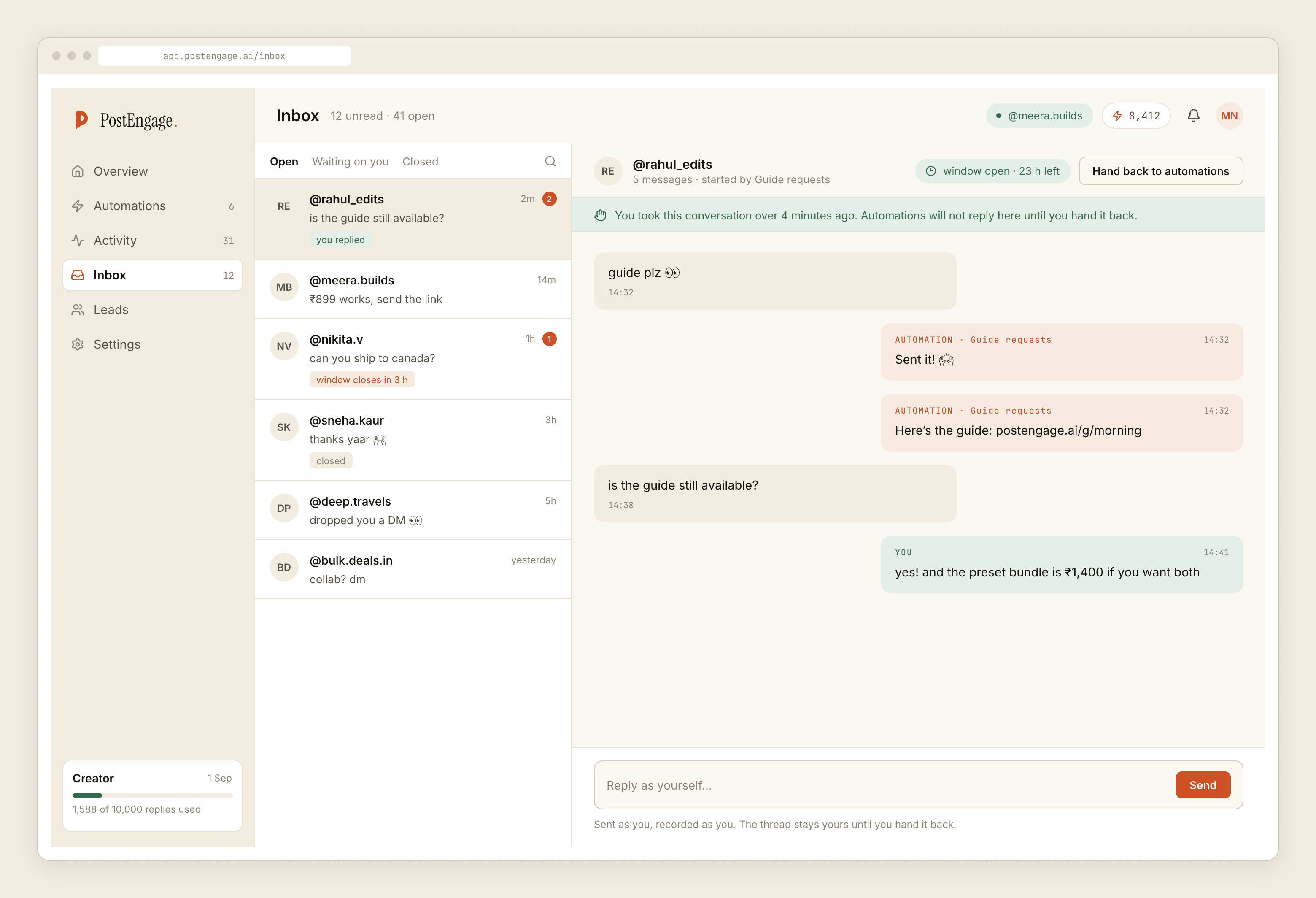
Takeover covers the rest. The instant you reply to a thread by hand it stands down for that conversation and stays down, so the correct posture in the hour after a Live is to sit in the inbox and take over anything real, letting the automation hold the queue of straightforward asks.
Sequencing the evening
- Before. Landing pad post published, automation armed and tested with Test on myself, negative keywords in, quiet hours checked against the hour your Live actually ends.
- During. Say the keyword name repeatedly and point at the post. Answer what you can on air; do not attempt to run the inbox while broadcasting.
- The first hour after. Sit in the inbox. Take over the real conversations. Let the templates handle the repeats.
- The next day. Read Activity. Closed windows mean people wrote and got nothing inside twenty-four hours, which after a Live is the failure worth acting on. Quiet-hours holds followed by closed windows mean your boundary is set for a schedule your audience does not keep.
- The week after. Leave the automation on the clip. Comments keep arriving, each with its own seven days, long after you have moved on.
The unglamorous part
Most of the revenue from a Live comes from perhaps a handful of conversations that went four or five turns, all of which started with a message the automation answered in under a minute while you were still on air or still eating dinner.
Automation does not sell anything. It keeps the door from closing during the two hours you cannot be in the inbox, and it hands you the conversations warm. What you do in turn three is the part that was always going to be yours. If you want the mechanics of that first turn done properly, the keyword guide is the place to start.