Playbooks · 6 min read
Selling a Course in DMs: What the First Reply Must Contain

Assume you get one message. Not as a worst case — as the normal case.
Somebody comments a word under your reel, the automation opens a DM, and that reply is the only thing you are guaranteed to put in front of them. They may write back. Plenty do not. There is no sequence behind it, no nudge on day three, no cart-close broadcast. So the entire selling job that a page or a webinar would do over twenty minutes has to survive inside one message that a person reads on a phone, standing up, half-interested.
That is a writing problem, and it is a different one from the coaching version. A coaching sale happens in a conversation, because the thing being bought is a person. A course is a fixed product with a fixed price and a public page, which means much more of the decision can honestly happen inside the first reply.
The six things that belong in it
- What it actually is, in one line. Not the transformation. The format. "Six live sessions, Tuesdays and Thursdays, 8pm, recorded." People decide on format far earlier than creators think.
- The price, as a number. If it is on your page it goes in the reply. Sending "DM me for details" to somebody who just did that reads as a tactic, and it is the most common reason a warm thread goes cold.
- Who it is not for. One sentence. This is the line everybody deletes and it is the highest-value sentence in the message.
- The nearest date that matters. When it starts, or when it closes. Which means this template has an expiry — see below.
- One link, going one place. The page that carries the syllabus and the checkout. Not three links. A reply with three links gets none of them clicked.
- A route to you. "Reply here if you want the syllabus" is a route. It also restarts the twenty-four hour clock when they use it, which is the only mechanism you have for a second turn.
The disqualifying sentence
Point three deserves its own section because it is counterintuitive and because most people will not do it.
"This is for people who already have some Python. If you have never written code, this one will be frustrating — the beginner batch is on the same page."
Every instinct says that sentence loses sales. What it actually does is three things at once. It removes the people who would have refunded, which is the most expensive kind of customer a course business has. It makes the rest of the message credible, because a message that says no to somebody is a message written by a person with a real product. And it answers, pre-emptively, the question that was actually stopping the buyer: will I be out of my depth.
A reply that says who it is not for is the only part of a sales template that a reader believes automatically.
What must not be in it
Anything that negotiates. If somebody asks about a discount, EMI, a student rate, or whether you will do it cheaper because they are from a small town, that is not a template — that is you, deciding, with your own money on the line. Put discount, offer, EMI, scholarship, sponsor, cheaper on the negative keyword list and route them to yourself.
Anything that promises an outcome. "Kitne din mein job lag jayegi" has no honest templated answer, and a generated one will sound certain because most course marketing on the internet sounds certain.
And anything at all if the message reads like support rather than sales. Somebody who has already paid and cannot log in must never receive a pitch — that inbox is a separate build and it comes first.
Read it on a phone before it goes live
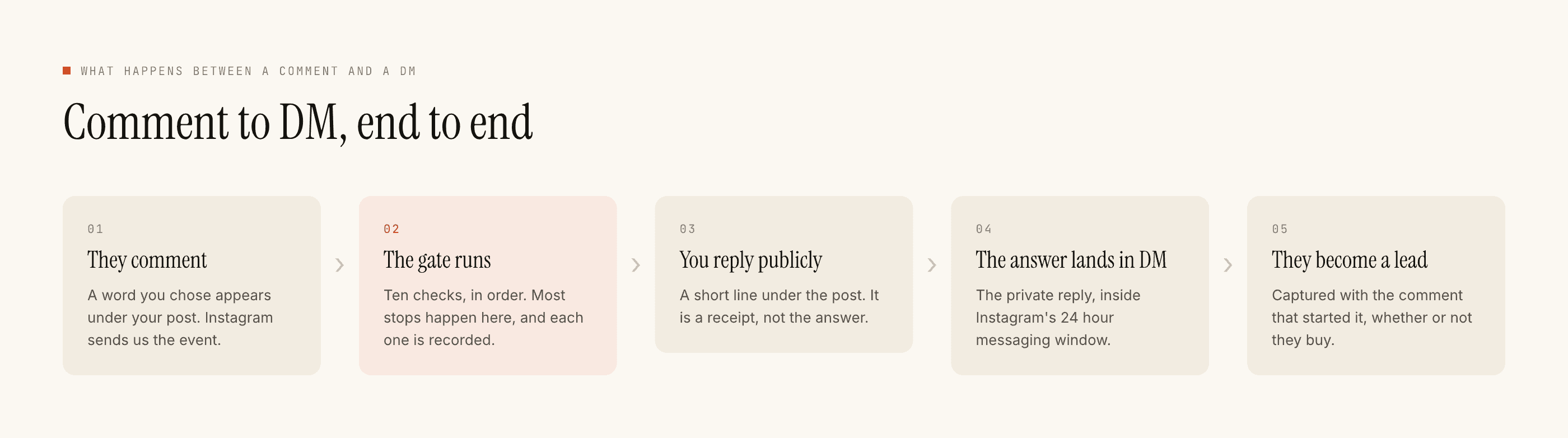
There is a Test on myself button that runs the whole pipeline — the trigger match, the ten checks, the reply, the send — and delivers the result to your own account. Nothing is faked, and it is the only way to find out what your carefully written message looks like as a wall of grey text in a notification.
Two things you will catch almost every time. It is too long: six items does not mean six paragraphs, and the version that works is closer to eight lines than twenty. And the register is off, because writing a template feels like writing a document, so a creator whose captions are all lowercase suddenly opens with "Thank you for your interest in our programme."
The clock, and why there is no second attempt to plan around
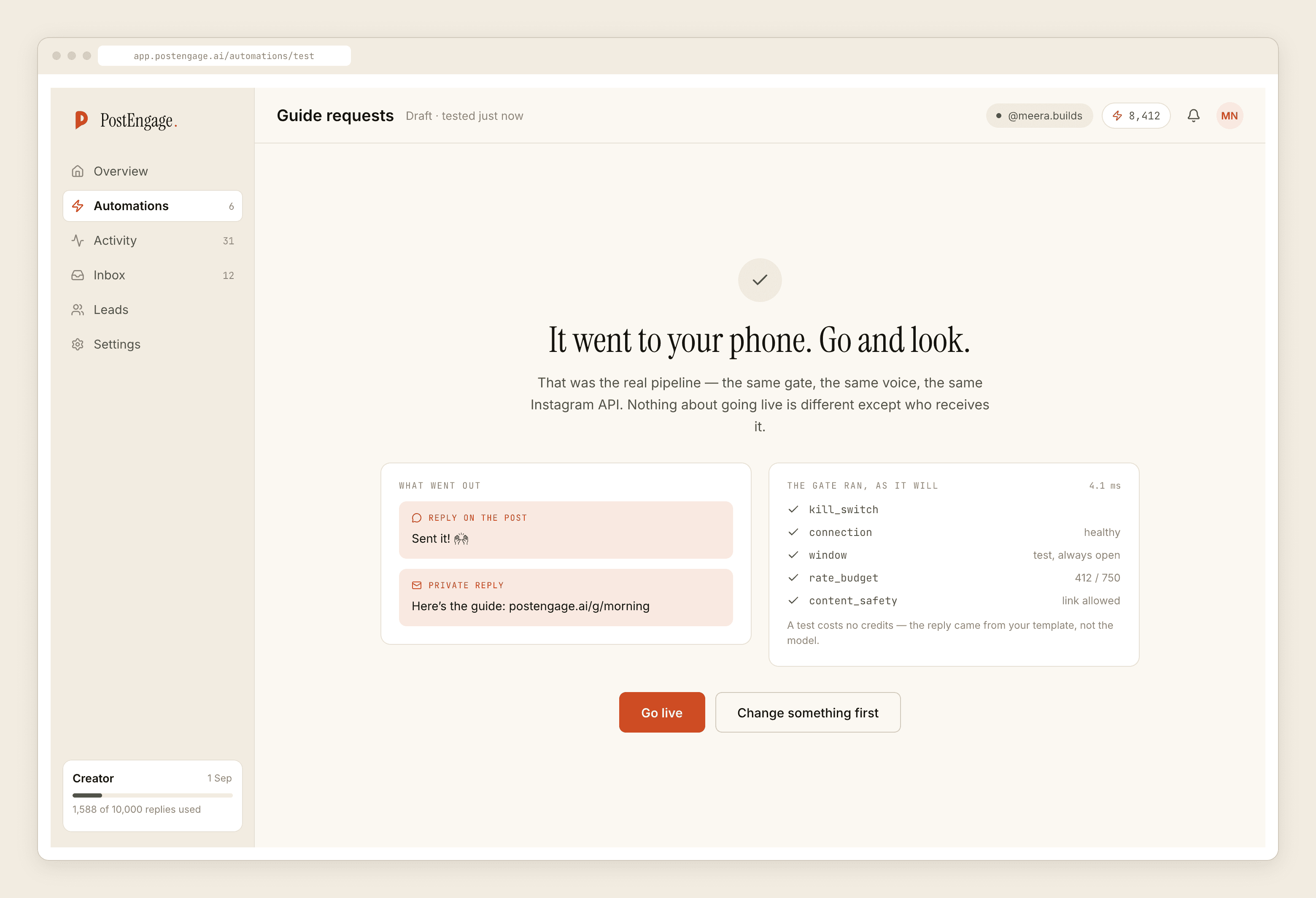
Official Instagram Graph API, so: a comment can be replied to for seven days from when that comment was posted, and a DM thread stays open for twenty-four hours from their last message. Only their message restarts it. You cannot reopen it, and there is no broadcast, no drip, no nurture sequence and no WhatsApp here.
The practical consequence is the whole argument of this post. Do not design a course sale that depends on a follow-up you control. Whatever the person needs in order to keep deciding goes in the reply they got while the window was open, or it goes on the page you linked, which is available to them forever regardless of any window.
What it costs and what it will not do
Templated replies are free and unlimited, so the reply described above runs forever at no cost. A credit is spent only when the AI writes a new reply, one credit per reply. Free tier is 100 credits with no card, and packs start at ₹499.
It cannot message anyone who has not messaged you first. No payment links, no checkout, no cart, no course-platform integration, no calendar, no CRM sync — captured people leave as a CSV. And takeover means that the second you reply by hand, the automation stands down in that thread, which for a sale in progress should be early and often.
If you want the shape of the funnel rather than the copy inside it, the comment-to-DM walkthrough is the one to read next.