Lead generation · 4 min read
Where Your Funnel Stages Actually Live on Instagram

"A full sales funnel inside your DMs" is a phrase that sells software, and it is describing something real badly. The stages do exist. They just do not all happen in the inbox, and the one that does is the last one.
Getting this wrong has a specific cost. If you think the DM is the top of the funnel, you write a first message that introduces the business, builds rapport and works towards a pitch. You have then spent the only turn you are guaranteed on material the person did not need, and the twenty-four hour window closes on it.
The translation table
Take the standard stages and put each one where it actually occurs.
- Awareness happens in the feed. A post or a Reel reaches somebody. Nothing here touches that — no publishing, no scheduling, no hashtag tool, no growth features, and no way to influence reach.
- Interest happens in the caption and the comment section. They read what the post says and then scroll down to see whether anyone answers. Your public replies are doing this stage's work, for readers who will never comment.
- Consideration happens when they type the word. This is the part people miss. Typing
priceis an act of qualification — the person has named their intent, publicly, before you have said anything. - Decision happens in your private reply. One message. This is the only stage the inbox owns.
- Purchase happens somewhere else entirely. There is no checkout here, no cart, no payment, no order object. The DM ends with a link, an address, a UPI handle or an instruction.
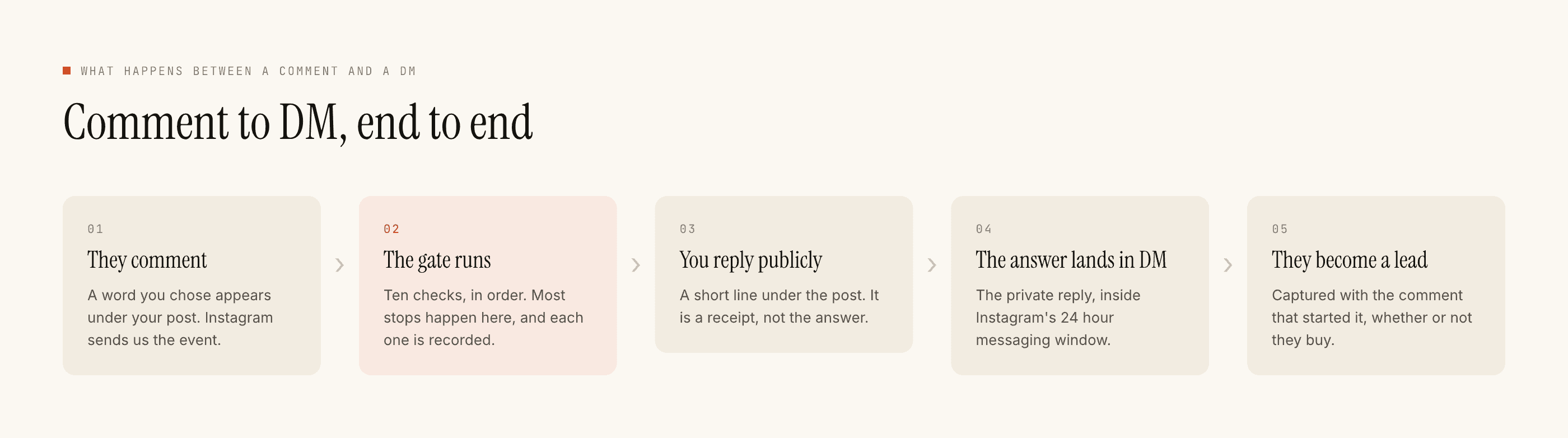
Which means the DM is bottom of funnel, always
By the time you get to speak, the person has seen the post, read the comments, decided you were worth the effort, and told you what they want. Two thirds of the funnel completed without your participation.
A bottom-of-funnel message does bottom-of-funnel things. It removes the last obstacle. It does not warm anybody up, because they are already warm — that is what typing the word meant.
Written as top of funnel
Written as bottom of funnel
They did not ask who you are. They asked how much. Answer the question they asked.
The four things a decision-stage message has to contain
The number. Whatever the specific answer is — the price, the date, the size, the address. Deferring it is the single most common failure: "our team will get back to you shortly" spends the guaranteed turn saying nothing, and nothing they do afterwards is likely.
The obstacle removed. Whatever normally stops this person. Delivery time, COD availability, sizing, whether it fits their situation. You already know what it is, because you have answered it fifty times.
One next step. A link, an address, an instruction. One. Two next steps is zero next steps.
One closed question. Not to gather data — to get another turn. Their reply is the only thing that restarts the twenty-four hours, and it has to be answerable with one thumb. M ya L? gets answered. "Let us know your requirements" does not.
What this costs to run, which shapes the design
Templated replies are free and unlimited. A credit is spent only when the model writes a new reply, one credit per reply, and the free tier is 100 credits with no card. Packs start at ₹499.
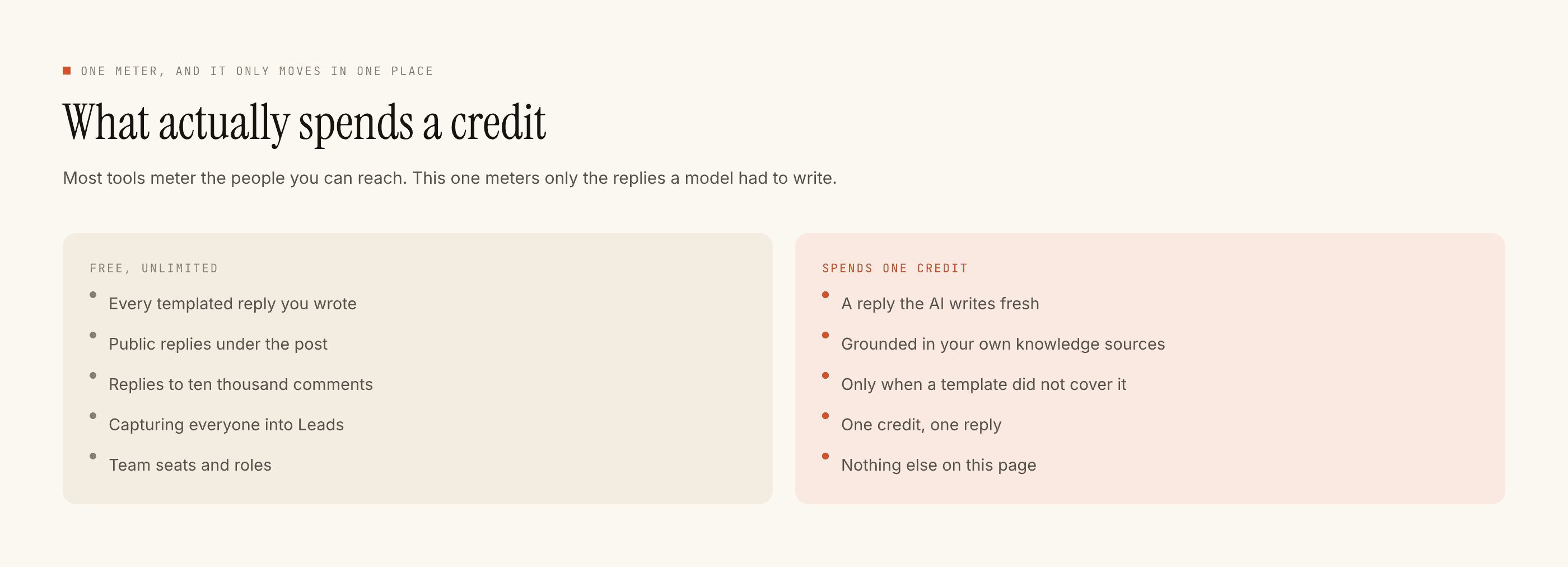
Which is convenient, because the decision-stage message is the most repetitive message in the business. The model is worth a credit on the turn after, when somebody replies with something specific that no template anticipated.
The stages that genuinely have nowhere to live here
Being complete about the absences, since the phrase "full funnel" implies otherwise.
There is no retention stage, because you cannot message a past customer unless they message you. No upsell campaign, because there is no broadcast. No abandoned-anything recovery, because there is no cart and no way to reach somebody who stopped replying. No post-purchase sequence, no re-engagement, no retargeting, and no attribution connecting any of this to a payment.
What exists after the sale is the lead record and a CSV export. Anything that needs sending on your schedule belongs in a channel that permits sending, and the argument for getting an email address is exactly this argument from the other end.
If you are building it today
Work backwards. Decide the one sentence you want the conversation to end at, write the decision-stage message that gets there, then choose the keyword that makes that message the right answer. Designing the funnel from the destination walks that properly, and the objections that arrive on the second turn are the other half of what the inbox has to handle.