Playbooks · 5 min read
Architect DMs: Most of Your Inbox Is Not a Project

If you practise on your own, your Instagram is doing something slightly unusual. It is not a shopfront. It is a portfolio that happens to have a messaging app bolted to the side of it, and the messages it collects are mostly not work.
Sort a month of them honestly and the piles look roughly like this. Students asking for an internship or a portfolio review. Someone with a plot who wants to know, free, whether their existing drawing is any good. A vendor with a tile catalogue. Someone from four states away whose site you would never travel to. A contractor introducing himself. And, somewhere in there, one or two people who genuinely want to build something and can pay for it.
That distribution is the whole brief. Automation for a solo architect is not a conversion tool. It is a filter that runs while you are on site.
Time is the deliverable, so a reply is not free
This is the difference between your practice and a business that sells objects.
A bakery answering a question loses nothing but the seconds. You answer a question and you have given away a small piece of the thing people pay you for. Not a product — an opinion. That is the entire inventory of a design practice.
Which makes one specific message the dangerous one: "Can you just tell me if this plan is okay?" Sometimes with a photo of a drawing. Sometimes with a sketch on graph paper. Almost always ending in "just quickly."
An AI given a floor plan question will answer it. Fluently, immediately, with your name at the top of the message, for free.
That is the leak. Not a compliance problem, not a safety problem — a business one. The system does not know that this reply is the product. It knows a question arrived.
Saying no well, at scale, is the feature
Most automation writing assumes you want more conversations. A solo practice usually wants fewer and better ones, and the good news is that a template is unusually well suited to declining.
The internship pile is the clearest case. Thesis season arrives, forty students write in the same fortnight, every message deserves a kind answer, and you have no time to write forty kind answers. One good template — whether you take interns, when you look at portfolios, where to send one, and a genuine sentence of encouragement — is better than what actually happens now, which is that thirty-five of them get nothing at all.
The same shape works for the geography problem. If you only take work within a certain travel radius, saying that immediately is a kindness. Somebody in another city discovers in four seconds instead of after three days of hope.
What to ask the one enquiry that is real
When something does look like a project, the automation should not try to close it. It should collect the four things that decide whether it is a conversation you want, so that when you sit down on Sunday evening you are reading facts rather than reconstructing a thread.
- Where is the site. Not the city — the actual location, because travel is the hidden cost in a one-person practice and it decides everything.
- What stage. Land bought or being looked at. Drawings exist or do not. Approvals started or not. This separates a project from a daydream more reliably than any other question.
- Scope and rough size. New build, interior, extension, renovation. Approximate area. Enough to know whether this is three months or two years of your life.
- When they want to start. A date, however soft. "Whenever" is an answer too, and a useful one.
Notice what is not on that list. No fee, no rate, no ballpark. An architect's fee depends on scope, stage, site and how the appointment is structured, and a number sent by template is a number you will be held to for the rest of the conversation. What you can safely automate is the mechanism — that you quote after a first conversation, that you work in stages, that there is a fee for the initial design stage if there is. Say the structure and people accept it.
What it costs and what it will not do
Templated replies are free and unlimited. A credit is spent only when the AI writes a new reply. For a practice where most of the inbox is four repeatable declines, that is close to free forever. The free tier is 100 credits with no card and packs start at ₹499.
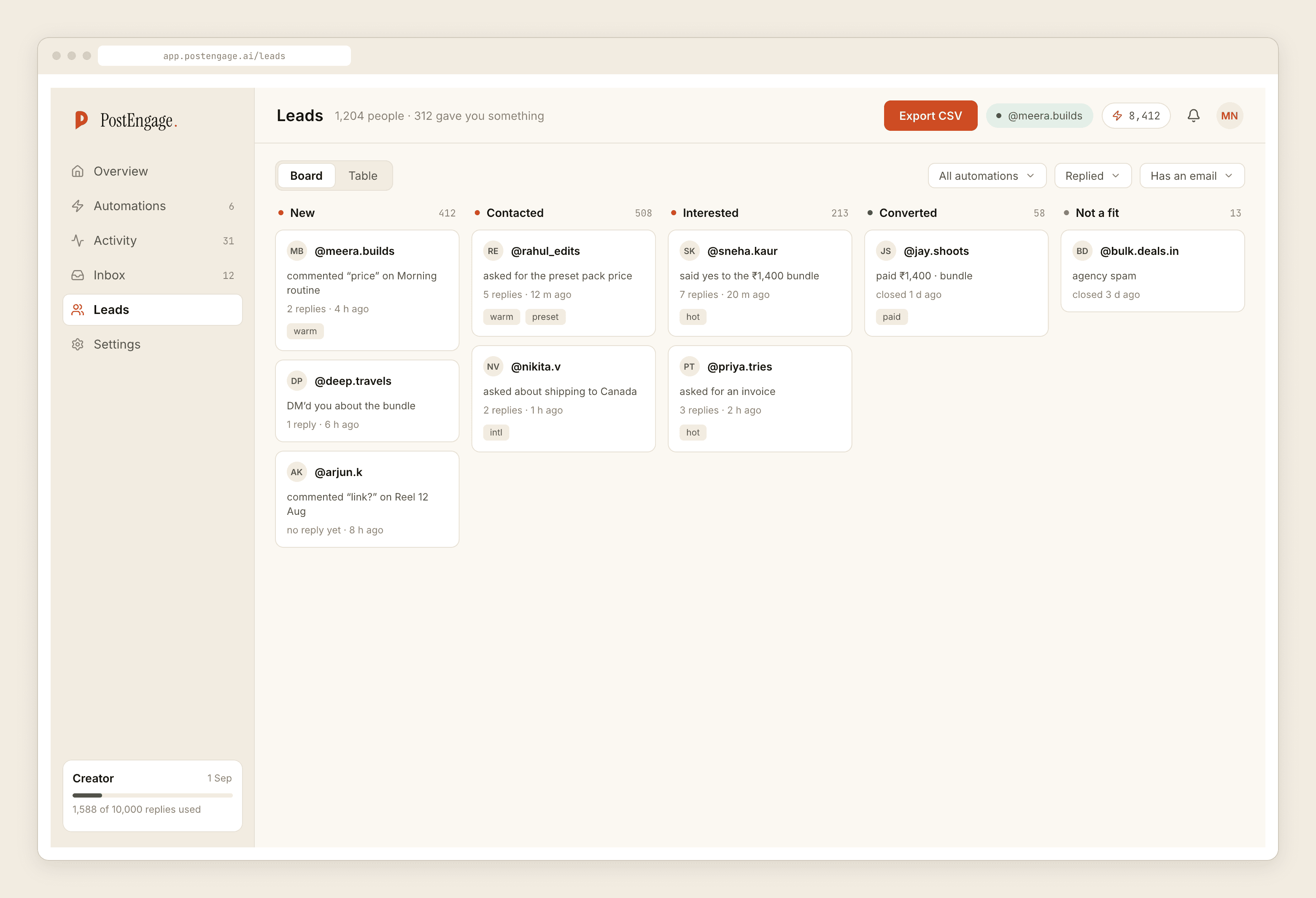
It cannot open your calendar, book a site visit, or hold a meeting slot — there is no calendar integration of any kind. It cannot message anybody who has not messaged you first. It does not do WhatsApp. Leads leave as a CSV file, which for one person is genuinely enough.
Takeover matters more here than almost anywhere: you will jump into a thread the second you see something interesting, and automation stands down in that thread the moment you do. And the clocks are real — a comment stays answerable for seven days, a DM thread for twenty-four hours, and that DM clock restarts only when they write again, not when you do.
If you work inside a studio rather than alone, the routing and inbox-ownership problems are different enough to need their own post — the architecture firms version is here. And if a lot of your enquiries are really interiors, the interior designers post covers that inbox.