Playbooks · 4 min read
Why Reply Speed Matters, and It Is Not the Reason You Think

Every article about response time opens with a number. Some percentage of customers buy from whoever replies first, usually attributed to a study nobody links. We are not going to use one, because we cannot source it and because the real argument does not need it.
Here is the real argument. On Instagram, a reply that arrives late enough is not a slow reply. It is a reply the platform refuses to send.
The mechanism
You may send a direct message for twenty-four hours from their last message. Only another message from them restarts that clock. Nothing you send extends it, no plan tier lengthens it, and once it closes only they can reopen it by writing again.
A comment gives you seven days to open a DM — generously, and per comment rather than per post, so an old Reel that resurfaces still works.
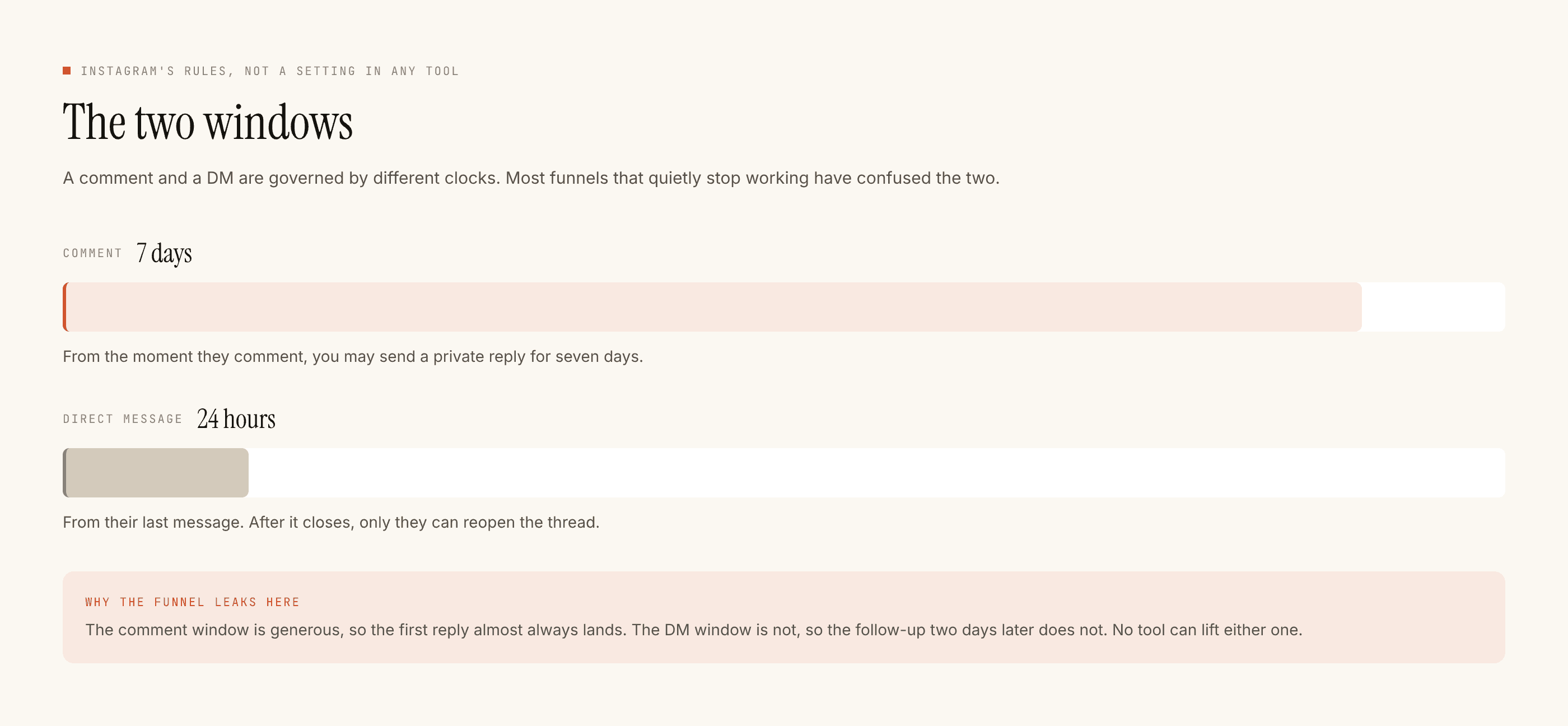
So "reply fast" is not advice about attention spans. It is a description of a hard boundary. Inside it you can have a conversation; outside it you cannot have one at all.
There is no such thing as replying too late. There is replying, and there is being refused.
Three intervals that behave differently
Seconds. Only achievable by a template, and only for questions you predicted. This is what automation buys: the four questions that repeat get an answer immediately, at 2am, in words you wrote.
Minutes to a few hours. A person answering, having seen a notification. Fine for almost everything, and the range most real businesses operate in for the messages that need judgement.
A day or more. Now you are gambling against the window. Sometimes it works, because they wrote recently enough. Often the send is refused and the person concludes you ignored them, which is functionally the same as ignoring them.
Where speed does not help
Worth saying, because "faster is always better" produces bad setups.
A fast wrong answer is worse than a slow right one, and considerably worse than silence. The messages where speed is actively harmful:
- Anyone who is angry. A template arriving in nine seconds under a complaint reads as being processed by a machine too busy to notice. Route it to a person and let it take an hour.
- Anything about money that has already moved. Refunds, failed payments, "paisa kat gaya but no access". Speed here signals carelessness.
- Anything you cannot verify. A delivery date, stock on a one-off item, a price that depends on things you do not know yet. Fast and wrong becomes a commitment.
- Anything emotional. The correct response time for a difficult message is however long it takes a person to read it properly.
Those all belong on the negative keyword list, which stops the automated reply entirely rather than making it quicker.
The setting that trades speed away deliberately
Quiet hours. Most accounts should keep them, and it is worth understanding what they cost rather than assuming they are free.
A message arriving at 11:40pm with quiet hours until 8am gets answered at 8am. That is the right call for the recipient — nobody wants a business messaging them at midnight — but the twenty-four hour window started at 11:40pm. By the time you answer you have spent eight hours of it.
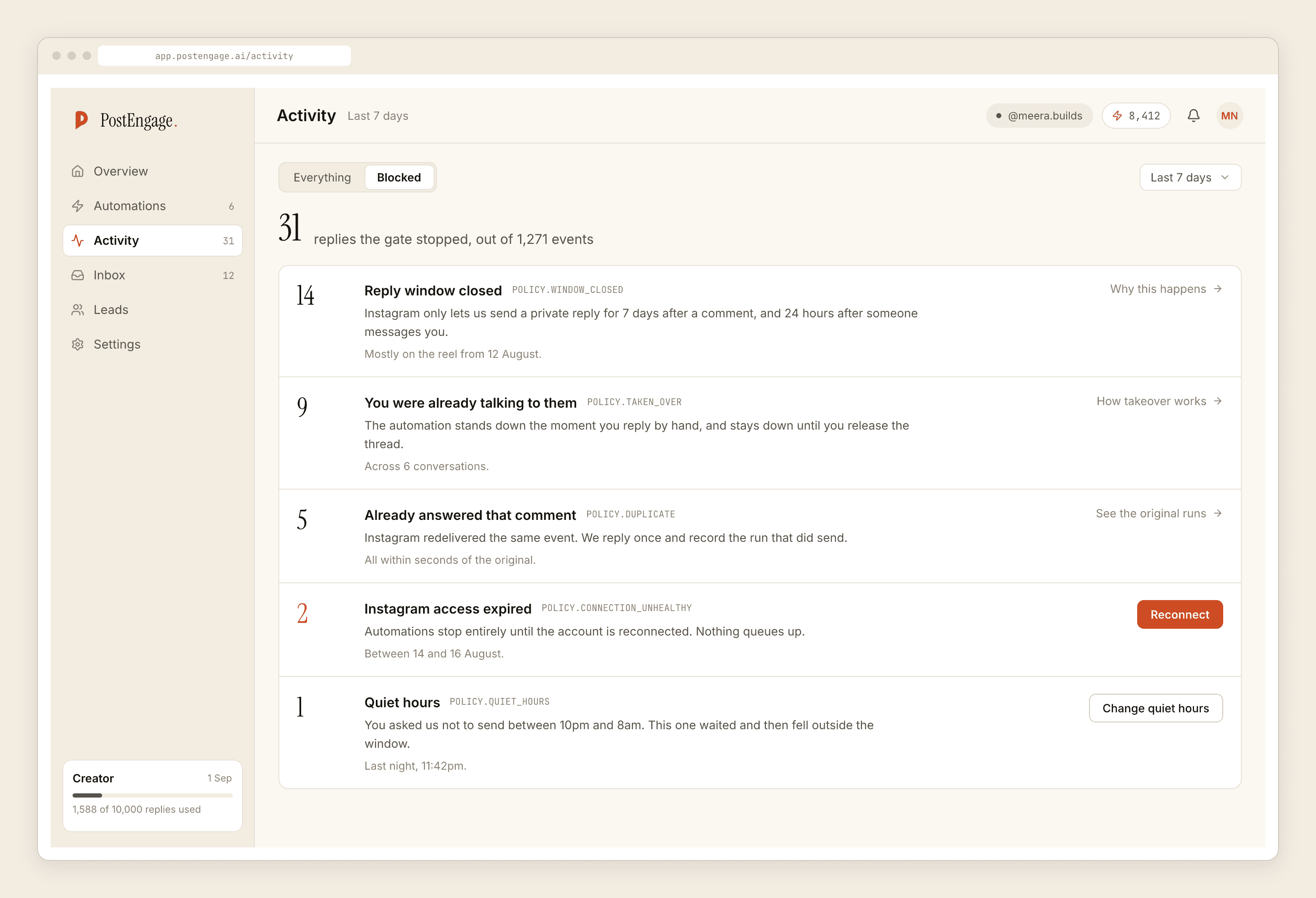
Set the hours in your audience's timezone rather than your own, and check the blocked list once a fortnight to see which of those two patterns you have.
What to measure instead of a benchmark
You will not find a defensible industry number, and you do not need one. Four things you can count by hand:
- How many messages arrived.
- How many got any reply at all.
- How many were refused because the window had closed.
- How many conversations you personally took over.
That third number is the honest measure of what slowness is costing you, and it is the only one on this list that a stranger's statistic could never tell you.
There is no dashboard for it here — no analytics product, no reporting — but the blocked list gives you the count directly, and it takes about two minutes.
The version worth remembering
Automate the questions that repeat so those are answered instantly and for free. Route the ones that need judgement to a person and let them take as long as reading properly takes. Keep quiet hours, in the right timezone, and check occasionally whether they are protecting people or eating conversations.
That is the whole of speed as a strategy, and none of it requires believing a number.
If you want the full list of what can stop a send, the checks are documented here. If your inbox is the problem rather than your speed, start with triage.