Lead generation · 5 min read
Instagram Reply Response Time: The Window That Actually Matters

Every article about response time opens with a statistic. Some share of customers buy from whoever replies first. Some multiple of leads go cold after an hour.
We are not going to repeat any of them, because we cannot source them and neither, usually, can the article quoting them. They get copied between blog posts until they read like physics.
There is a better argument for replying fast and it is not a statistic. It is a rule, it is published, and it applies to your account whether or not the study was real.
The clock is the argument
On the official Instagram API there are two windows, and they behave differently.
A comment gives you seven days to reply publicly and to send that person a private reply. That is generous. Almost nobody misses it.
A DM thread gives you twenty-four hours, measured from their last message. Not from your reply. Not from when you opened the app. Your own messages do not extend it, waiting does not extend it, and there is no paid override, admin switch or template that revives a closed thread. The only key is a new message from them.
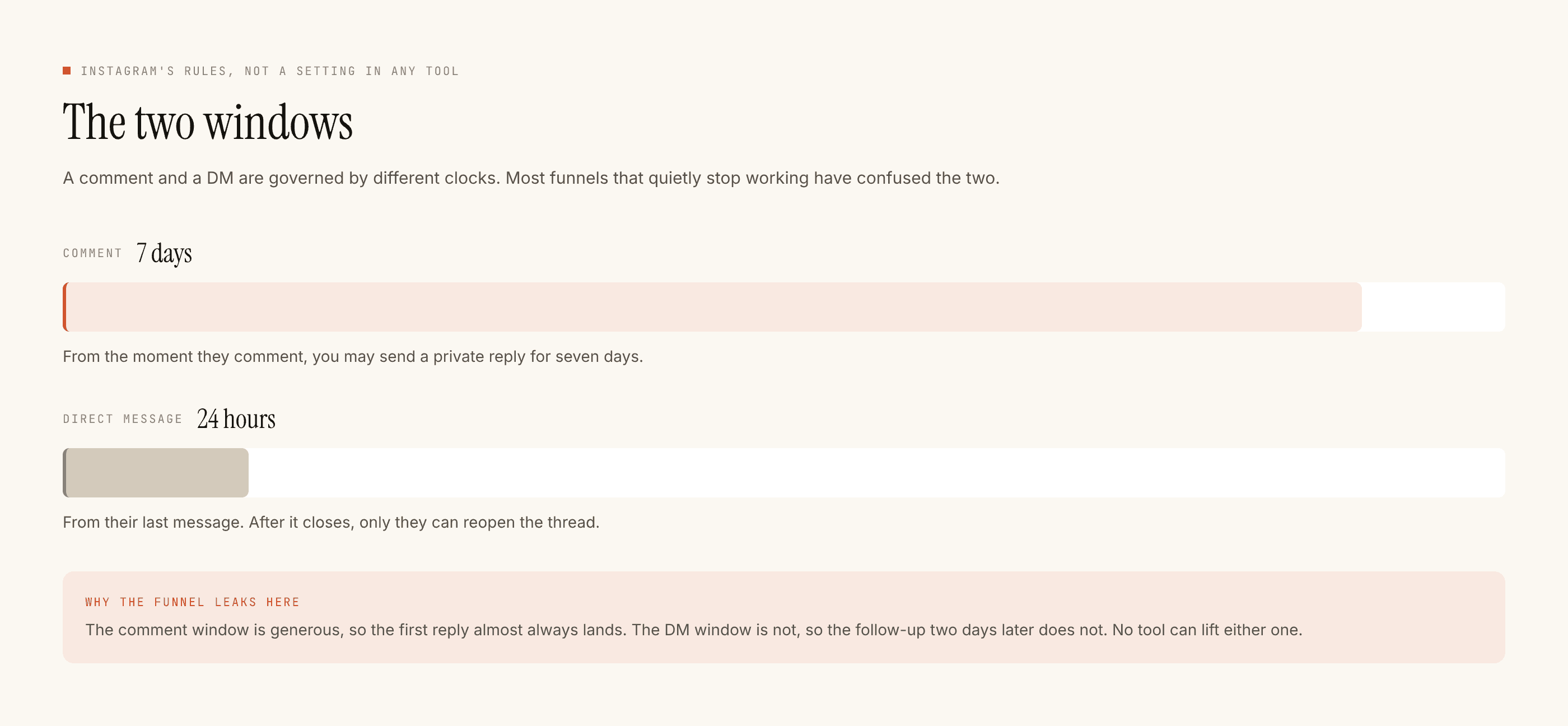
So the honest framing of response time is not that slow replies convert less well. It is that past the window there is no reply at all. It goes from late to impossible with no gradient in between, and the gate records the refusal against window rather than sending something that would break the rules.
Late is not a worse version of on-time. Past twenty-four hours it is a different category: nothing was sent, and nothing can be.
Three intervals, and only one of them is a software problem
"Response time" is one phrase covering three different measurements. Separating them tells you where to spend effort.
- Comment to public reply. Should be seconds, and can be, because it is entirely automatable. This is the one people brag about and it is the least valuable of the three.
- First DM to first real response. The one that matters. Not first acknowledgement — first response containing something the customer can act on.
- First response to resolved. Human, variable, and bounded by the same twenty-four hours if it needs another turn from you.
Interval one is free to fix. Interval two is where automation earns its place, and only if the template actually answers. Interval three cannot be automated at all, and the mistake most accounts make is trying, usually by sending something fast and empty.
The fast empty reply is the expensive one
"Thanks for your message, our team will get back to you shortly."
It arrives in four seconds and it makes your response-time number look wonderful. It also spends the one turn you were guaranteed, tells the customer nothing, and starts the countdown you now have to beat — a countdown that began when they typed, not when you answered. If they wrote at 11pm and you acknowledged at 11.01pm, somebody has until 11pm tomorrow to produce the real answer, and the acknowledgement bought no time whatsoever.
Being deliberately slower, on purpose
Speed is not the only virtue and the product ships two features that make you slower.
Quiet hours holds replies overnight. A question arriving at 2am waits until morning, which looks like a worse response time and is better behaviour: a business messaging strangers at 3am reads as a bot, and the window is twenty-four hours wide, so an 8am answer to a 2am question is comfortably inside it. Set them in your audience's timezone rather than yours.
Cooldown stops several automations landing in one thread inside a minute. Dedupe stops the same comment being answered twice when Instagram redelivers the event. Both make individual replies later and the conversation saner.
The gate runs in a fixed order — kill_switch, connection, takeover, window, dedupe, cooldown, quiet_hours, rate_budget, credits, content_safety — and three of those exist specifically to slow you down. That is not a compromise; a reply nobody wanted at 3am is not a fast reply, it is a complaint.
What actually makes the first response fast
Not effort. Four things, in descending order of effect.
Templates over generation. A templated reply is free, unlimited, and has nothing to compute. It is also the one you have already read, which is why it is the right instrument for the questions you get most.
Fewer, wider automations. Four automations covering the four questions that make up most of your inbox will beat twenty narrow ones, because the narrow ones miss and a miss is an infinite response time.
Negative keywords. A fast wrong reply is worse than a slow right one. not interested, already ordered, just looking should stop the send.
Somebody looking at the inbox once a day. Everything above handles the predictable. The unpredictable still needs a person, and there is no alerting product here — nothing pages you when a token expires or a thread goes unanswered.
Do not build a response-time dashboard
There is no analytics product here. No average response time, no distribution, no per-agent breakdown, no report. If you want the number, you count it by hand from what Activity shows you, and the limits of measuring any of this are worth reading before you promise a client a chart.
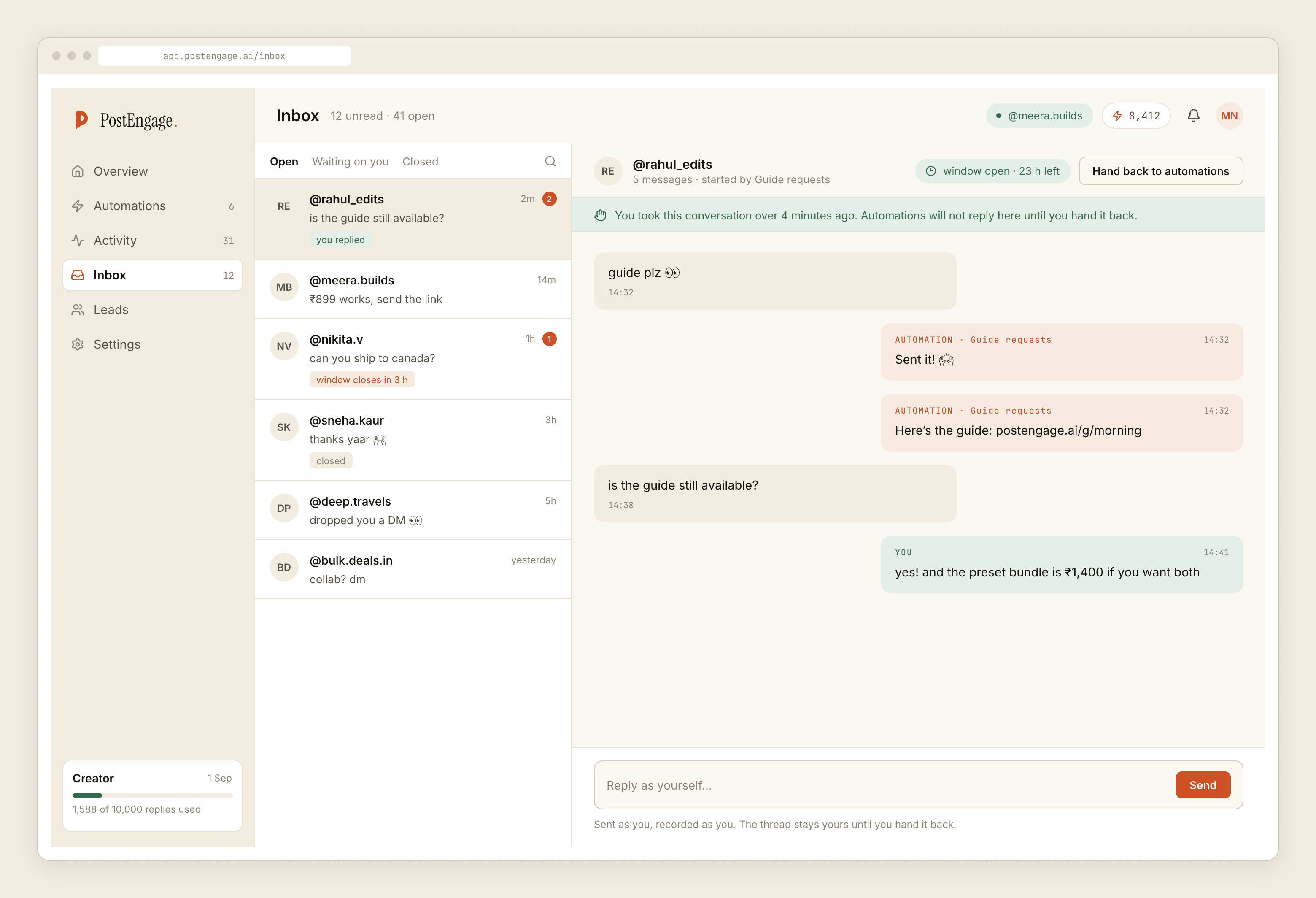
One thing in Activity is worth watching, though, and it is a speed signal in disguise. If takeover is stopping a lot of automated sends, your team is beating the automation to those threads by hand. That means the automation is answering questions they would rather answer themselves — and the fix is a narrower automation, not a faster one.
For the day-to-day habits rather than the mechanism, replying faster has its own post, and the case for speed as a sales argument is made separately from this one.