
The advice usually offered here is "automate your DMs", which is not advice so much as a product category. It also skips the part that determines whether any of it works: an inbox that feels unmanageable is almost never uniformly hard. It is a small number of genuinely difficult messages buried under a large number of identical ones, and the difficulty of finding the first kind is what makes the whole thing feel impossible.
So the first job is not automation. It is sorting.
Read a week of it before you build anything
Open your notifications, go back seven days, and read the messages as strings rather than as obligations. Mark each one with a letter.
- T — a template could answer this. The answer does not change based on who asked. Price, delivery time, whether you ship somewhere, where the size chart is.
- G — needs composing, but not by you. A real question with a real answer that lives in your own material, phrased differently every time it arrives.
- P — needs a person. A complaint, a negotiation, something emotional, anything about money that has already moved.
- N — needs nothing. Compliments, emoji, tag-spam under a giveaway, bots.
Do not skip this and reason about it from memory. Everyone's memory of their inbox is dominated by the P pile, because those are the messages that took energy. The count almost always says something different.
The pile that exhausts you is rarely the pile that fills your inbox.
What the letters tell you
If T is most of it, you have a volume problem with a cheap fix, and the four or five templates that cover it will pay back permanently. Templated replies are free and unlimited here; a credit is only spent when a model has to write something new.
If G is most of it, you have a knowledge problem. The answers exist, they are just in your head, and the useful work is writing them down once so something can draw on them.
If P is most of it, be careful. This is the case where automation removes very little, and installing it can make things worse by putting a written-in- advance sentence on top of a conversation that needed a person. If your inbox is mostly P, the honest recommendation is that a reply tool is not your problem's shape.
If N is most of it, your inbox is not full, it is noisy, and the fix is a negative keyword list rather than a reply system.
Handle the T pile first, and only the T pile
Pick the single most repeated question and write one automation for it. One post, one keyword, one public reply, one private reply. Not five automations on your first afternoon — you cannot tell which of five produced a bad answer, and you can always tell when there is one.
Test it on yourself before it goes near anybody else. The test runs the whole pipeline, all ten checks included, and delivers to your own account, so a reply that survives it is a reply that would genuinely have gone out.
Protect the P pile explicitly
This is the part most setups skip, and it is the one that prevents the failure everybody remembers.
Write a negative keyword list before you write your second automation. Anything
on it stops the automated reply entirely and leaves the message for you:
refund, cancel, not received, payment failed, broken, wrong item,
complaint, plus the phrasings your own audience actually uses — paisa kat gaya, abhi tak nahi aaya, kharab nikla.
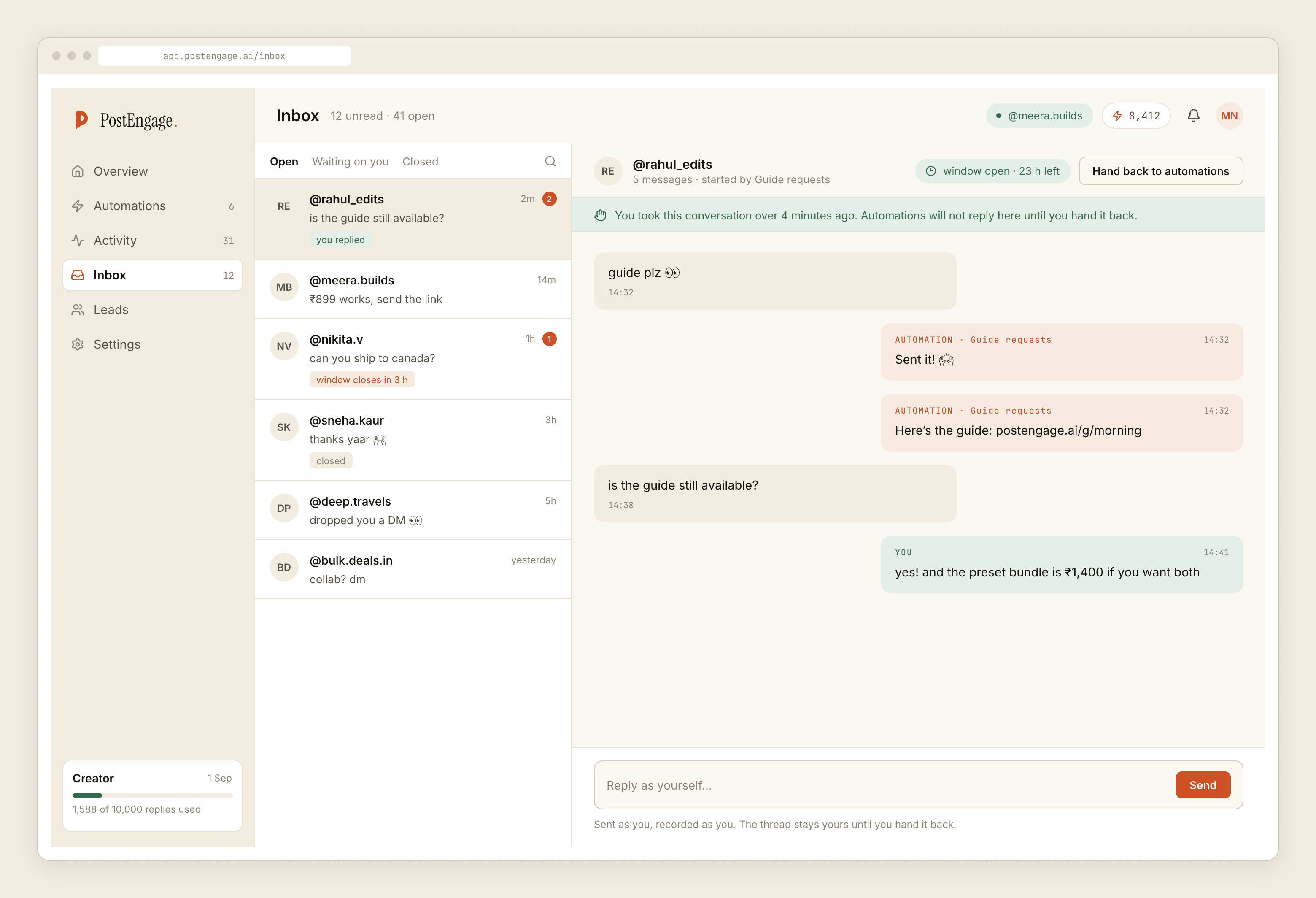
There is also a check that handles this on its own: the moment you reply to a thread by hand, the automation stands down for that conversation and stays down. You do not have to switch anything off to take over.
The clock is the reason triage matters
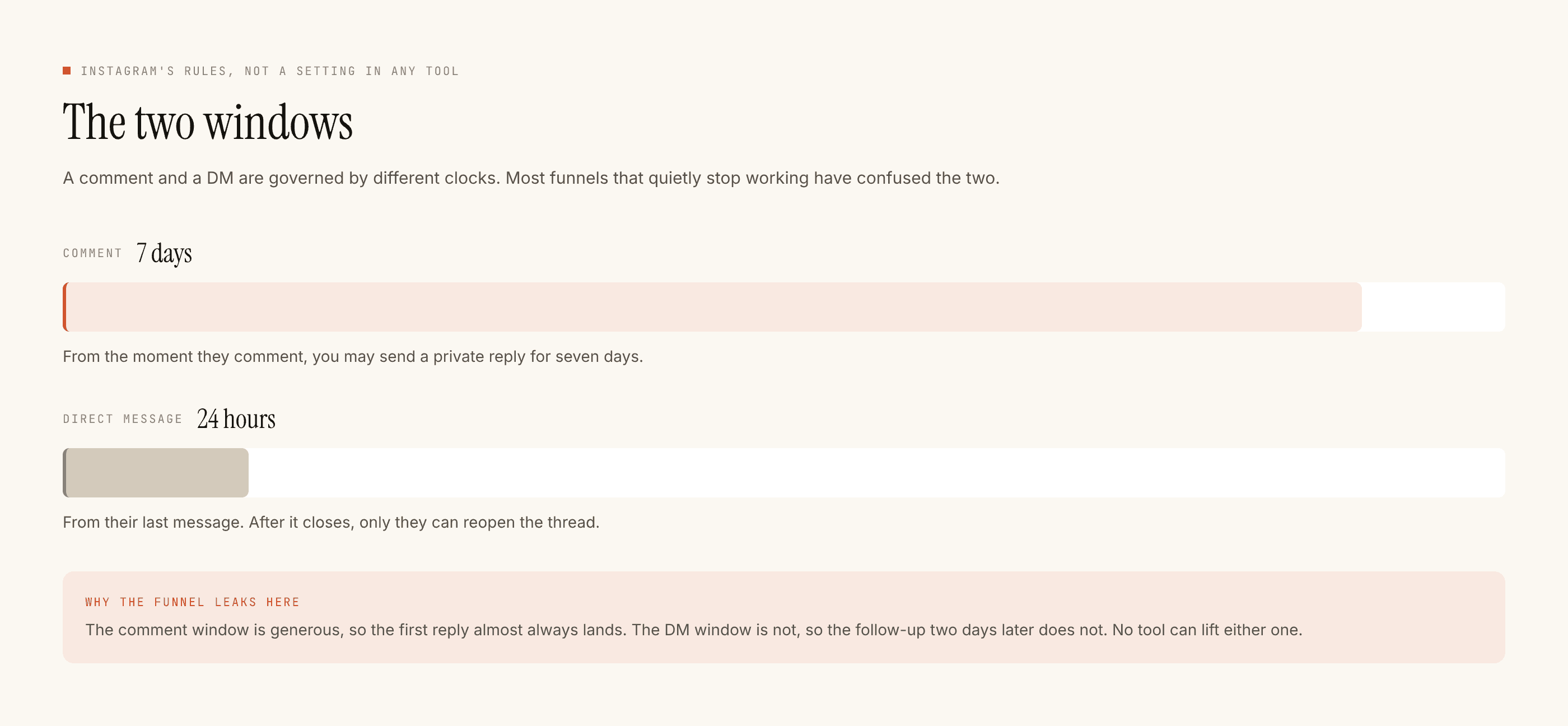
An unsorted inbox is not just unpleasant, it is lossy, because messages expire. You may reply to a direct message for twenty-four hours after their last message, and only another message from them restarts that clock. A comment gives you seven days to open a DM.
So a message you meant to get to on Thursday is not waiting for you on Saturday. It is gone, in the specific sense that the platform will refuse the send.
Read what got stopped, once a week
After a week of running, open Activity and filter to blocked. A healthy list is mostly closed windows and duplicates — those are Instagram's rules and its redelivery behaviour, not faults.
The row worth acting on is a large count of takeovers, which usually means you are answering by hand faster than the automation can, and it should be narrower rather than broader.
What this does not fix
It does not reduce how many people want something from you. It does not make the notifications stop. It removes one specific load — typing an answer you have already typed — and leaves everything else exactly where it was.
That is a real gain and a narrow one, and it is worth being clear about which, because the other kind of drowning is not an inbox problem and no software fixes it.
If you want the build steps rather than the sorting argument, the setup guide is here. If your remaining question is what a good reply should actually say, that is a separate craft.