Product · 5 min read
There Are No VIP Tiers Here. There Is a Lead Record.
On this page
- What actually exists
- The switch is more useful than a tier would be
- Recognition is a person's job, and that is not a limitation
- Using the record to recognise, manually
- What a tier system would have needed, and why it is not there
- What this means for the small business actually reading this
- Cost, and the rest

Say the disappointing part immediately.
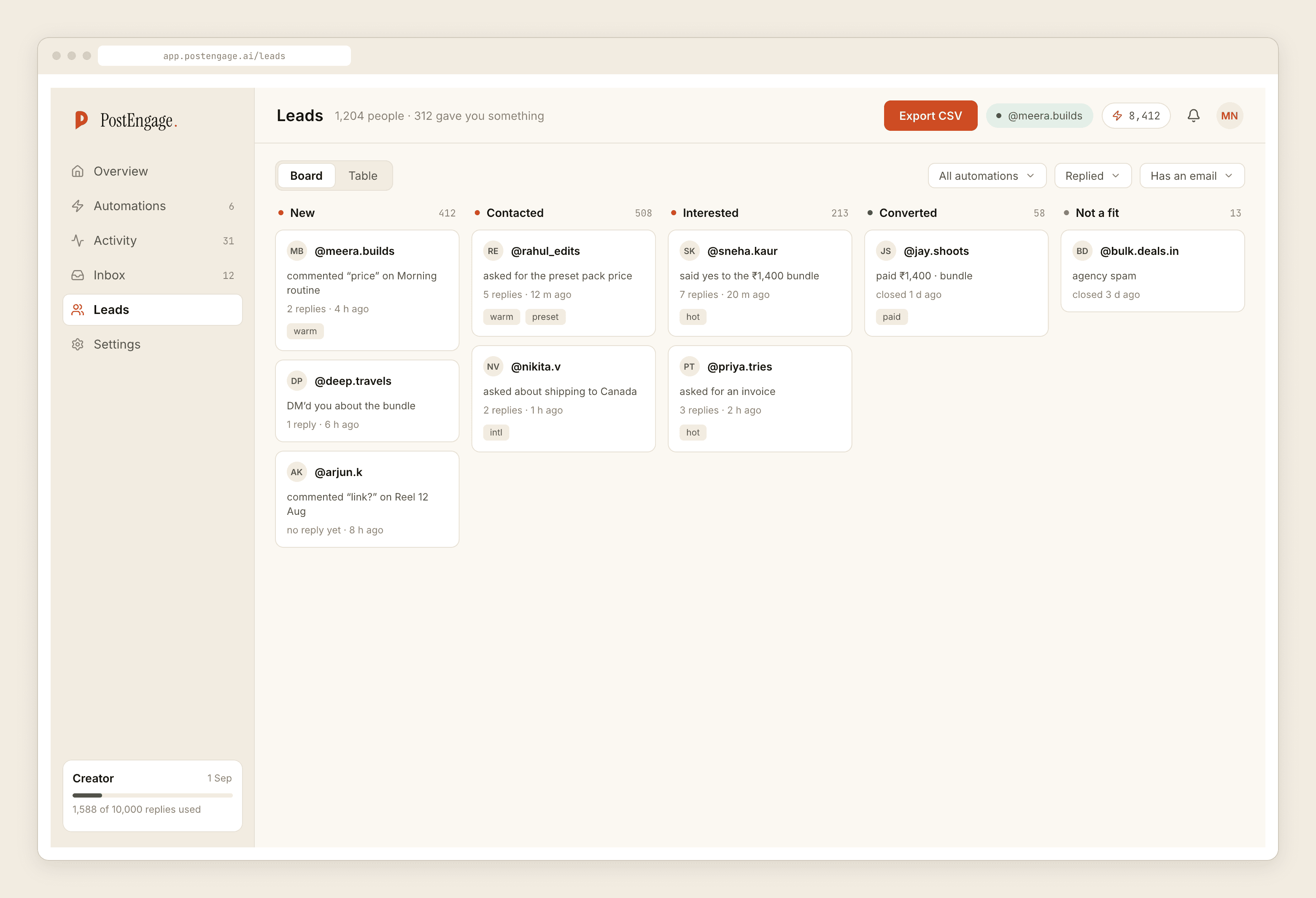
There is no VIP tier in this product. No customer segments, no tags, no lifetime-value field, no loyalty status, no automatic scoring engine that decides who is important. There is no CRM to sync with, no purchase history to read, and no way for an automation to know that the person commenting spent a lot of money with you last year.
If you arrived looking for a tool that treats your best customers differently and automatically, this is not it, and no amount of configuration turns it into it.
What exists is narrower and worth understanding properly, because used well it does more of the actual job than a tier system would.
What actually exists
Three things, and that is the whole inventory.
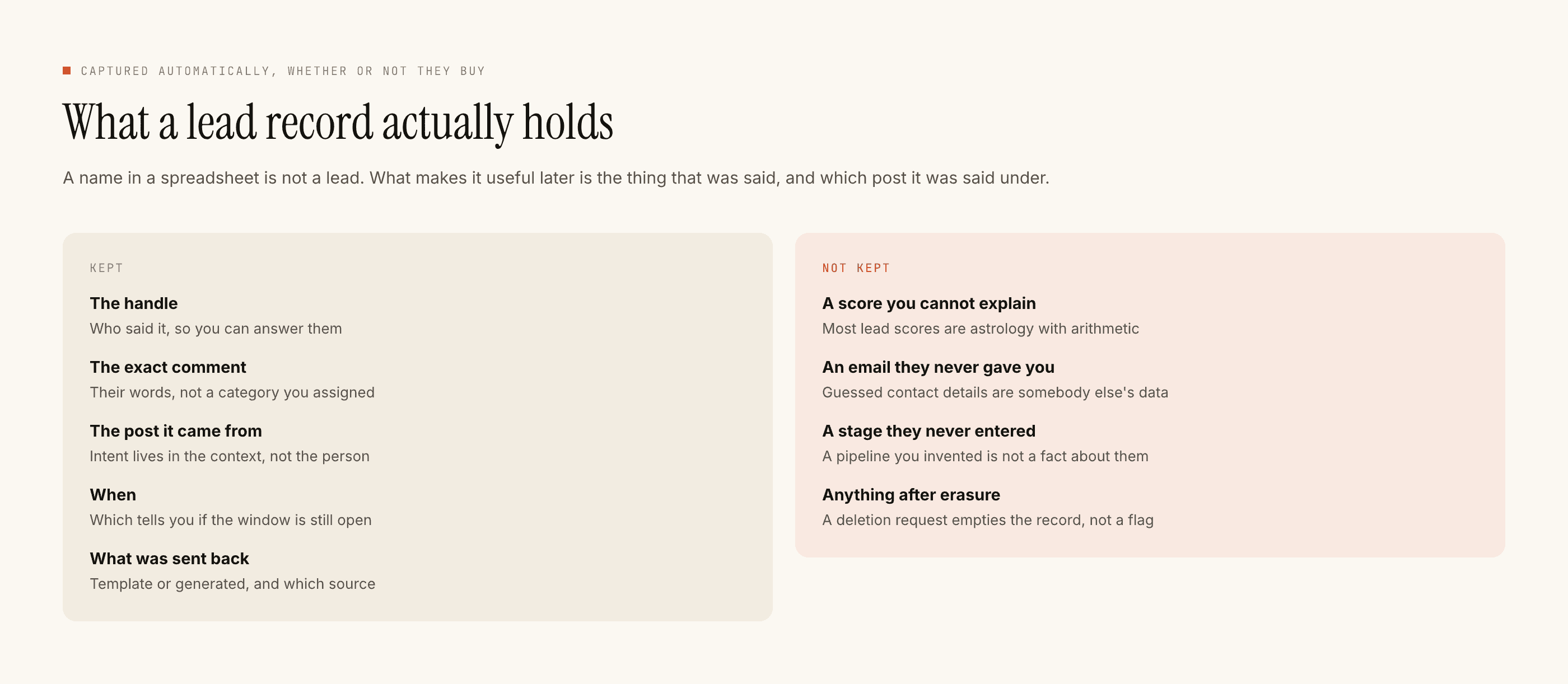
A lead record. A handle, the post the message came from, the words the person typed, and a timestamp. Free text is the interesting field and it is the one everybody ignores.
A first-time-senders-only switch. One binary condition under Advanced: has this person written to you before, or not. That is the only segmentation control in the product.
Takeover. The moment a human replies by hand, automation stands down in that thread permanently.
The switch is more useful than a tier would be
First-time senders only is a blunt instrument and that is its virtue. It answers one question — is this a stranger — and there are two genuinely different ways to use it, which most accounts never think through.
Switched on
Switched off
That single decision, made per automation, does most of what people are hoping a tier system will do. Your best customers stop receiving the introductory template, and the messages that only existing customers send stop being filtered out.
Recognition is a person's job, and that is not a limitation
Here is the part worth arguing rather than just stating.
What makes a regular feel like a regular is that somebody recognised them. Not that a system applied a label. An automated message that says "as one of our valued customers" to somebody it has never met is worse than a plain one, because it is claiming a relationship it does not have, and the recipient knows exactly how the sentence was produced.
Automated recognition is a contradiction. The whole content of being recognised is that a person did it.
So the design that works is the opposite of the one people ask for. Write every automated reply so it is safe and unembarrassing for anyone — a stranger, a first-time buyer, a customer of four years — and then let a human do the recognising in the threads that matter. Takeover exists precisely for that handover, and it is permanent in that thread, so nothing generic lands underneath what you wrote.
Using the record to recognise, manually
The record is thin but it is not useless, and there is a small routine that turns it into something.
- Sort by source post before anything else. Two campaigns produce two different lists, and merging them is how a follow-up references the wrong thing.
- Read the free text. "Third time ordering" and "kitna hai" are two completely different people, and the record already tells you which is which without you asking anything.
- Search the handle against whatever you already have. Your order system, your booking book, your own memory. Nothing here does that lookup — you do, and for a small business it takes seconds and is usually accurate.
- Score by behaviour, not by field. With four fields and no value data, the only honest ranking is what somebody did: replied, asked a second question, gave a number, asked to buy. In that order. Anything more elaborate is a model built on data you do not have.
- Export deliberately. Leads leave as CSV. No CRM sync, no connector. If nobody is named as the person who downloads and works the file, the list is not a list.
What a tier system would have needed, and why it is not there
Worth spelling out so nobody waits for it.
To treat somebody as a VIP automatically you need to know what they have spent, which means reading a shop or a billing system. There is no shop integration here, no order data, no payments, no stock, no purchase history of any kind. The product replies to messages on Instagram through the official Graph API and that is the boundary of what it can see.
Building tiers on the data that does exist — how many times somebody commented — would produce a system that rewards the loudest accounts rather than the best customers, and dresses a guess up as a status. That is worse than nothing, because people act on it.
What this means for the small business actually reading this
Most accounts running automation are one to five people. For them the honest version of VIP management is not a feature at all. It is a rule:
The automation handles the tail. It answers the repeated questions, at any hour, for free, and it never claims to know anybody. Every conversation that matters gets a person, and the person has the context because they read the free text and they remember the customer.
That is a smaller promise than a tier system and it survives contact with reality, which a tier system built on comment counts would not.
Cost, and the rest
Templated replies are free and unlimited. A credit is spent only when the AI writes a new reply, one credit per reply. Free tier is 100 credits, no card; packs start at ₹499.
Official Graph API only: seven days to answer a comment, counted per comment, and twenty-four hours inside a DM thread, restarted only when the person writes again. No sequences, no broadcasts, no way to message anyone who has not written to you first, and no WhatsApp.
If you want the ranking question in more depth, what a hot lead actually is and how scoring behaves with four fields both go further. If you were looking for a CRM connection specifically, that post says plainly what does and does not exist.