Lead generation · 5 min read
Segmentation Without Segments: What a Lead Record Knows

There is no audience segmentation in this product. No personas, no cohorts, no smart lists, no tags applied by a model, no demographic data, no age or gender or city, and no per-segment message sequences — there are no sequences at all. If you came here for a screen where you drag people into buckets, that screen does not exist.
What exists is a lead record, and it happens to carry the one kind of segmentation that is a fact rather than an inference. Most of this post is about why that is the better trade, and the rest is how to actually work it.
What a lead record holds
Six things, and every one of them originated as something a person typed or did.
The handle. Whatever contact detail they wrote into a message themselves. The post the comment came from. The trigger word that matched. The message text. The timestamp.
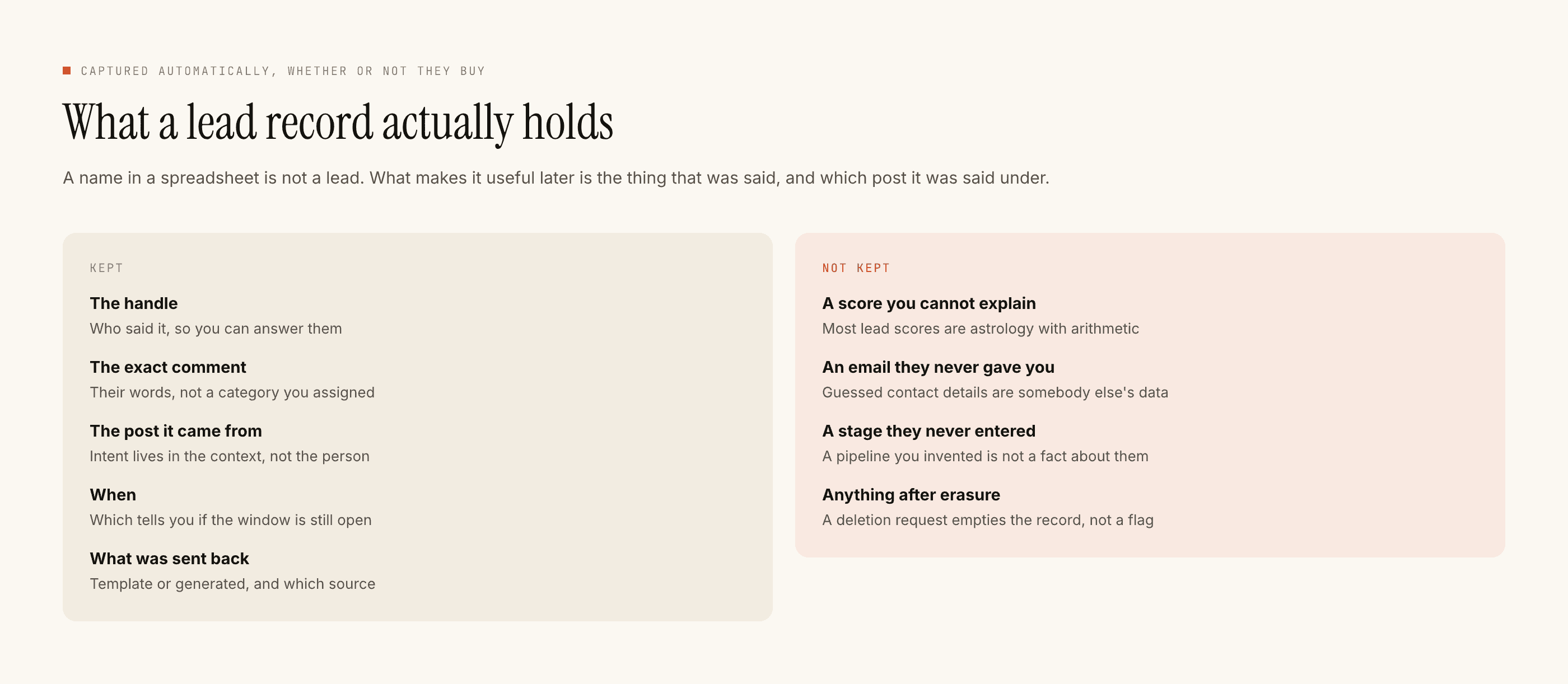
Notice what is absent. No company, no job title, no seniority, no estimated income, no industry. Not because we have not got around to it — because we were never told, and the alternative to being told is guessing, which produces a database that looks richer and is quietly wrong.
Provenance beats profile
Segmentation as the category usually means it is a guess about who somebody is. Provenance is a record of what they did.
Compare the two on the same person. A profile-style segment says: female, twenty-five to thirty-four, metro, likely interested in ethnic wear. Every clause is an inference, and the last one is an inference built on the first three.
The provenance version says: commented PRICE on the bridal set Reel on the fourteenth of September, at eleven at night, and wrote "kitne ka hai, delivery Jaipur ho jayegi?".
One of those tells you what to send. The other tells you what a model thinks about a photograph.
The second version also carries the objection, the city, and the hour they were shopping. It is a segment of one that behaves like a segment, because the next person who does the same thing wants the same answer.
Segment at the trigger, not in the list
This is the actual technique and it is upstream of everything else. If you want labelled leads, do the labelling when the automation fires, by making the trigger word the label.
One automation per intent, rather than one automation with a long keyword list covering several intents. The keyword that matched is stored on the lead, so a narrow automation produces a clean label and a broad one produces mush.
- Split by question, not by product.
PRICE,SIZE,SHIPPING,BULK,WHOLESALE. These are the segments that determine what you say next, which is the only definition of a segment that earns its keep. - Let it cost nothing. Templated replies are free and unlimited, so a sixth automation for a sixth intent adds no cost. There is no reason to cram intents together to save money.
- Keep the labels clean with negative keywords. A
PRICEautomation that also fires on "price zyada hai" is producing a label that means two opposite things. - Scope to specific posts where the post is the segment. Under Advanced you can restrict an automation to particular posts. A bridal collection Reel and a daily-wear carousel produce different buyers, and the source post records that without anyone typing a tag.
- Write Indic keywords exactly as people type them. Matching folds case, punctuation and Latin accents. It does not fold Indic vowel signs —
दामandदमstay different words — so both spellings belong in the list if your audience uses both.
Four groupings the export actually supports
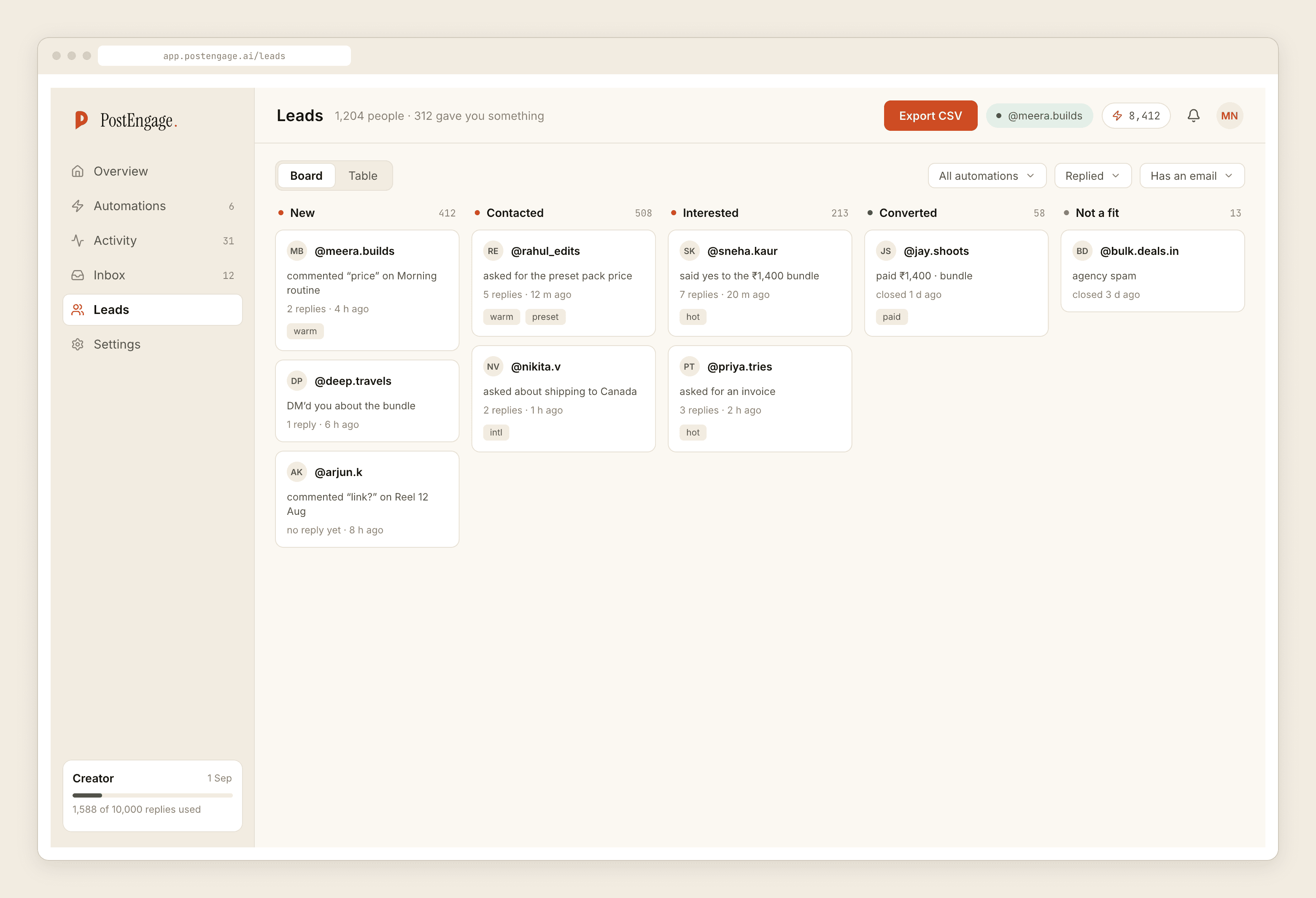
Leads leave as a CSV. No integration pushes them anywhere, so the sorting happens in a spreadsheet, and these four columns are the ones worth sorting on.
By trigger. Which question your audience actually has. This doubles as a merchandising report — the word people type most is the thing they most want to know, and it is frequently not the thing your caption was about.
By source post. Which piece of content produces people who follow through, rather than people who react. A Reel with a huge comment count and four leads and a carousel with sixty comments and thirty leads are telling you two different things about your audience.
By recency. This is the one people forget and it is operational, not analytical. The DM window is twenty-four hours from their last message and comments age out at seven days. A lead from three weeks ago cannot be messaged through the automation at all, so the top of a recency sort is the only part of the list that is live.
By whether they answered. Split the list in two: threads where the person replied to you, and threads where they did not. The first group is a genuinely different audience and it is small enough to work by hand.
Where this runs out
Honestly: it runs out fast if you want lifecycle marketing. There is no way to say "everyone who asked about shipping in March and has not bought, send them this". Nothing here sends to a group, because nothing here broadcasts, and outside the twenty-four hour window there is no permission to message anyway.
What you have is a well-labelled list of people who raised a hand recently, exported to a file, with the question they asked attached. If that list is getting long enough that reading it is a chore, sorting it by intent is the next problem rather than the first one, and what the CSV handoff can and cannot do is worth knowing before you plan a workflow around it. The upstream half — getting the trigger word right so the label means something — is covered separately.