Playbooks · 5 min read
Tutors: Two People Message You, and They Want Different Replies

"Do you take class 11 physics?"
Two people send that message. One is a parent comparing three tutors, worried about a board year, who wants to know your background, your batch size, where you teach and what it costs. The other is a sixteen-year-old who wants to know if you explain rotational motion properly and whether the batch is at a time that does not collide with football.
Same eight words. Completely different replies. And your automation has no idea which one it is talking to.
The sender is the fact you are missing
Every other vertical on this blog knows roughly who is writing. A salon gets customers, a producer gets artists. A tutor gets a buyer and a user, and they are not the same person, and the one who is going to sit in your class is usually not the one paying.
You cannot solve this reliably, but you can get most of the way with vocabulary, because the two of them do not write alike:
Almost always a parent
Almost always the student
Two automations, two vocabularies, two registers. The parent's reply is about credibility and logistics. The student's reply is about the subject and the timetable. Neither should receive the other's paragraph — a parent who gets a chatty message about how fun integration is will not book, and a student who gets a formal note about fee structures will not reply at all.
Write the parent's template as though a person is deciding whether to trust you. Write the student's as though a person is deciding whether to be bored.
Never quote a result, and never promise one
This is the hard rule for tuition and it has two halves.
Do not put anybody's marks in a template. A specific score belonging to a specific student is that student's information, and an automation is a very efficient way of sending it to several hundred strangers who did not ask. Even with permission, a name and a number sitting in a template months later, still going out, is not what anyone agreed to. Talk about results the way you would in a room: as something you will discuss, not something the account announces.
Do not promise an outcome. No rank, no percentage of a mark, no "your child will improve", no "selection guaranteed", not hedged, not softened. An automated promise made to a stranger about a child you have never taught is a claim you will be asked about in April by a parent holding a screenshot.
Exam season is a spike with a very short fuse
Tuition demand is not flat. It arrives in walls — results week, admission season, the fortnight before boards, the month a new session starts — and in between it is quiet.
Two settings matter during a wall.
Rate budget. A reel that does well during admission season can fill a comment section faster than any other content you post all year. Cap it. A comment stays answerable for seven days, which is longer than the spike, so the queue drains inside the window and nothing is lost. Uncapped, the same volume is how a legitimate account starts looking like spam.
Quiet hours, thought about honestly. Students message at midnight, especially the night before a test. Parents message at 7am. A single 9pm-to-8am window silences your account across both edges of your actual demand. And the DM window is twenty-four hours from their last message, restarted only when they write again — a student who asks at 11:40pm and is in school all the next day may be out of reach before you open the app.
You are frequently talking to a minor
Worth saying plainly, because tuition is one of the few verticals here where it is routinely true.
Keep the automated side of a student conversation to logistics: subjects, batch times, where the class is, what the syllabus covers, how to get in touch. Do not have templates asking a student for personal details, an address, or a phone number. Anything commercial — fees, enrolment, payment, home visits — should route to a parent or guardian, and the template should say so rather than negotiate.
And be careful with photographs. Students send pictures of homework and question papers and, sometimes, of themselves. A keyword matcher sees an attachment with no text and fires whatever automation was closest, which is not a reply you want landing under a child's photo. For automations likely to attract images, prefer a public comment reply that invites a thread a human will read.
What is safe, and what it costs
The reliable volume: subjects and boards you teach, batch timings, group versus one-to-one, online or in person, where you are, whether there is a demo class, what a session covers, whether notes are provided, how many students in a batch, your background.
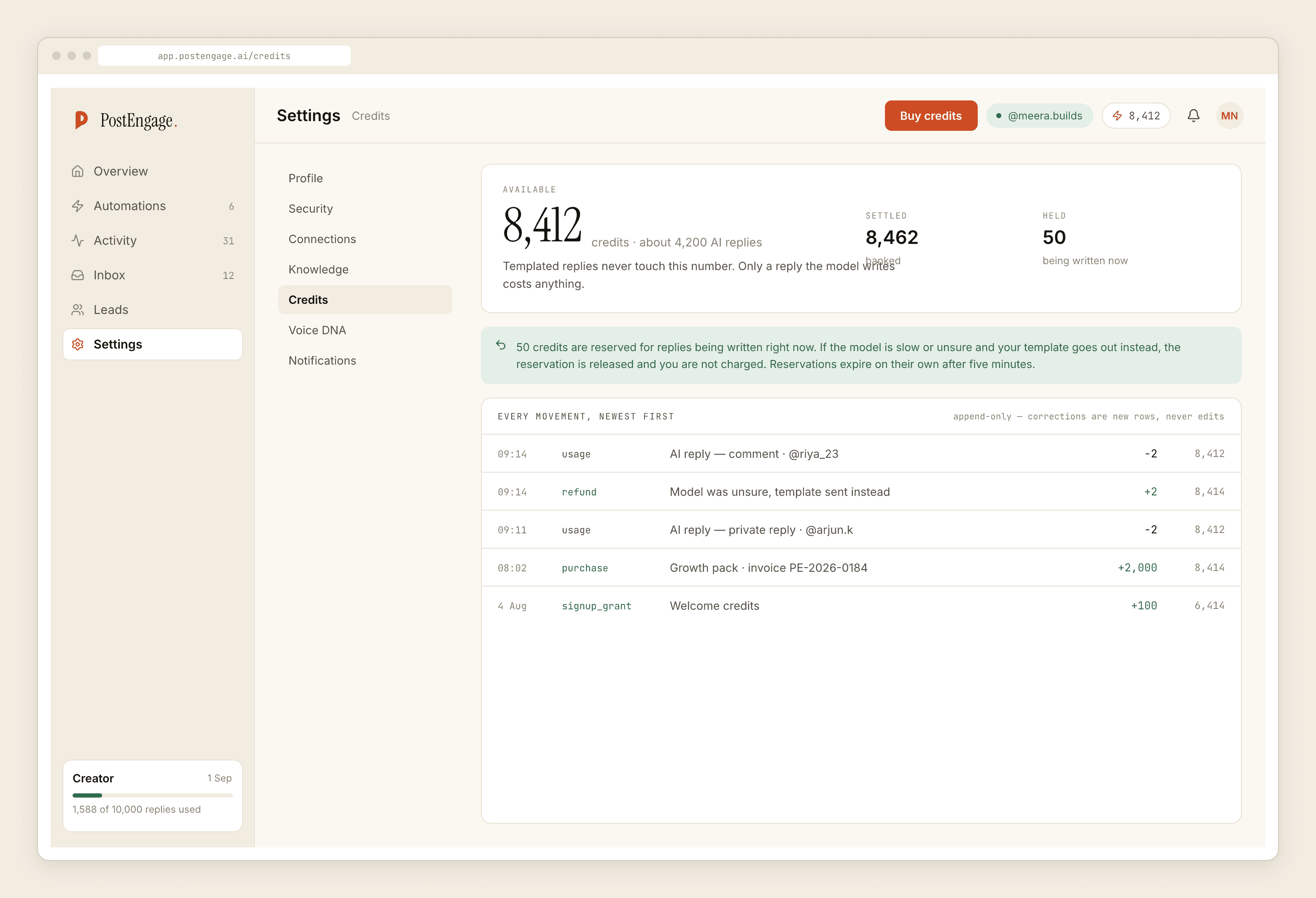
All fixed information, all templates, and templated replies are free and unlimited — a credit is spent only when the AI writes a new reply. For a tutor that means the admission-season flood costs nothing however loud it gets, and the credits go on the odd message that is genuinely unlike the others. Free tier is 100 credits, no card; packs start at ₹499.
Official Graph API only. It cannot enrol anybody, take a fee, hold a seat, or message someone who has not messaged you first. It does not post, schedule or caption. It does not do WhatsApp, and leads export as a CSV that somebody has to actually open.
Build the two sender templates first, then the outcome stop list, then read what got blocked after one week of a busy season. The broader version of this for institutions is in the education post.