Compliance · 5 min read
Spa and Wellness DMs: Never Automate a Health Claim

"Kya ye back pain ke liye theek rahega?"
That message will look, to whoever is writing your automation, like a service enquiry. Somebody is asking about a treatment. The obvious template says yes, describes the massage, and routes them to the desk.
It is not a service enquiry. It is a question about whether a treatment will help a medical condition, asked by a person you have never met, and the moment your account answers it in the affirmative you have made a health claim on Instagram about a stranger's back.
That is the whole subject of this post, because a spa inbox is unusually full of these and they are unusually easy to miss.
Two things a wellness automation must never send
A health benefit claim. Not for a condition the sender names, and not in general. "Helps with anxiety." "Good for PCOS." "Detoxes the system." "Boosts immunity." "Relieves sciatica." Whether or not you believe them, these are therapeutic claims, and what a business may claim about a treatment's effects is regulated — differently in different jurisdictions, and often more tightly than the people writing wellness captions realise.
Clearance for a treatment. "Is it safe if I'm pregnant?" "I had surgery last month, can I still do the steam?" "I'm diabetic, is the foot treatment okay?" "I'm on blood pressure medication." Every one of those is a person asking to be cleared, and clearing someone is a judgement made with a history in front of you. A template does not have a history in front of it. It has a sentence.
The difference between a service question and a health question is not the wording. It is what happens if the answer is wrong.
Both go into negative keywords, which stops the automated reply going out at all and puts the thread in front of a person. Build that list before you build the first automation: pain, injury, pregnant, pregnancy, surgery, operation, diabetes, BP, blood pressure, thyroid, PCOS, allergy, skin condition, medication, cure, treat, heal, detox, immunity, plus the local vocabulary your clients actually type.
Describe the treatment, not the outcome
Here is the practical line that lets you write useful templates without walking into the problem.
Describing the treatment is fine. How long it takes. What actually happens in the room. Which oils or products are used. Whether it is dry or wet. Whether you shower afterwards. What to wear, how early to arrive, whether the room is shared. All of it is a factual description of a service you sell, and none of it asserts an effect on a body.
Describing the outcome is where the trouble is. The moment a template contains a verb like relieves, cures, heals, corrects, balances, boosts or detoxifies, it has stopped describing a service and started making a claim.
Run that test over your existing templates and you will usually find one or two offenders, because the wording was copied out of a caption. Marketing copy and an automated reply are not the same artefact: a caption is a general statement to an audience, and a DM reply is a specific statement to a named individual who just told you what is wrong with them.
Preferences you route, not decisions you make
Spas get a category of request that other businesses do not: therapist gender preference, a request for a quieter room, a couple wanting adjacent tables, someone who wants a female therapist for a specific treatment only.
These are fine to capture and route. They are not fine to confirm, because confirming means knowing who is rostered on Thursday afternoon, and there is no calendar integration here — nothing in this product can see your schedule or your staff roster.
So the honest reply captures the preference, states that it is noted, and routes to whoever actually builds the rota. The lead record carries the detail so the desk is not starting the conversation from zero.
What is left, and it is a lot
Strip out the health questions and the availability questions and a spa inbox is still mostly automatable, because most of what remains is fixed:
Where you are and where to park. Hours, and whether the last appointment is earlier than closing. Whether you take walk-ins. What a package includes and how long the whole thing runs. Whether men, women or couples are accommodated, and in which areas. Whether showers, lockers and towels are provided. Gift vouchers — how to buy one, how long it is valid. Whether children are allowed. Whether you do groups or bridal parties.
All fixed, all asked constantly, all templates. Templated replies are free and unlimited, and a credit is spent only when the AI writes a new reply.
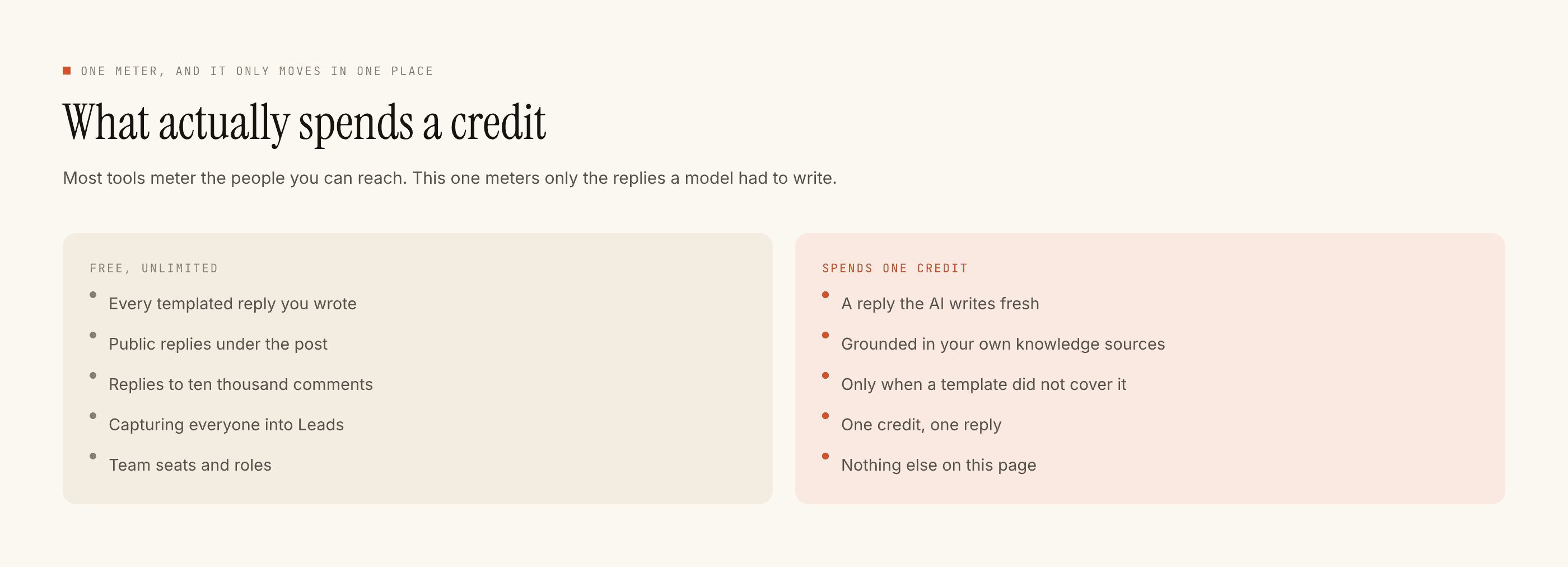
The free tier is 100 credits with no card and packs start at ₹499. A spa running the build above rarely gets near a pack, and if it is burning credits that usually means the automation is generating answers to questions it should be refusing.
Two settings and one honest limit
Takeover. The moment anyone at the desk replies by hand, automation is out of that thread permanently. In a spa this matters because staff dip in and out between clients, and a template landing forty seconds after a warm human reply reads as though nobody is home.
Rate budget. A treatment reel can travel a long way. A cap turns a spike into a queue rather than into something that looks like spam.
And the limit: no booking. Nothing here can see, hold or confirm a slot. What a booking automation can honestly do is qualify and route, which is a specific design problem worth its own post. The economics of running this on a small appointment business are laid out in the salon post.
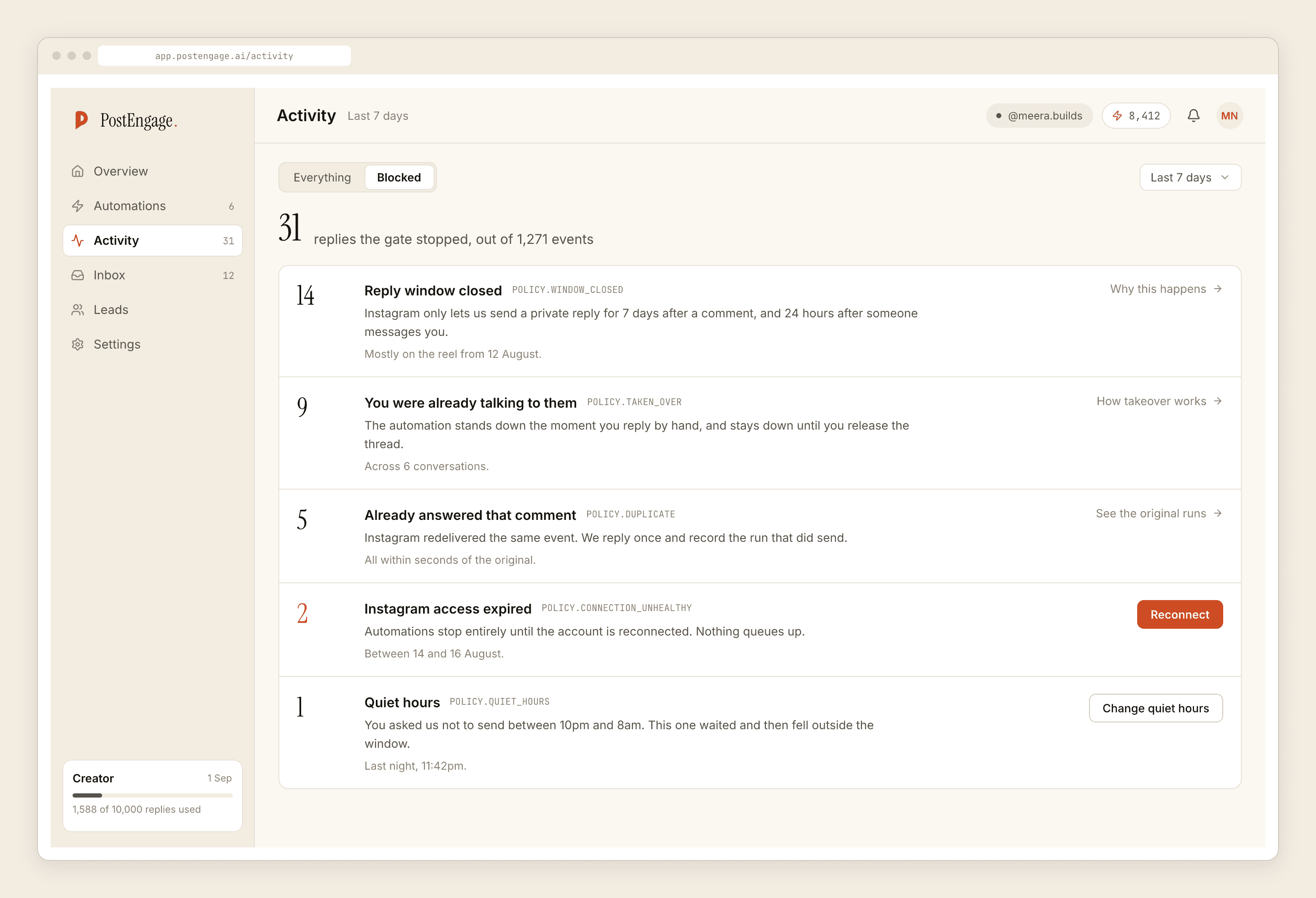
It cannot message anyone who has not messaged you first. It does not do WhatsApp. Official Graph API only: seven days on a comment, twenty-four hours in a DM thread, restarted only by their message.