Playbooks · 5 min read
Spas on WhatsApp: The Words That Turn Into Health Claims

A spa's inbox is mostly four messages: what do you charge, are you free on Saturday, where exactly are you, and do you have a female therapist. All four are answerable and the last one matters more than it looks.
Underneath them sits a category of message that reads like a service question and is not one, and it is the reason this post is not a list of booking tips.
Never let a template make a health claim
Wellness has a vocabulary it uses without thinking. Detox. Healing. Therapeutic. Rejuvenating. Immunity. Stress relief. Pain relief. Slimming. Toxins.
On a poster those words are atmosphere. In an automated reply they become something else, because the reply is a direct answer to a named person who asked about their own body. "Will this help my back pain?" answered with "yes, our deep tissue therapy relieves back pain" is a health claim made to an individual by a machine, and it will be read as a professional opinion by somebody who may be putting off seeing a doctor.
It gets worse when the AI writes the sentence rather than a human, because generated text is fluent and specific and will happily produce a mechanism — something about circulation or lymph or inflammation — that nobody at the spa would have written down.
We are not in a position to tell you what claims are permitted where you operate — advertising and health-claim rules differ by jurisdiction and change, and that question belongs with your own advisers before it belongs in a template. Nothing here is medical advice.
The intake questions belong to a person
Spas ask about health before a treatment for a reason: pregnancy, recent surgery, blood pressure, skin conditions and injuries all change what is safe to do.
That conversation should not be automated in either direction. Asking a list of health questions by bot produces a store of health information in a chat thread that four staff members can open. Answering one produces a judgement about safety made by software.
Collect what you need on paper or in a form at the spa, keep it with whoever needs it, and let the automation say only that a therapist will go through a short health check before the session.
A spa can automate the calendar. It cannot automate the question of whether a treatment is safe for the person asking.
The enquiry that is not an enquiry
Every spa in India knows this one, and it never appears in articles about automation.
A share of incoming messages are not from prospective clients. They are people asking, in varying degrees of coded language, for services the spa does not offer. Some are crude, some are careful, and they arrive at all hours.
An automated system will answer them cheerfully, because it has no idea. A warm, professional reply with a price list attached under that kind of message is exactly the thing that gets screenshotted and shared with a caption, and it damages a legitimate business badly.
The practical handling: build a stop list from the actual language you receive, route it to nothing at all rather than to a polite decline, and let a person decide whether to block. The other half of the same problem is why "do you have a female therapist" needs a clear, factual, published answer — it is a safety question, and a vague reply reads as evasion.
What is genuinely worth automating
Automate
Person
Confirming the slot deserves the same treatment as any other diary business: the automation captures the request and a person confirms it, because the appointment book is not something a keyword rule can see. A client arriving for a 6pm that was never booked is worse than a client who waited twenty minutes for a confirmation.
Tone is the product, and it survives poorly
Spas sell calm, and then answer messages in the voice of a courier notification.
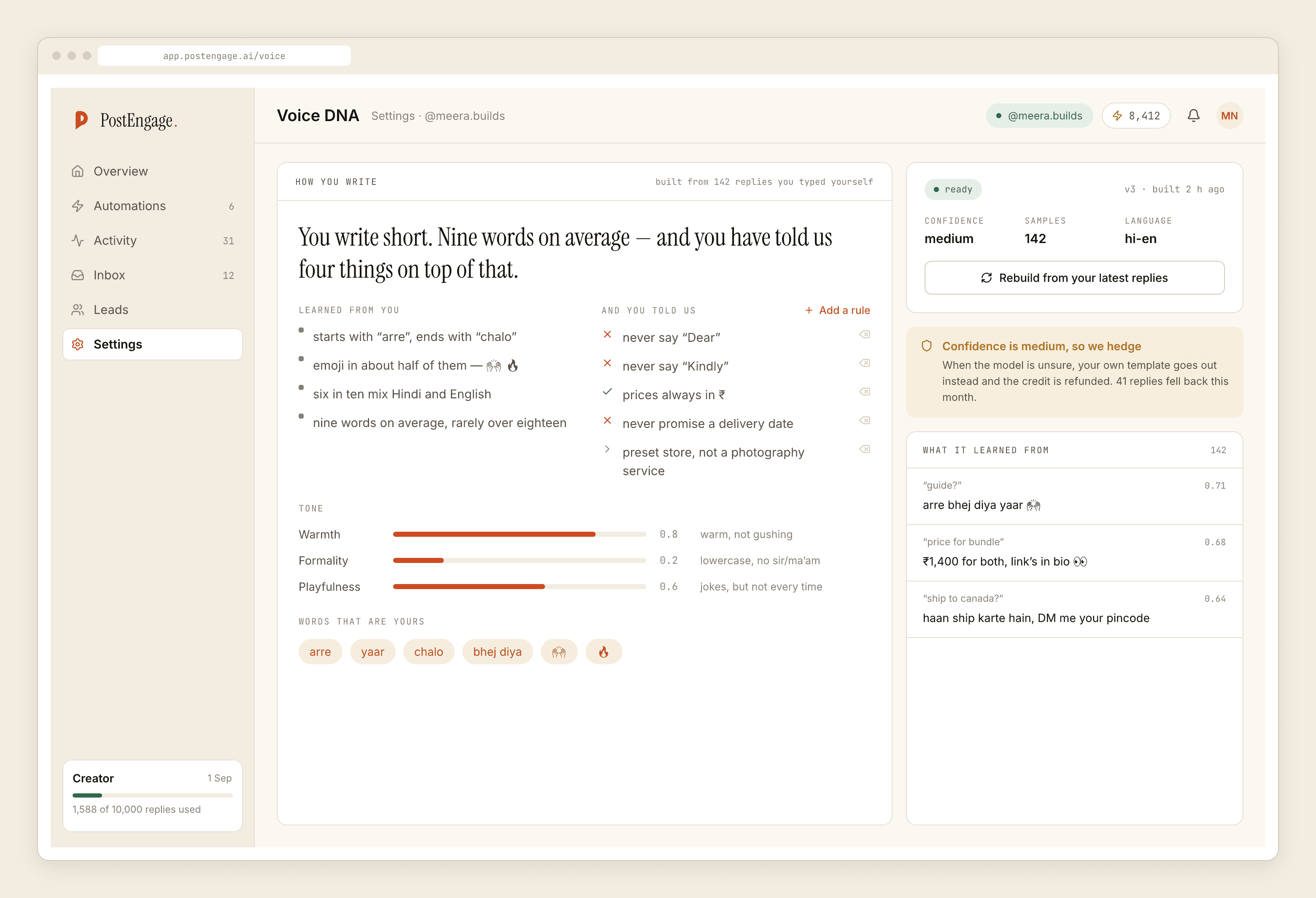
The gap is visible on messaging because your sentence sits in the same font as the client's friends. If you use AI to write replies at all, build the voice from replies your own staff actually wrote, keep it on the enquiry half, and keep it out of anything operational — nobody wants warmth attached to a cancellation.
What we run today
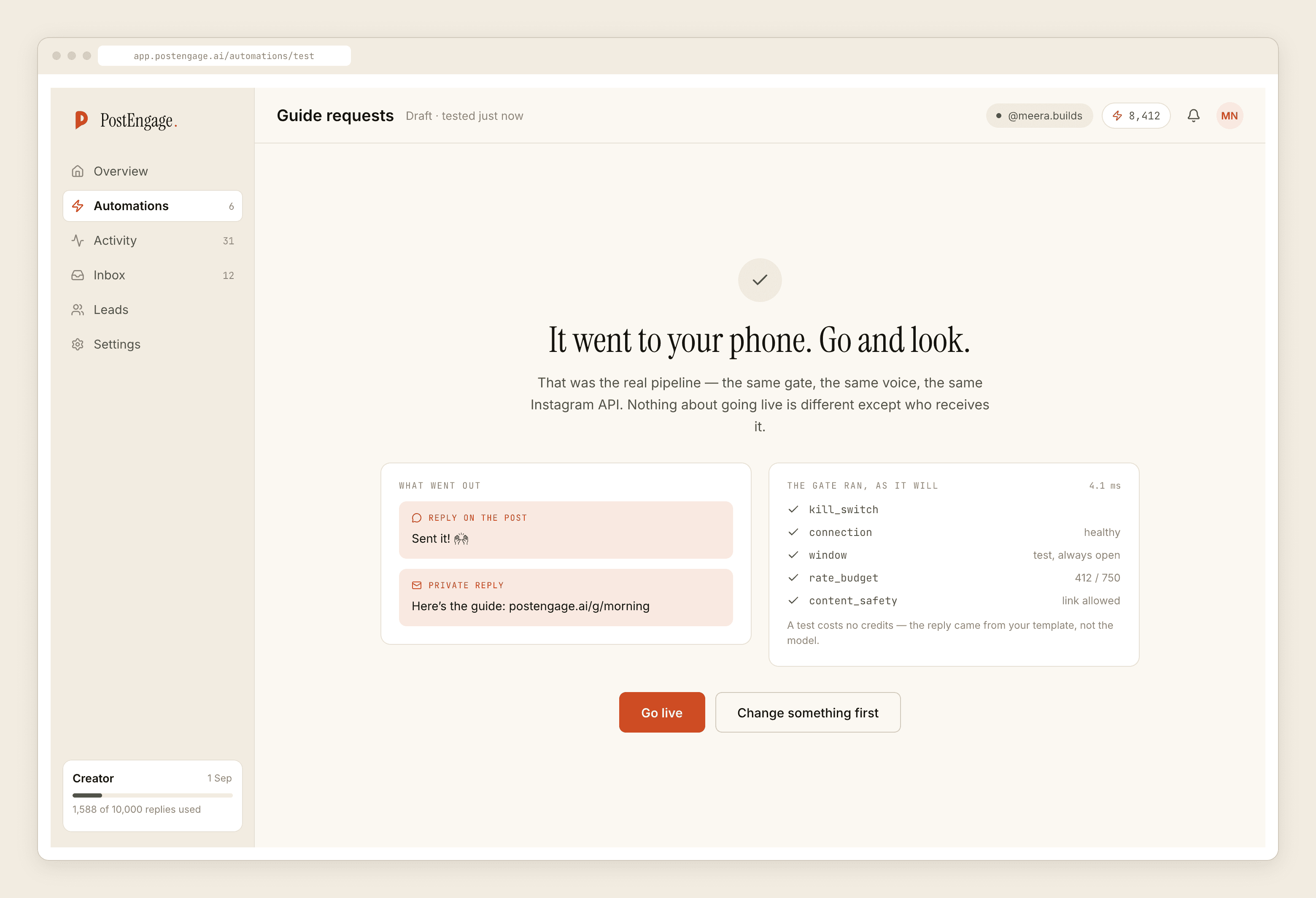
PostEngage answers Instagram comments and DMs on the official Graph API, and that is the entire product. There is no WhatsApp in it. This post is about the channel because spas search for it and the honest description is more useful than a pitch.
Instagram is where most spa enquiries begin anyway. There the clocks are fixed: a comment stays answerable for seven days, a DM thread for twenty-four hours, restarted only by the client's own next message. Templated replies are free and unlimited — a credit is spent only when the AI writes new text — so answering "timings kya hai" three hundred times costs nothing. The free tier is 100 credits with no card, and packs start at ₹499.
Related: spa and wellness on Instagram, beauty salons on this channel, and appointment booking done honestly.