Compliance · 6 min read
Wellness Brands on Instagram: Automate the Commerce, Not the Care
On this page
- Why a brand's inbox is harder than a clinic's
- Rule one, which is absolute
- Rule two: never automate a health claim
- Publish your own crisis route, where nothing has to fire
- What is honestly automatable, and it is a decent list
- The public reply, and why it is worse for a brand
- The build, briefly
- The honest ending

This post is about brands: a journaling app, a meditation studio, a sleep-supplement label, a wellness D2C line, an app that sends you breathing exercises. Commercial accounts selling something in the mental health and wellness space.
It is deliberately not about clinical practice. The therapists post owns that case and it is more thorough than anything here would be, so if you are a practitioner, read that one instead.
The reason the two are separate is not that a brand's situation is milder. In one specific respect it is worse, and that is where this starts.
Why a brand's inbox is harder than a clinic's
Someone messaging a therapy practice knows they are messaging a therapy practice. They have a model of what that account is, who staffs it, and roughly what will happen next.
Someone messaging your brand has no such model. They arrived through a reel about feeling overwhelmed at work. The reel was warm and it sounded like it understood them, because that is what good marketing in this category does. Nothing on the way in told them that the account is run by a two-person growth team, that nobody there is a clinician, and that the reply they are about to receive was written in advance.
So the register of your content invites disclosure, and your inbox will contain things a marketing template must never answer.
Your content is doing the work of a confidant. Your inbox is staffed like a shop. That gap is the whole risk.
Rule one, which is absolute
Never automate a reply to anyone in distress. Not a warm one. Not a signposting one. Not a carefully worded one that a copywriter and a founder both approved.
When such a message arrives, the only correct behaviour is that the automation stays out of the way and a person sees it. A reply that lands in four seconds does not read as efficiency. It reads as: this went somewhere nobody was.
A negative keyword list is necessary here and not sufficient, and you should know why before relying on it. Distress does not arrive in the vocabulary a filter expects. It arrives as four lowercase words, in Hinglish, in metaphor, as a reply to a post about something else. The blocklist catches the messages that name the thing, and those are not the only ones.
So the posture inverts: build automations that reply to nothing except a short list of situations you decided in advance were safe.
Rule two: never automate a health claim
A template is a claim made at scale, in identical words, to everyone who typed a keyword, with a timestamp on each one.
"Helps with anxiety." "Reduces stress." "Improves sleep." "Clinically proven." Those are health claims, and a health claim in a DM is still a health claim. Putting one in an automated reply means you have made it to everyone who typed the keyword, and you cannot recall a single instance of it.
What your category may claim depends on your product type, your market and your regulator, and the wording is decided by whoever handles your compliance — not by whoever is filling in the reply field on a Tuesday. Some categories cannot make efficacy claims at all.
Publish your own crisis route, where nothing has to fire
Your brand needs a visible, current route for someone who needs help now, and it must work when the automation is off, out of window, or blocked by a check. So it lives in the bio, in a pinned post, and on your site — not inside a reply.
This post will not print any numbers. Crisis services are national, they change, and a stale number is worse than no number. Whoever runs the brand picks the services relevant to the countries you sell into, writes them down, and re-checks them twice a year.
Say plainly, in the same place, that your Instagram is not monitored continuously and is not a route for urgent help. Say it where somebody reads it before they write, not in a reply afterwards.
What is honestly automatable, and it is a decent list
The automatable part of a wellness brand is the commerce part.
Where to buy. What is in the box. Shipping times. The ingredient list exactly as printed on the label, with no interpretation attached. How to cancel a subscription. Class timings and how to book. The refund policy. Which plan includes what.
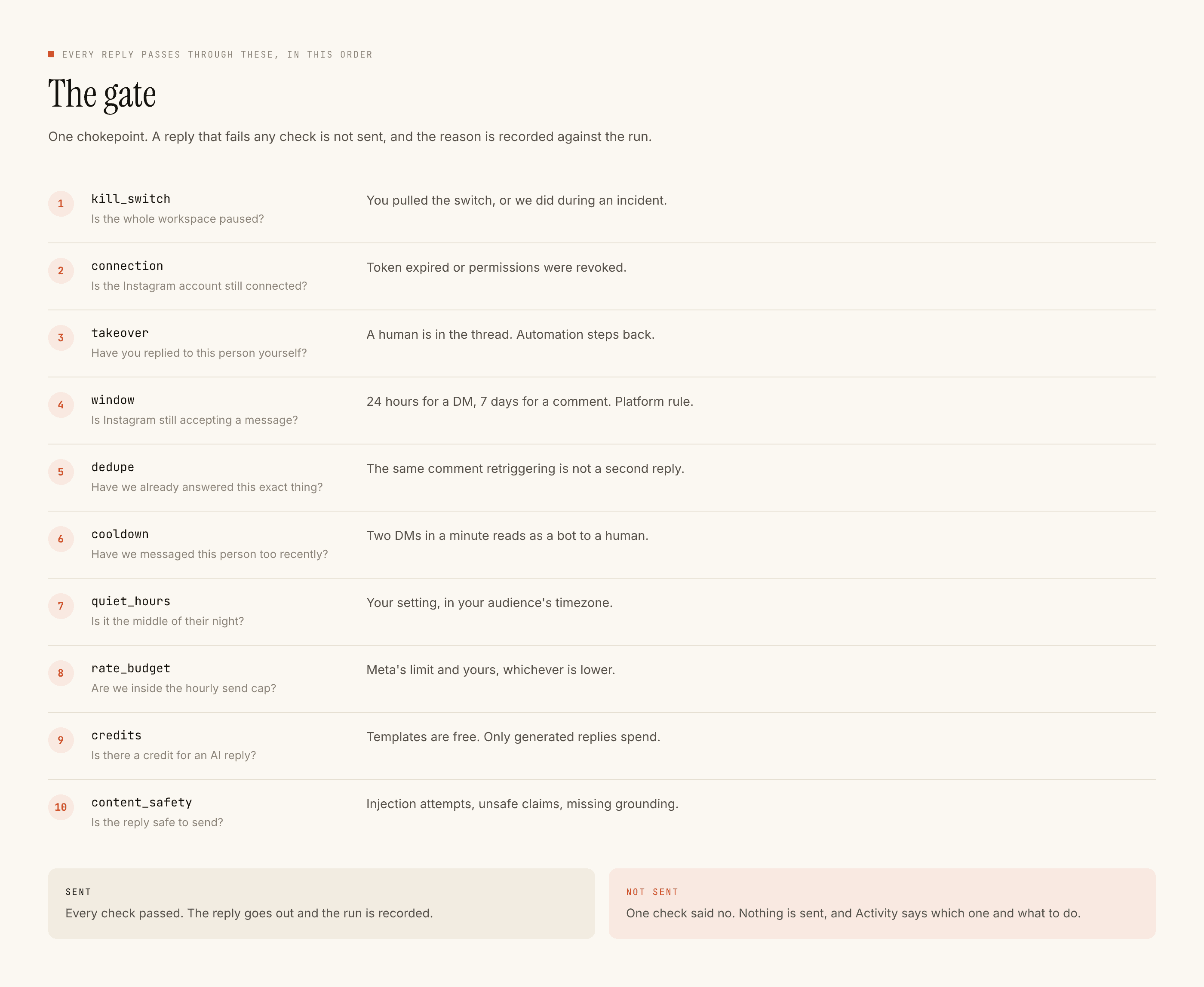
That is a real chunk of your volume, it repeats, and the answers are stable. Templated replies are free and unlimited, so absorbing it costs nothing per message.
The public reply, and why it is worse for a brand
A comment automation posts in public. Under a post about burnout, a reply addressed to somebody by name associates that person with the subject in front of everyone who follows them.
For a brand there is a second layer: the public reply is also marketing. A promotional line under a comment where someone just said something personal will be screenshotted before you can delete it.
Keep the public reply completely generic, or leave it empty.
The build, briefly
- Scope every automation to specific posts. The product post, the shipping FAQ post. Never account-wide, and never on the posts that invite disclosure.
- Trigger on a word you asked for in the caption. Typed on purpose, not caught by accident.
- Route everything else to silence and a person. A message that matches nothing gets no automated reply. That is the correct outcome, not a coverage gap.
- Use the review queue as the default state. Anything the system is not confident about waits for a human.
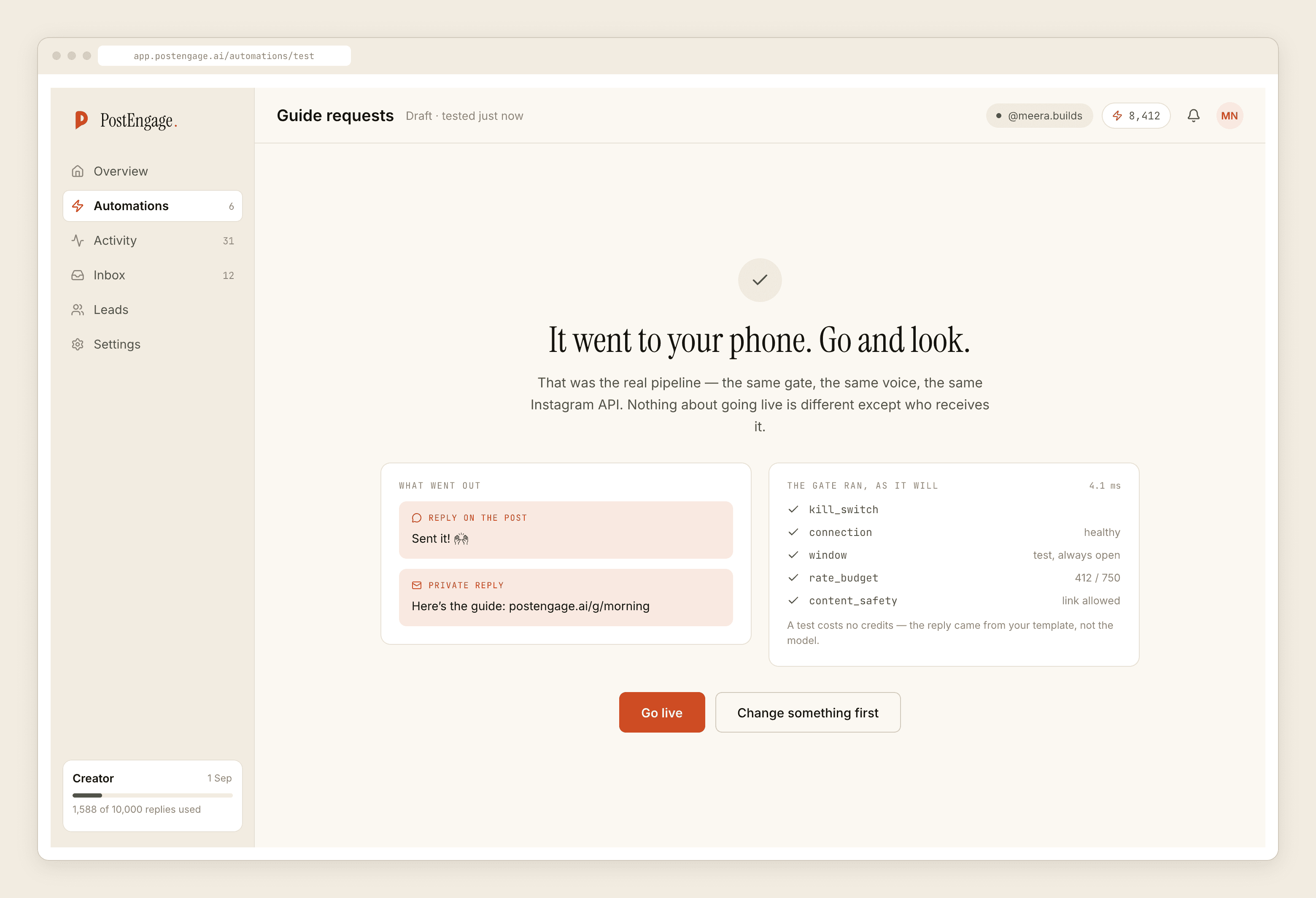
- Test on yourself before anything goes live. The full pipeline runs and delivers to your own account, so you read the tone as your audience would.
The honest ending
Takeover means the moment anyone replies by hand, automation stands down in that thread permanently. Use it constantly.
No CRM sync — leads export as a CSV. No WhatsApp. No scheduling, publishing, sequences or broadcasts. Nothing here can message someone who has not messaged first. Official Graph API only: seven days on a comment, twenty-four hours in a DM thread, restarted only by their message. That window is a platform constraint and it should never set the pace at which your team responds to a person.
Templated replies are free and unlimited; a credit moves only when the AI writes something new. Free tier is 100 credits with no card, packs from ₹499. Cost is not the deciding factor on this kind of account and pretending otherwise would be the wrong note.
Running no automation is a legitimate configuration. The checks and the spa and wellness centre version are both worth reading before you decide.