Playbooks · 6 min read
Nutritionists: The Inbox Where Advice Is Never Automatic

Most verticals have a small dangerous corner of the inbox and a large safe majority. A nutritionist's inbox is the other way round.
The messages arriving are questions you personally are qualified to answer, from people who found you because you answer them well, phrased in a way that makes answering feel not just safe but generous. That is what makes this the hardest inbox on this blog to automate, and the one where a single automatic reply does the most damage.
The line, stated once and without hedging
No automated reply from a nutrition account should ever contain advice. Not a food to eat, not a food to avoid, not a portion, not a timing, not a swap, not a supplement, not a "generally speaking."
Not a softened version with a disclaimer underneath. The disclaimer does not travel with the screenshot, and it does not change what the person did on Tuesday because your account told them to.
The reason is structural, not squeamish. Advice is only advice when it is attached to a person — their history, their bloodwork, their medication, whether they are pregnant, what they can afford, what their family eats. An automated reply has none of that and cannot ask for it in a way that means anything. What it has is a keyword and a very fluent way of writing sentences that sound like they came from you.
The confident, generic answer is the failure mode. It reads exactly like expertise and contains none.
The one-line diet question is the trap
"Can I eat rice at night?" "Is ghee good or bad?" "Kya breakfast skip karna theek hai?" "How much protein should I have?"
These are the highest-volume messages you get, and they are the ones that feel most obviously automatable. They are short. They have a common answer. You have said the answer in eleven reels.
They are still not automatable, because the correct answer to every one of them is "it depends on you", and an automation that says "it depends on you" three hundred times is fine — while an automation that ever says "yes, rice at night is fine for most people" has issued dietary advice to somebody with a condition you were not told about.
Write the template so it can never be wrong: acknowledge the question, say that the answer depends on things you would need to know, and offer the real route — a consultation, a call, a form. That is a reply you can send at 2am forever.
Symptoms and disordered eating: stop, always
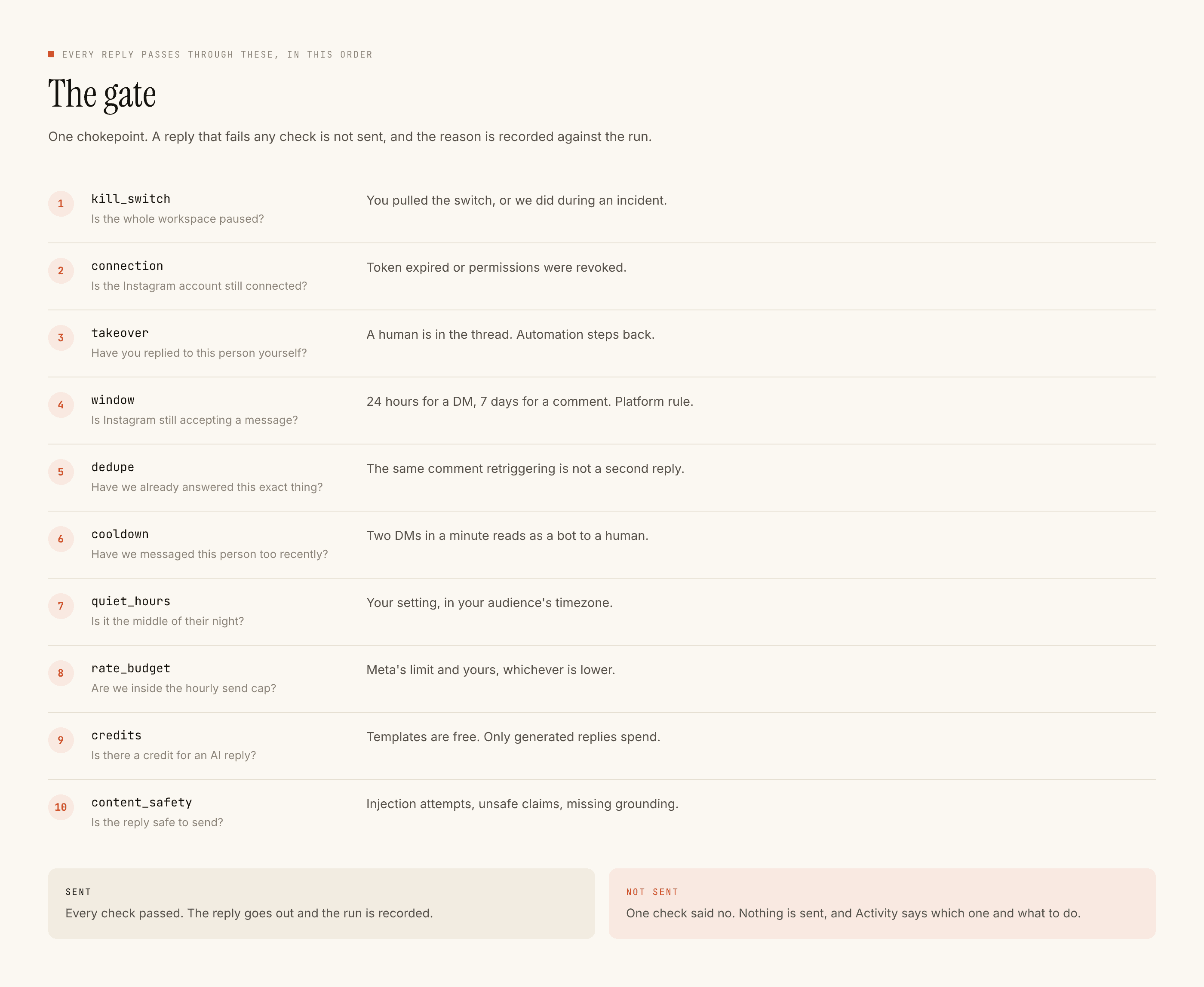
Two categories must never receive an automated reply of any kind, including a polite one.
Anything describing symptoms. Bloating, pain, fatigue, hair loss, a missed period, dizziness, a diagnosis, a medication, a test result someone has photographed and sent you. These belong to a clinical conversation. They also frequently belong to a different professional altogether, and the honest reply is a person saying so.
Anything that reads like disordered eating. Messages about not eating, purging, counting in a way that has stopped being about health, self-hatred aimed at a body, a request for the fastest possible loss. These arrive in nutrition inboxes regularly, often late at night, often from young people, and they take a long time to type.
An automated reply to that second category is the worst outcome available to this product. It tells somebody who finally said a thing out loud that nobody was there.
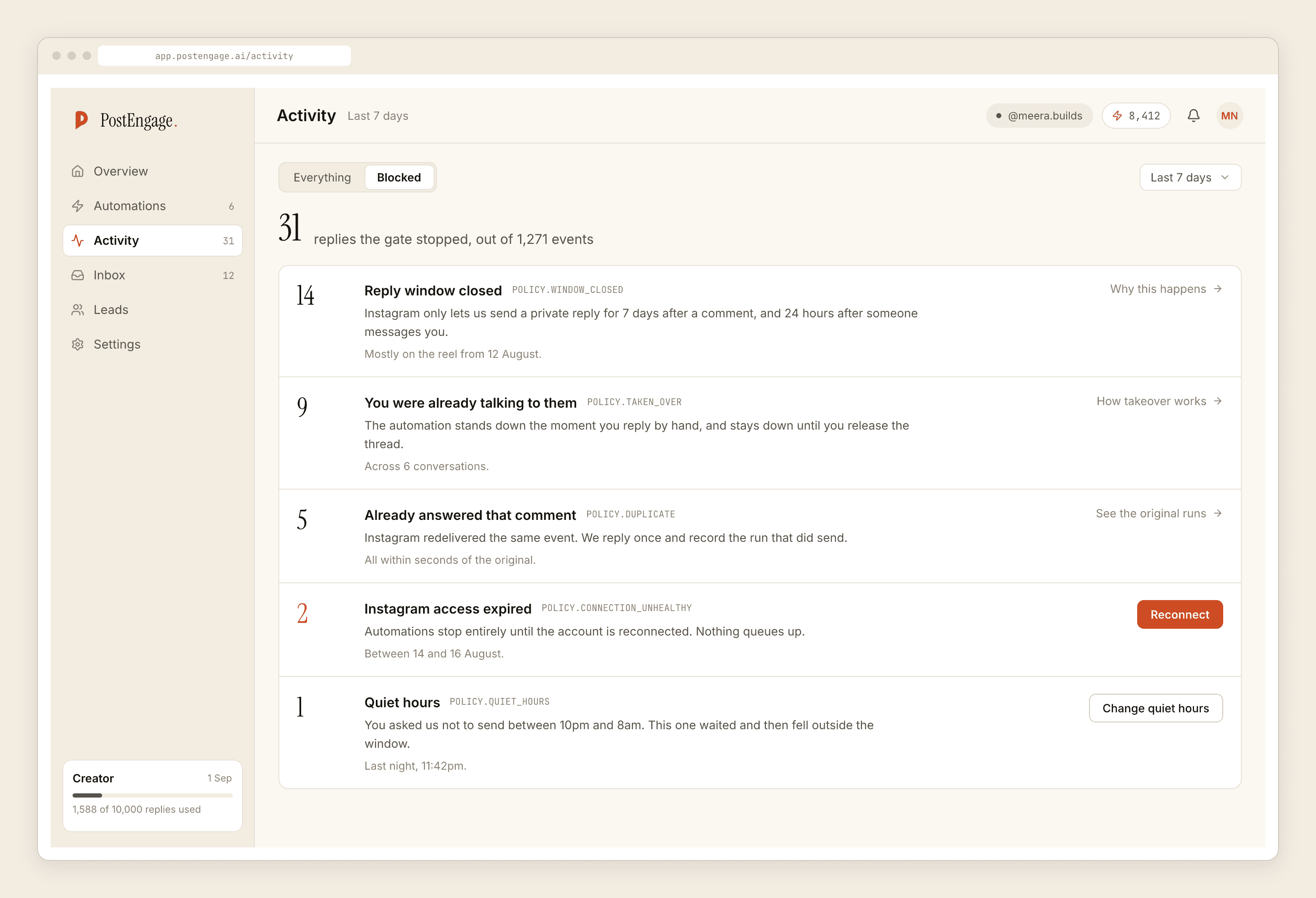
Then read that log. Daily, not weekly. Every negative-keyword row in it is a person who is waiting.
What you may not state, and what you should not imply
Do not write templates that assert what you are permitted to do, or that describe what a professional in your field is allowed to advise on. Who may give dietary advice, what titles are protected, what counts as clinical practice and what disclosures are required all vary by jurisdiction and change. State your own qualifications plainly if you like. Do not have an automation characterise the rules.
Keep outcome claims out entirely. No timeline, no number, no "you will", not even hedged. A result promised automatically to a stranger whose situation you have not seen is a claim you will be asked to stand behind.
What is actually safe to automate
A real and useful list, and it is all logistics:
How a consultation works. How long the first one is. Whether you consult online, and in which languages. What to bring or fill in beforehand. Whether follow-ups are included. How to book, and where. Whether you work with clinics. What your qualification is. Where you are based. That the plan is individual and is not sent by DM.
That is a lot of repeating volume, and it is genuinely most of the messages you actually have to type. Automating it buys back real hours without touching a single thing you should not touch.
One more habit worth adopting: watch what your content is asking for. A reel about a specific condition will fill your inbox with people describing that condition. If you publish it, staff the inbox that week, or expect the stop lists to be doing heavy work and check them daily.
Cost, clocks, and limits
Templated replies are free and unlimited. A credit is spent only when the AI writes a new reply — and in this vertical you should be sceptical of letting it write new replies at all outside logistics. Free tier is 100 credits with no card; packs start at ₹499.
Official Graph API only: a comment is answerable for seven days, a DM thread for twenty-four hours from their last message, restarted only by their next message. There is no scheduling, no sequences, no broadcasts, no WhatsApp, no CRM sync and no payment link. Leads leave as a CSV.
Build both stop lists first. Then one automation, on one post, sending consultation logistics and nothing else, and watch it for a week — the paced setup guide is the right order, and what gets blocked and why is the page to read after the first week. Coaches face a related version of this problem and handle it here.