Playbooks · 5 min read
Producers: Beat Enquiries, Collab Asks and Custom Quotes

You post eight bars over a drum loop. It does numbers. By morning the comments are a column of LINK, BEAT, price?, daam kya hai, and three people who want to "collab."
Those look like one kind of message and they are three, with three different correct replies and three different costs of getting it wrong. Artists releasing under their own name have a different problem; this one is about the enquiry, not the release.
The three questions hiding in one word
"Send me the beat." Somebody wants the thing that already exists on your store or your drive. Fixed answer, same every time, sendable at 3am. This is pure template and it should be automated completely.
"How much for a custom?" A judgement that depends on things you have not been told yet. A number sent automatically is either you underpricing yourself in writing or an expectation you will spend four messages walking back.
"Let's collab." Which, most of the time, means free work with a credit attached. Not a bad thing — some of them are worth doing — but it is a conversation, not a transaction, and it should never receive a price list.
The word beat in your inbox means "send me a link" and "quote me for a week of work" with equal frequency. One trigger cannot serve both.
Never let an automation answer a licensing question
This is the line that matters most, and producers cross it more casually than any other vertical.
Lease or exclusive. How many streams the licence covers. Whether they can put it on a commercial release. Whether they can register it. What happens to your split if the track charts. Whether they can use it in a reel that a brand is paying for. Whether the exclusive means you take the beat down everywhere.
Every one of those is a contract term. An AI writing a new reply will answer all of them fluently, because it has read a great deal of confident content about beat licensing on the internet, most of it written by people with no obligation to be right about your agreement. And a statement about licence terms sent from your account is a statement you will be held to when the track is out and somebody's lawyer reads the thread.
The sample question deserves its own mention. "Is this cleared?" about a chopped sample is not a music question, it is a rights question with real consequences downstream for the artist who buys it, and the honest answer is a human one.
Keyword matching folds less than you think
Producers get triggers wrong in a specific technical way, because your audience types in three scripts.
Matching ignores case and punctuation, and it folds Latin accents. BEAT, beat, Beat! and béat all reach the same trigger. What it does not do is fold Indic vowel signs. दाम and दम are two different words to the matcher and always will be, and so are कीमत and किमत. If your comment section runs in Devanagari, you have to list the spellings people actually type — including the wrong ones — rather than assuming a stem will catch them.
The same applies to romanisation. daam, dam, dame, kitna, kitne, price, pricing, rate. It costs nothing to list twenty words on a trigger and it is the difference between an automation that fires and one that quietly does not.
A custom brief is an intake, and it is short
Six things decide what a custom job costs and how long it takes. Ask them in one human message rather than a form, and let the automation capture the answers to Leads:
- A reference. Two or three tracks. Producers who skip this end up doing the job twice.
- What it is for. A release, a pitch, an ad, a film cue, a reel. It changes the work and it changes everything about the licence.
- Deadline. The single filter that removes most of the jobs you would have regretted taking.
- What they need delivered. A two-track, stems, a mixed and mastered file, a session. These are wildly different amounts of work and people assume all of them are included.
- How many revisions they are expecting. Ask it early, in writing, before anybody is invested.
- Whether there is an artist attached, and who. "For a friend who might record it" is not the same job as a signed release with a date.
Then you quote. Actually you, having read the six answers. The automation has saved you the four messages it takes to get there and has committed you to nothing.
Your voice is part of what they are buying
A producer's DMs are auditioned as closely as the beats. Artists are deciding whether working with you for three weeks is going to be pleasant, and they are deciding it from a reply.
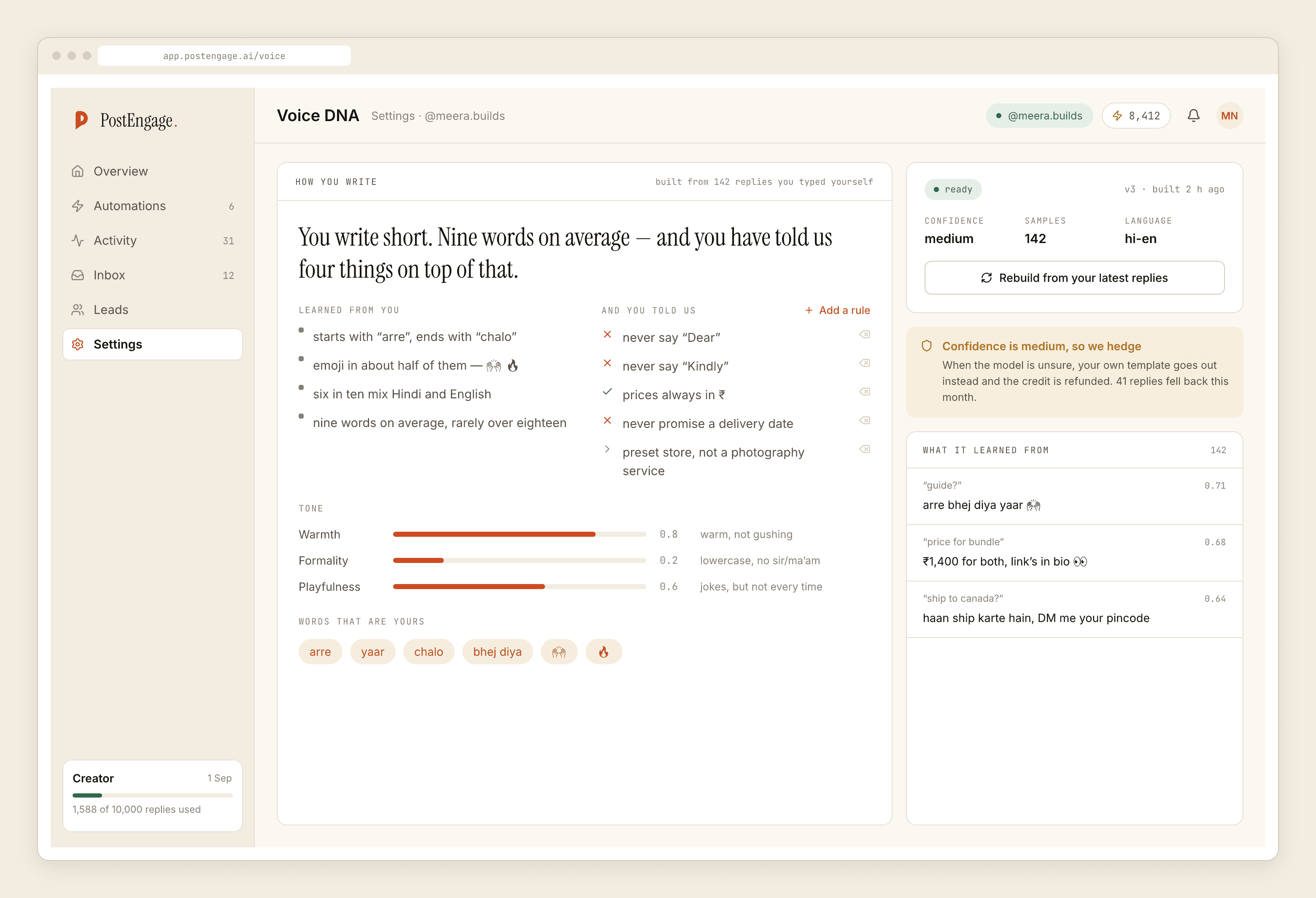
How the voice profile gets trained is worth the ten minutes, because your reply is the demo.
Clocks, cost, and what it will not do
Official Graph API. Seven days to reply to a comment, twenty-four hours inside a DM thread, and that DM clock restarts only when they message again. An artist who asks about a custom on Sunday and disappears until Thursday is unreachable in between. So the store link, the licence page and your email go in the first reply — there are no sequences, no scheduled follow-ups and no broadcasts here.
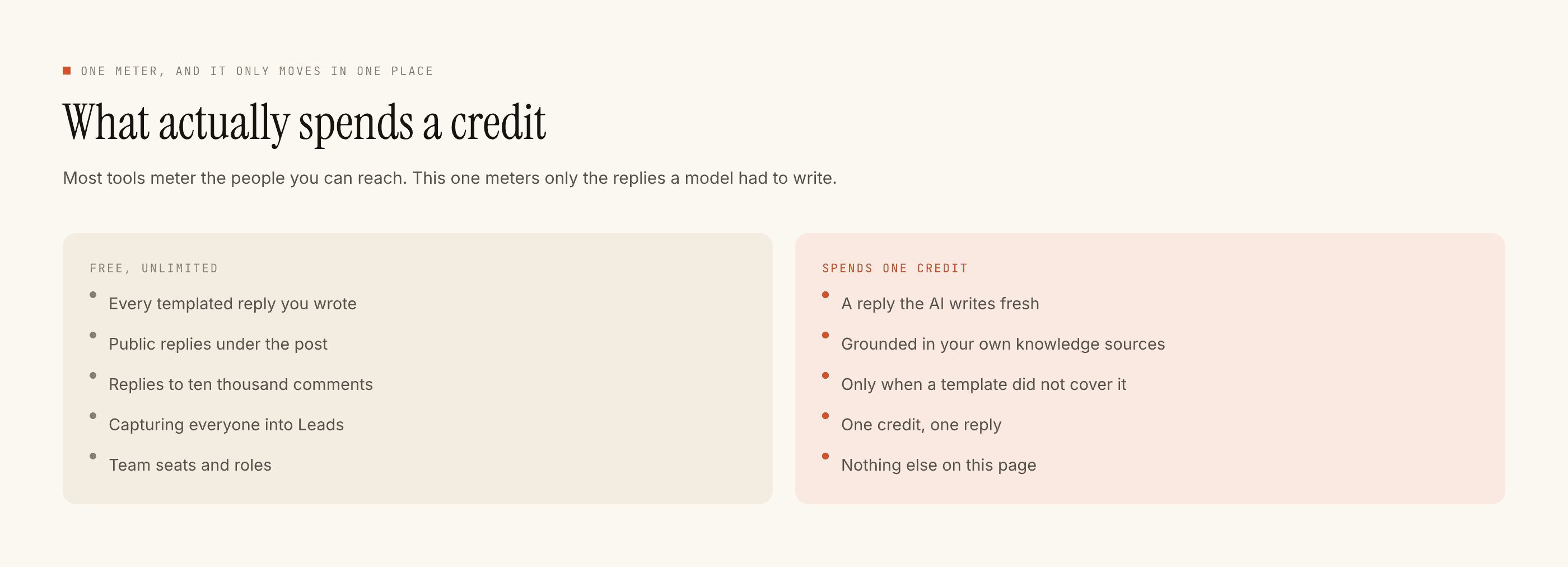
Templated replies are free and unlimited. A credit is spent only when the AI writes a new reply. The LINK flood under a viral loop costs nothing whatever it does. Free tier is 100 credits, no card; packs start at ₹499.
It cannot take a payment, deliver a file, issue a licence, or message anyone who has not messaged you first. It does not post or schedule. It does not do WhatsApp, and leads leave as a CSV rather than into anything.
Build the licensing refusal list first, then the store-link automation, then the custom intake. Read what got blocked after a week — the negative-keyword rows are the ones that were worth building.