Playbooks · 6 min read
Fans Ask Two Questions. Only One of Them Has an Answer

Nothing here grows a fan base. No follower features, nothing that likes or comments on other accounts, nothing that finds listeners, no scheduling, no posting, no analytics, no way to message anyone who has not written to you first. The music is the growth strategy. This is an inbox tool.
What it does is handle what arrives after a clip travels, and for an artist that is a narrower and more specific set of messages than most people assume. Strip away the compliments and the emoji and almost everything reduces to two questions.
Question one: where can I listen
This is the good one. It is asked constantly, it has a fixed answer, and that answer does not change.
A template covers it, templated replies are free and unlimited, and it will keep working for years on a post you made once. One reel that finds an audience in a country you have never played produces four hundred versions of this question and costs you nothing to answer all four hundred.
Write it in your own words. Fans know how you type — half the reason they messaged is that you seem reachable — and a reply in label English breaks that instantly. Voice DNA is built from replies you actually wrote rather than from a tone slider, which matters more here than in almost any other category, because the mismatch between the automated line and your own reply the next morning is obvious to the people reading both.
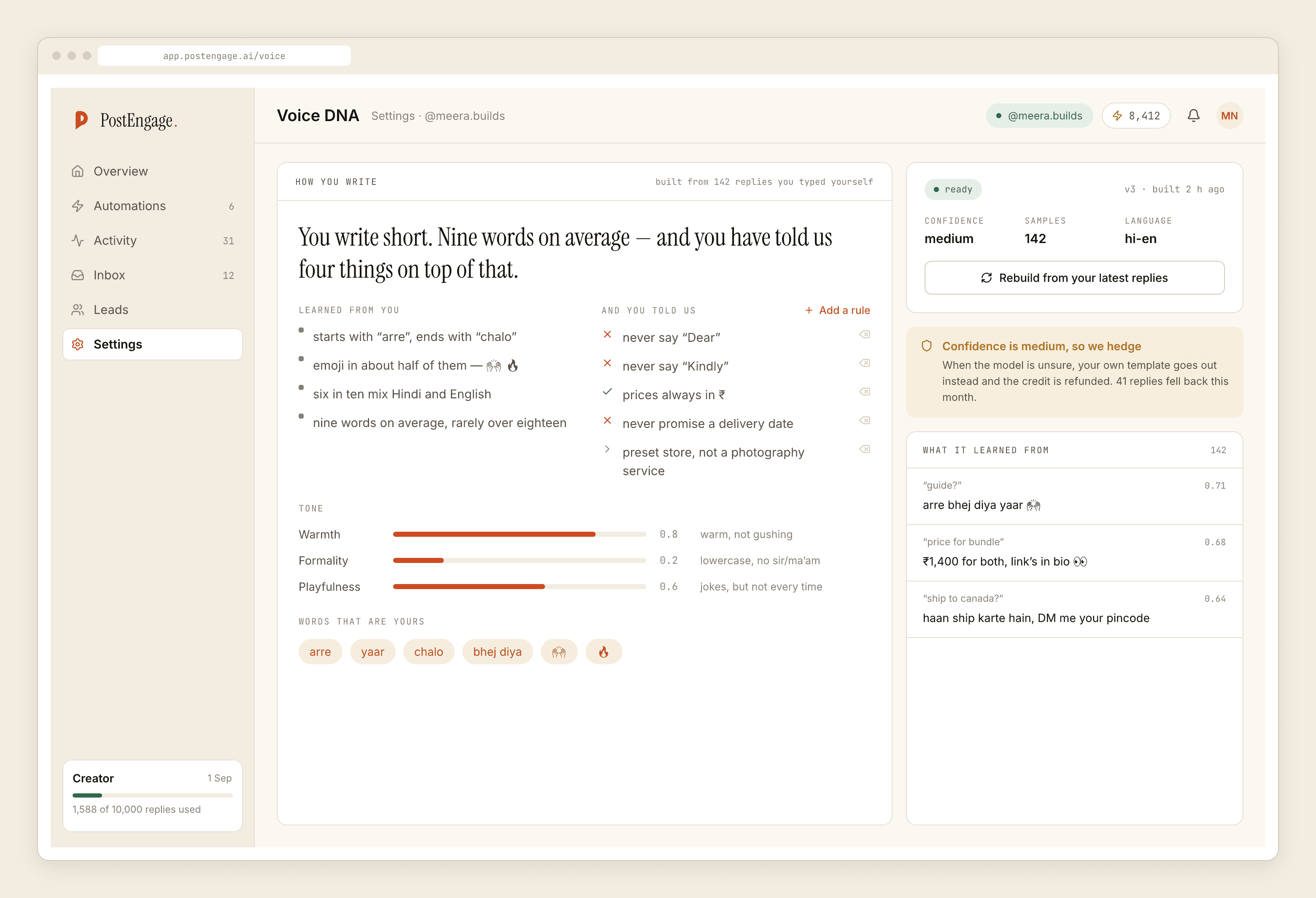
Point the reply at somewhere that stays current rather than listing platforms. "Everything's in the bio link" survives a distributor change, a new single and a delisting. A hardcoded list of four platforms does not.
Question two: when are you playing here
This is the one that causes trouble, and it causes it for a reason artists rarely think about until it has already happened.
The answer is not yours.
A tour date belongs to a promoter. A festival slot belongs to whoever runs the festival, and it is frequently confidential until they announce it. A set time changes on the afternoon of the show. A venue moves. A city gets added and then quietly dropped. In every one of those cases somebody else owns the fact, and your automation is holding whatever you typed into it three weeks ago.
An automated reply stating a date you did not announce is an announcement, made by your account, on somebody else's behalf, to a stranger.
The damage is not that fans are disappointed. It is that a promoter or a label finds out from a screenshot that your Instagram confirmed a show before they did.
The question is not a question, it is data
Here is the part worth building for, and it is the opposite of what artists usually try to automate.
"Bhai Pune kab aa rahe ho" is not really a request for information. It is somebody telling you where they are and that they would buy a ticket. That is the single most useful piece of information an independent artist can collect, and almost everyone throws it away by answering it and moving on.
Turn on capture. The record holds the handle, the post they came from, the words they typed and a timestamp. Three months later that list is a city-by-city map of where your audience actually is, in their own words, gathered for free.
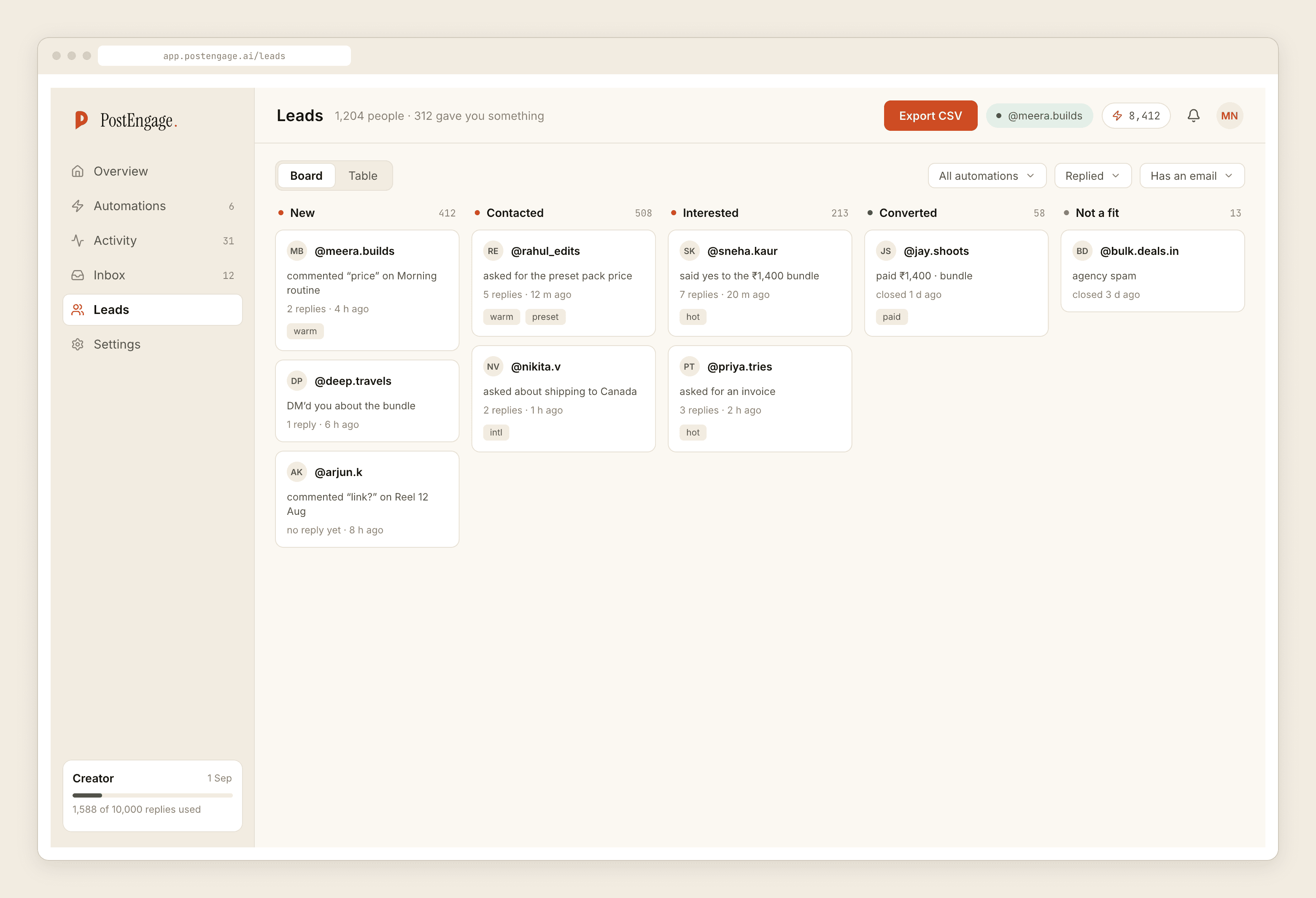
The reply that goes with it is short and says nothing about dates: thanks, nothing announced for your city yet, everything confirmed goes in the bio link first. Then it captures. That is an automation that is useful to the fan, safe for the promoter, and building you an asset at the same time.
Leads export as CSV. There is no CRM sync and no connector into anything, so somebody has to download the file and open it. Decide who before the next release, not after.
The list that stops the automation entirely
Everything commercial arrives in the same inbox using words your fan triggers already match. "Can I use your song" hits the same SONG keyword as a fan asking where to hear it.
- Rights and money.
licence,license,sync,rights,royalt,publishing,split,master,copyright,takedown. A reply from your account is a reply from you, and these belong to whoever handles that side. - Bookings.
booking,fee,quote,event,fest,contract. A templated answer to a real booking enquiry is expensive in a way you find out about later. - Press.
press,interview,feature,PR,media kit. - Unhappy people. Refunds, a stream that will not play, a ticket problem. None of that wants a warm template.
Matching folds case and punctuation and Latin accents, so Licence, licence. and LICENSE are the same word. It does not fold Indic vowel signs, and it matches whole words — press will not catch pressing. Write both if you need both.
Release week is a spike, and the spike needs a cap
An announcement post behaves nothing like the rest of your grid. It gets shared into group chats and the comments arrive in bursts.
Set a rate budget before it goes up. An uncapped automation firing at a thousand comments an hour is how an ordinary good release starts looking like coordinated spam, and the account it happens to is yours. The cap costs you nothing: a comment stays answerable for seven days, counted from each comment, which is longer than release week, so the queue drains well inside it.
The DM side is tighter — twenty-four hours from their last message, restarted only when they write again. There are no sequences here and no broadcasts, so the link goes in the first reply, always.
Cost, and the rest of the limits
Templated replies are free and unlimited, so the flood costs nothing at any size. A credit is spent only when the AI writes a new reply, one credit per reply. Free tier is 100 credits, no card; packs start at ₹499.
Official Graph API only. No WhatsApp, no YouTube, no publishing, no analytics — which reel drove listens is a question for your distributor's dashboard. Takeover stands the automation down in a thread the moment you reply by hand.
The release-week build, in order is the companion to this one, and how Voice DNA is actually built is worth reading before you write a single template.