Playbooks · 6 min read
Jewellery Brands: The Restock Message You Cannot Send
On this page
- The rule: point at the page, never restate what is on it
- The restock message, which is the honest limit of this product
- Ring size is the best template in this business
- Variants are availability questions in a costume
- The public reply, under a piece somebody is being gifted
- What the volume does to the economics
- The negative keyword list for a jewellery brand
- The edges

Jewellery DMs: never automate availability or price is written for a studio where every piece is one of one, and it is the right post for that business. The whole argument turns on scarcity: you made one, it sold at an exhibition on Saturday, and a template saying "yes, available" is a promise you will have to take back by hand.
A brand with repeatable stock has the mirror-image problem, and it is not milder. You have SKUs, variants, a product page that is actually maintained, and a restock schedule. There is a system that knows the truth. The automation is not connected to it, and never is.
So the failure mode inverts. The studio's danger is a confident yes. Yours is a confident anything — because your customer assumes an account with a proper catalogue is speaking for the catalogue.
The rule: point at the page, never restate what is on it
There is no catalogue sync here. No inventory feed, no stock count, no variant lookup, no order status, no shipment tracking, no price feed. Nothing in a reply is derived from your store; it is derived from what you typed into a template weeks ago.
Which means every fact that changes belongs on the product page, and the automated reply's job is to get somebody there in one tap with enough context to bother.
Anything you restate in a template becomes a second source of truth that nobody updates. In jewellery the second source is usually a price.
The practical split:
- Fixed product facts go in the template. Purity, hallmarking, what is solid and what is plated, whether stones are natural or lab-grown, what the finish is, whether it tarnishes. These are true for that SKU forever.
- Anything with a stock level or a rate attached goes to the page. In stock, sold out, current price on a weight-linked item, festive pricing. One link, and the truth is being maintained by a system that knows.
- Anything with a date attached is a temporary automation. A drop, a festive collection, an exhibition. Switch-off date written down the day you build it.
The restock message, which is the honest limit of this product
"Sold out ho gaya? Restock kab hoga? Notify me."
This is one of the most common messages a jewellery brand gets and it is the one thing an Instagram automation genuinely cannot do.
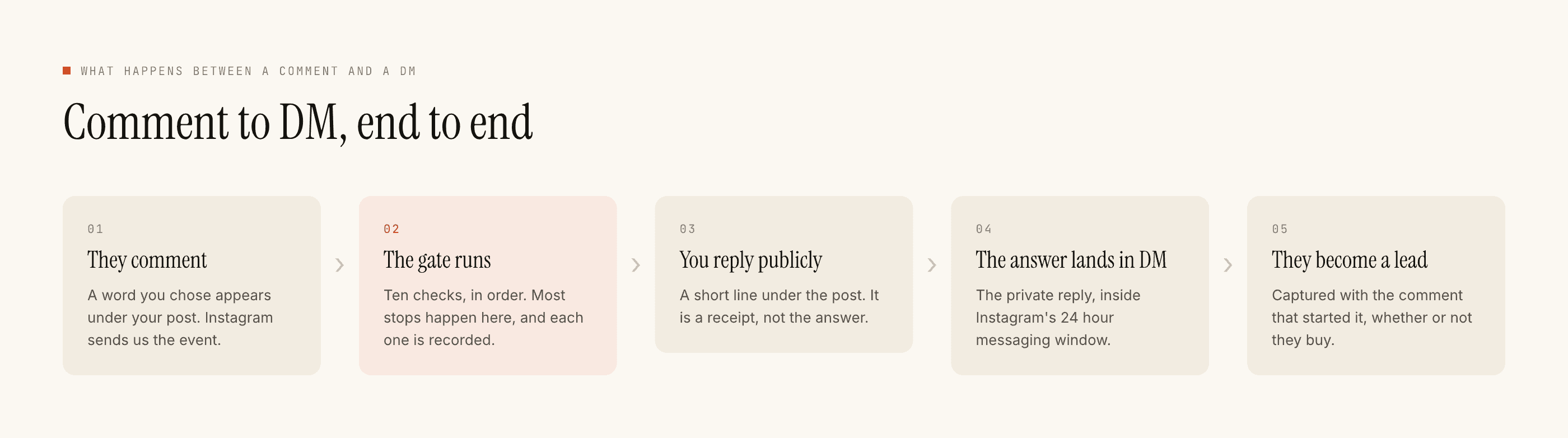
There are no broadcasts here. No sequences, no scheduled sends, no back-in-stock notification, no list you can message later. And the platform rule underneath that is firmer than any product decision: a DM thread stays open for twenty-four hours from the customer's last message, and only their next message reopens it. Nothing on your side restarts it. Three weeks later, when the piece is back, there is no thread to write into and no permission to start one.
That is a real limitation and it is worth designing around rather than papering over. Every "notify me" message is a customer asking to be sold to, and the only way to keep them is to move them onto a channel you control before the window shuts.
Ring size is the best template in this business
Every jewellery brand gets the same question at volume and it has exactly one answer that never changes: how to find your size.
Write that template properly. How to measure, whether you can send a sizer, what the size chart maps to, whether that particular design can be resized afterwards and whether resizing affects the stones or the hallmark. It is long, it is fixed, and it converts, because size uncertainty is the most common reason a jewellery order does not happen.
The same treatment suits chain length, bangle sizing, and how a piece sits on the ear. All fixed, all identical for every sender, all free — templated replies are free and unlimited.
Variants are availability questions in a costume
"Rose gold mein hai?" "18k mein milega?" "Silver version?"
Those look like product questions and they are stock questions. The automation cannot see whether the rose gold variant exists today, so the reply says what variants the design is made in — a fact about the design — and links to the page for what is in stock — a fact about today.
Keep those two sentences separate in the template. When they get merged into one, somebody eventually reads it as a confirmation.
The public reply, under a piece somebody is being gifted
A comment automation replies publicly, addressing a handle. On a jewellery post that has two specific hazards.
The first is the price, and it is the obvious one. A figure in a public reply is read by everyone who bought that design at a different number, and by everyone who will screenshot it during your next sale.
The second is quieter. A significant share of jewellery buying is gifting, and a public reply naming somebody under a ring post is occasionally a spoiler. Keep it to four content-free words.
What the volume does to the economics
A brand gets far more inbox traffic than a studio, and the shape of it is better suited to automation, not worse.
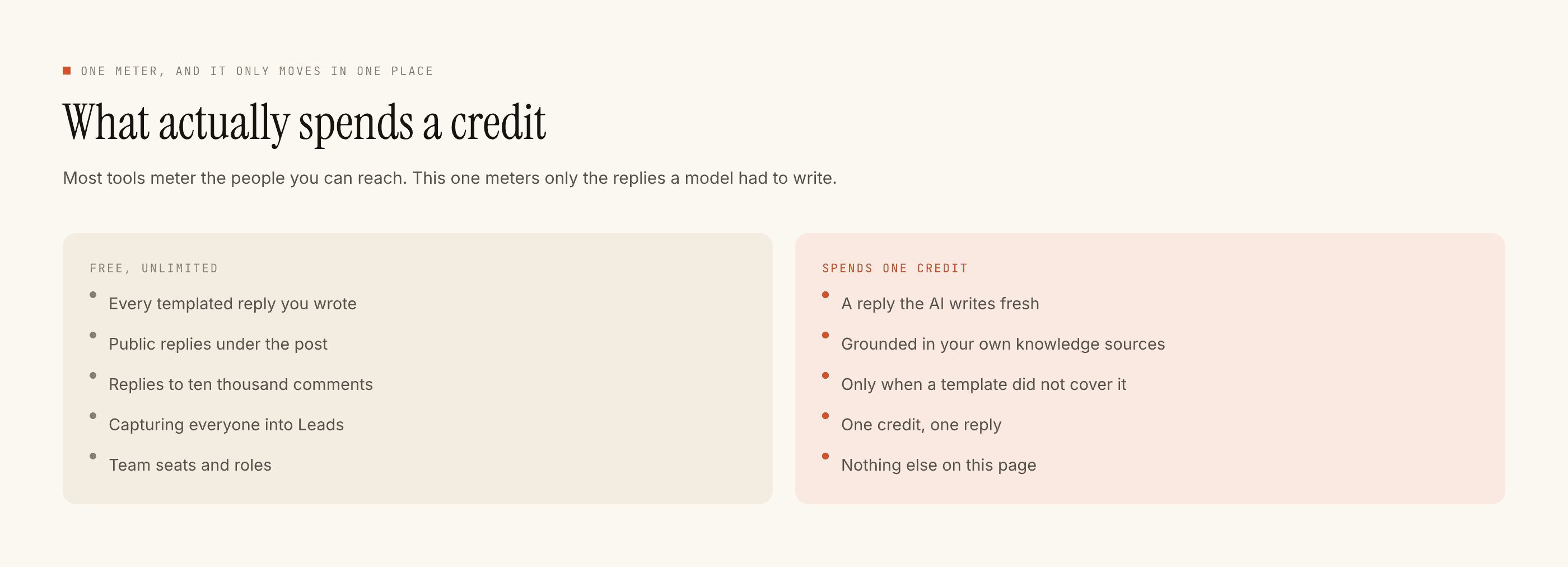
Templated replies are free and unlimited; a credit is spent only when the AI writes a new reply, one credit per reply. Free tier is 100 credits with no card, packs from ₹499. If your credit count is moving steadily, the automation is composing answers to questions that should have been written once and linked forever.
The negative keyword list for a jewellery brand
Different from a studio's. order status, tracking, kab aayega, delivery, not received, damaged, broken, exchange, refund, resize, warranty claim — everything post-purchase. There is no order lookup here, and an existing customer chasing a delayed parcel who receives a product template is a review you will read later.
Then the negotiation words: discount, best price, making charges kam, bulk. And wholesale, dealership, reseller if you do not do that, because a good jewellery reel brings all three.
The edges
No catalogue, inventory, order or shipping integration. No CRM sync — leads leave as a CSV, worth reading before you plan a collection, because a month of captured questions tells you which product page is missing its measurements. No WhatsApp. No messaging anybody who has not messaged you first.
Takeover means the moment your team replies by hand, the automation is out of that thread. Official Graph API only: seven days on a comment, twenty-four hours in a DM thread, restarted only by the customer's message — which is why a drop landing on a Friday night needs the automation running on Friday night.
Build the sizing template first, then purity and care, then returns split by stock and custom. The ecommerce version of the catalogue problem covers what does and does not connect, and what the checks stop is worth reading before a sale.