Playbooks · 5 min read
AI Replies for a Product Inbox, and What It Must Never Guess

The argument for putting a model in a store's Instagram inbox is straightforward. A template answers the question you anticipated. A customer asks the question you did not.
The argument against is the same sentence read differently. A model will answer the question you did not anticipate whether or not it has any way of knowing the answer, and it will do it in a fluent, friendly, entirely plausible register.
So the useful design question for a store is not "should the AI reply". It is: which messages should it be allowed near, and what should it be structurally unable to say.
The three categories of question a store gets
Template, always
Model, sometimes
There is a third category and it is the one that matters most: questions that look like the right column but are actually about facts only your systems hold. Is this in stock. Where is my order. Did my payment go through. Can you cancel it.
A model has no route to any of that. Nothing connects an Instagram reply to your inventory or your order table, so a confident answer to "is this available in L" is not a lookup, it is a guess dressed as service. The correct behaviour is to say what is true — you will check, or here is the product page — and to route it to a human.
Where a credit goes, which shapes the whole setup
Templated replies are free and unlimited. A credit is spent only when the model writes something new, one credit per reply.
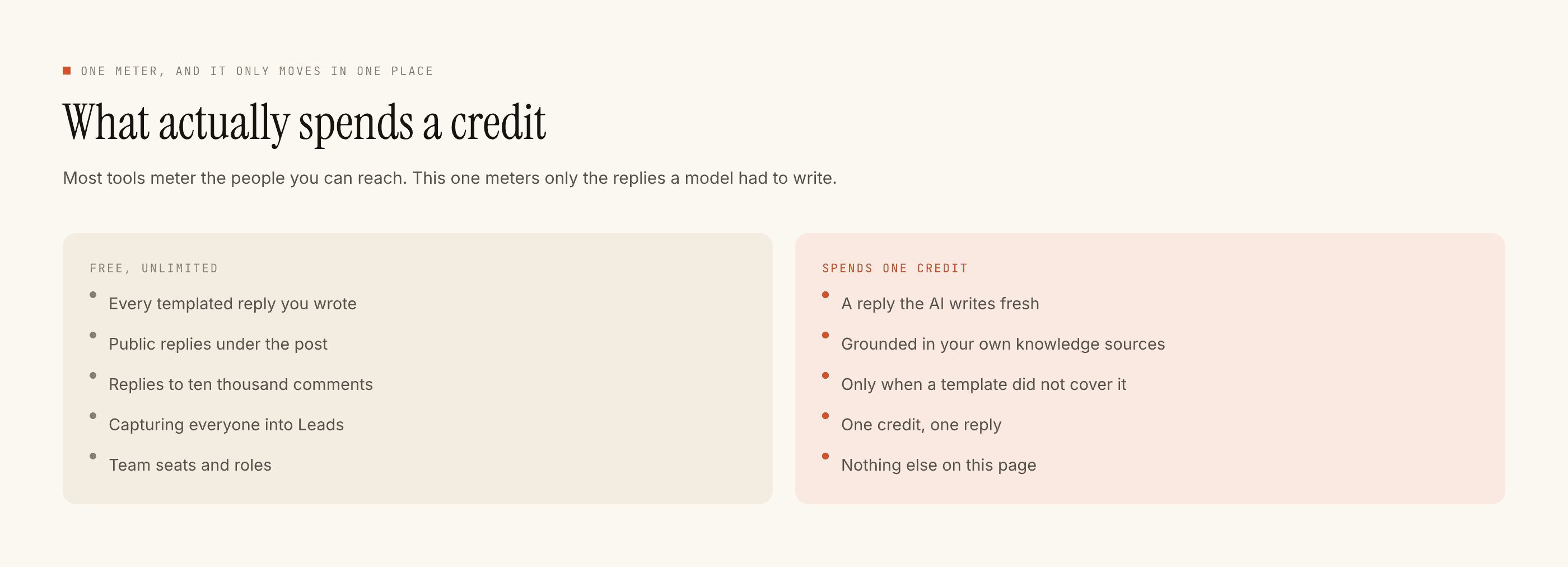
This has a specific consequence for a store, and it runs opposite to most people's intuition. Your busiest traffic is your cheapest traffic. If four questions cover most of what arrives, most of your automation has no marginal cost at all, and the spend lands on the smaller pile of messages that genuinely differ.
The free tier is a hundred credits with no card, which is enough to read a fortnight of the model's actual output before deciding anything. Packs start at ₹499. If you are watching cost, the lever is not a cheaper model — it is one more template.
Voice DNA, and why a product inbox is a good place for it
The model writes in a voice built from replies the account owner actually wrote. Not a tone slider, not "friendly and professional" — your sent messages.
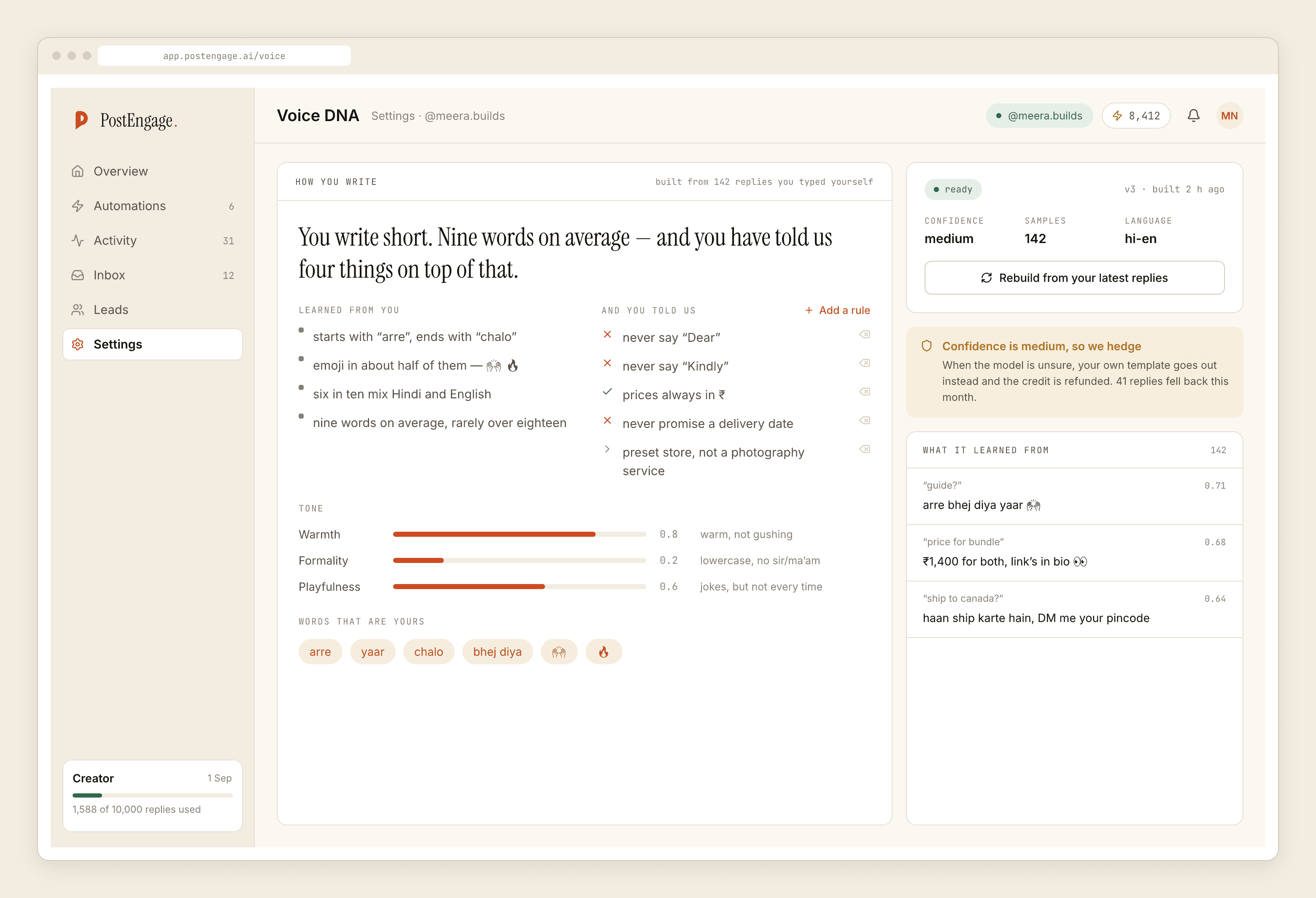
A store inbox is unusually good training material, because it is high volume, short form, and consistently on one subject. If you have spent six months typing "haan ji, M available hai, kal tak dispatch ho jayega", that is the register the model picks up, and it is a register no tone setting would have produced.
The failure it prevents is specific. A generic assistant answers a sizing question in flawless customer-service English under a caption written in Hinglish, and the customer notices the seam immediately. How the voice is built and what it does with a small sample is worth reading before you judge the first few replies.
Grounding, and the thing to check in week one
The model answers from what you gave it — your templates, your product notes, whatever you wrote into the automation. When a question falls outside that, the right outcome is a fallback to your own words, not an invention.
Watch for these three in your first week of generated replies:
- A price you never wrote anywhere. The clearest tell that something is being composed rather than retrieved. If it appears once, tighten the source and re-test.
- A delivery promise with a date in it. "By Friday" is a commitment your courier did not agree to.
- Agreement with a premise. A customer says "you said it would ship Monday" and a helpful model apologises for a delay nobody has verified. Route these to a person.
The review queue exists for exactly this stretch. Replies the model is not confident about wait for a human instead of going out, and reading a week of that queue teaches you more about your own catalogue documentation than about the model.
Most bad AI replies in a store inbox are not the model being wrong. They are the model answering a question that had no answer available to it.
Takeover, and why it matters more for commerce
The moment you reply by hand in a thread, automation stands down there. For a store this is not a nicety. Commerce conversations escalate — a sizing question becomes a complaint becomes a refund request — and the worst possible experience is a customer receiving your careful personal message and then a cheerful generated one forty seconds later.
The order the checks run in is deliberate about this. Takeover is evaluated before the window and long before credits, so a thread you have entered is never charged for and never answered twice.
What to switch on, and when
Week one, templates only, model off. Week two, read what got blocked and what got taken over. Week three, turn on generated replies for the leftovers, keeping templates as fallback.
That order is not caution for its own sake. It is the only sequence in which you find out what your inbox actually contains before you pay a model to guess at it. The wider scope of what automation does and does not do for a store is set out here, and the mechanics of how a reply gets its context are worth understanding before you widen anything.