Playbooks · 5 min read
Interior Design Enquiries: Sorting Beats Answering Fast

An interior studio's Instagram works differently from almost any other business on the platform. The posts perform well, the comments are enthusiastic, and the conversion from comment to signed project is thin — not because the automation is bad, but because a finished kitchen is genuinely nice to look at whether or not you are renovating one.
This post is the argument for why automation is still worth it here, and it is not the argument you usually get. It is not about replying faster. It is about the fact that four questions separate a project from a browse, and something can ask them at eleven at night without you.
The build sheet — the actual fields, keywords and reply text — is a separate post. This one is the case for doing it at all.
The question you cannot answer, and should stop trying to
"2BHK ka interior kitna aayega?"
There is no honest number. The figure depends on carpet area, on how much of it you are touching, on whether there is civil work, on finishes, on the city, on whether you are designing or also executing. Two flats on the same floor of the same building can differ by a multiple, and everyone in the business knows it.
So the reply "starts from X per sq ft" is a promise your studio will spend the next three meetings walking back. It is also the reply that gets typed most often, because it feels like answering.
A per-square-foot figure quoted before a site visit is not a price. It is the number the client will hold you to when the real one arrives.
What you can publish, with no risk at all, is the structure. How you charge — design fee, percentage of project value, turnkey — and what falls inside it. Whether you take single rooms or only full homes. Which cities you actually work in. Roughly how long a project runs. None of those depend on the flat, so none of them can be wrong.
The four facts that decide everything
Every studio I have watched do this well ends up with the same short list. Not because it is clever, but because these are the four things that turn an enquiry into a yes or a no, and everything else is detail.
- Where. The cheapest disqualifier there is, and the one almost nobody automates. If you work in three cities and the enquiry is from a fourth, both of you have just saved a week, in one message, for free.
- What and how big. 2BHK, 3BHK, villa, one room, only the kitchen. Carpet area if they know it. This is the difference between a design fee and a turnkey project.
- When possession is. The single most predictive thing anyone volunteers. Someone with handover in six weeks is a live project. Someone who "might do it next year" is a follower, and a good one.
- Whether they want design or execution. Studios lose weeks to enquiries that turn out to want a contractor, and clients lose weeks discovering you do not supply one.
You will not get all four in one exchange, and you should not ask for all four. Ask the one that disqualifies fastest — usually location — and let the rest come out of a conversation.
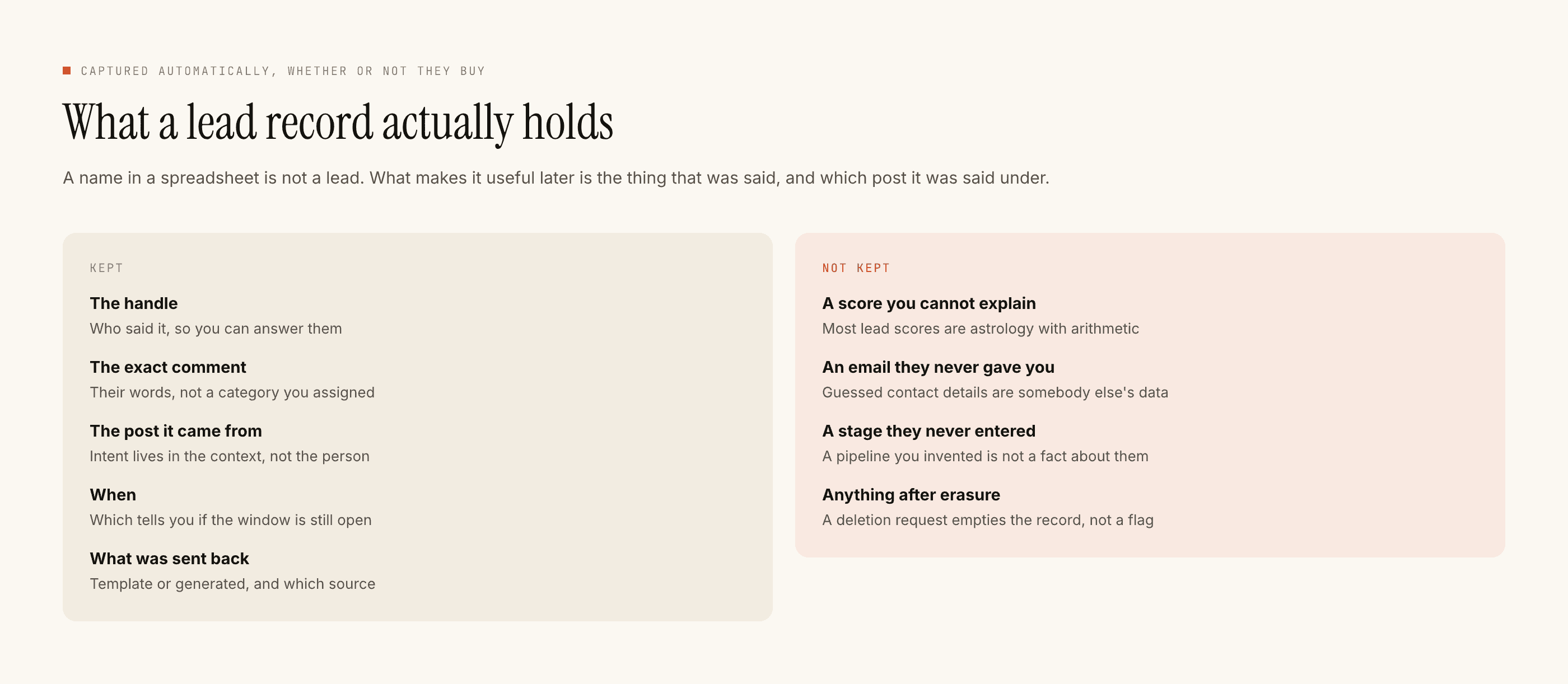
Capture every enquiry, including the ones that fail all four questions. A studio's slow season is a very good time to have a list of people who liked your work in March and were not ready. There is no CRM sync — the leads leave as a CSV, and for a business closing a small number of projects a year, a CSV is honestly the right size of tool.
Why the comment-to-DM shape fits this business specifically
Interior content has a long tail. A reel of a finished living room keeps collecting comments for months, and most of them are the same word: cost, price, kitna.
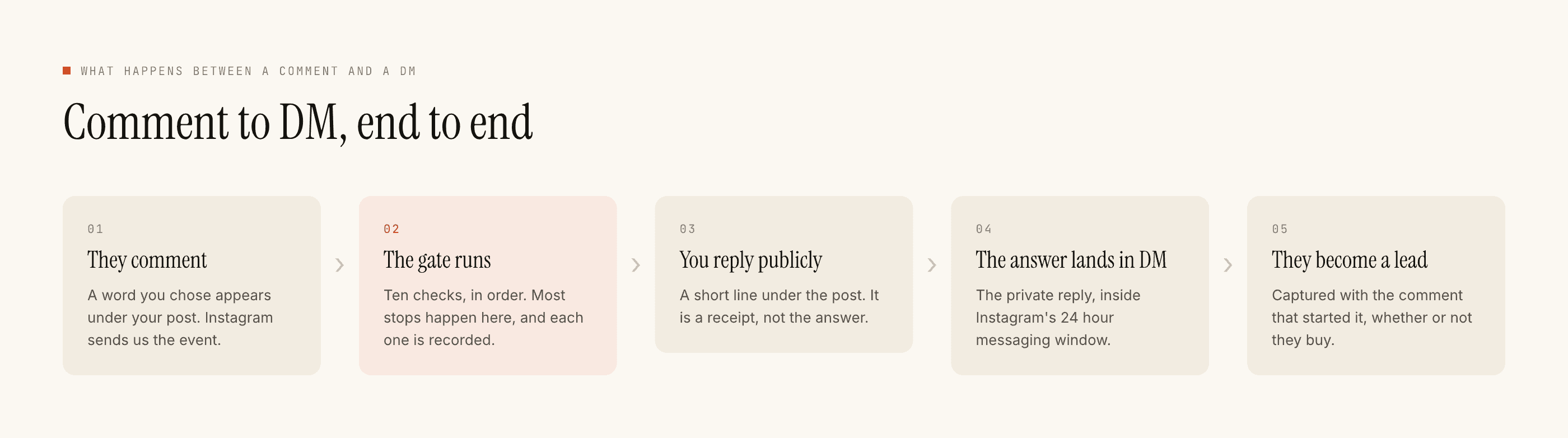
Two reasons this shape suits an interior studio better than most.
The first is discretion. You do not want a per-room budget conversation happening in public under your own portfolio piece, and you do not want two hundred identical cost? comments sitting unanswered underneath it either. A four-word public reply and a real private one solves both.
The second is a clock most people meet the hard way. You have seven days to reply to a comment on the official API, and an interior reel produces comments long after that. A comment from five weeks ago cannot be answered at all — not slowly, not manually, not by anyone. If your portfolio posts have a long tail, automation is not a convenience on them. It is the only thing that catches them inside the window.
What good looks like after a month
Not more enquiries. Roughly the same number, sorted — with the out-of-area ones already told so, the single-room ones separated from the full-home ones, and the handful with a possession date flagged as the ones to call.
That is a smaller promise than most automation writing makes and it is the one that survives contact with an actual studio. For the mechanics of building it, the build sheet is here. For deciding which of the sorted enquiries gets called first, this is a useful frame, and the funnel shape itself is documented here.