Most "automation in India" writing is a list of things that are true everywhere with the word India inserted. This is an attempt at the opposite: the handful of places where an Indian audience actually changes what you type into the builder.
There are about five, and none of them are about national character. They are about how people write, what they ask first, what a credit costs in rupees, and which app they open when they want to reach you.
One sender, two languages, one message
The single most practical difference is that a lot of Indian comments arrive in Roman-script Hindi, or in Hindi and English inside the same sentence, and the same person will switch between the two across three messages.
Real strings from a product reel look like this:
kitne ka haiavailable hai kyabhej do detailsprice?dm me bhaiyacost kya h
Keyword matching folds case, punctuation and accents away, so Price? and price are already the same thing and you do not have to plan for that. What it does not do is translate. price and kitna are two unrelated strings, and a trigger that only lists the first will sit there while the second half of your inbox goes unanswered.
The fix is unglamorous: read fifty of your own comments and list every word people actually used, then put them in one any-of list. price, cost, rate, kitna, kitne, kitni, daam. That is a five-minute job you do once, and it is the difference between an automation that fires and one that looks broken.
The mechanics of running a genuinely multi-language inbox — including the scripts, not just the transliterations — are their own problem, and there is a post on exactly that.
The first question is often the price
This one you should verify rather than believe. Open your notifications and read the first comment on your last ten product posts. On a large share of Indian D2C and creator accounts, the opening message is a price question, before any question about fit, delivery, or material.
If that is what your account looks like, it changes your build order. The automation worth building first is not a welcome message or a lead magnet. It is the one that answers kitne ka hai in four words publicly and in full privately.
If your account does not look like that — and plenty do not — build for what your inbox actually shows you instead. The point of reading fifty comments is that you stop needing anybody's generalisation about Indian buyers, including this one.
The metering is the argument at small volumes
Here is where rupees matter, and it is narrower than pricing-page rhetoric suggests.
Templated replies are free and unlimited. A credit is spent only when the AI writes a new reply. One credit, one reply.
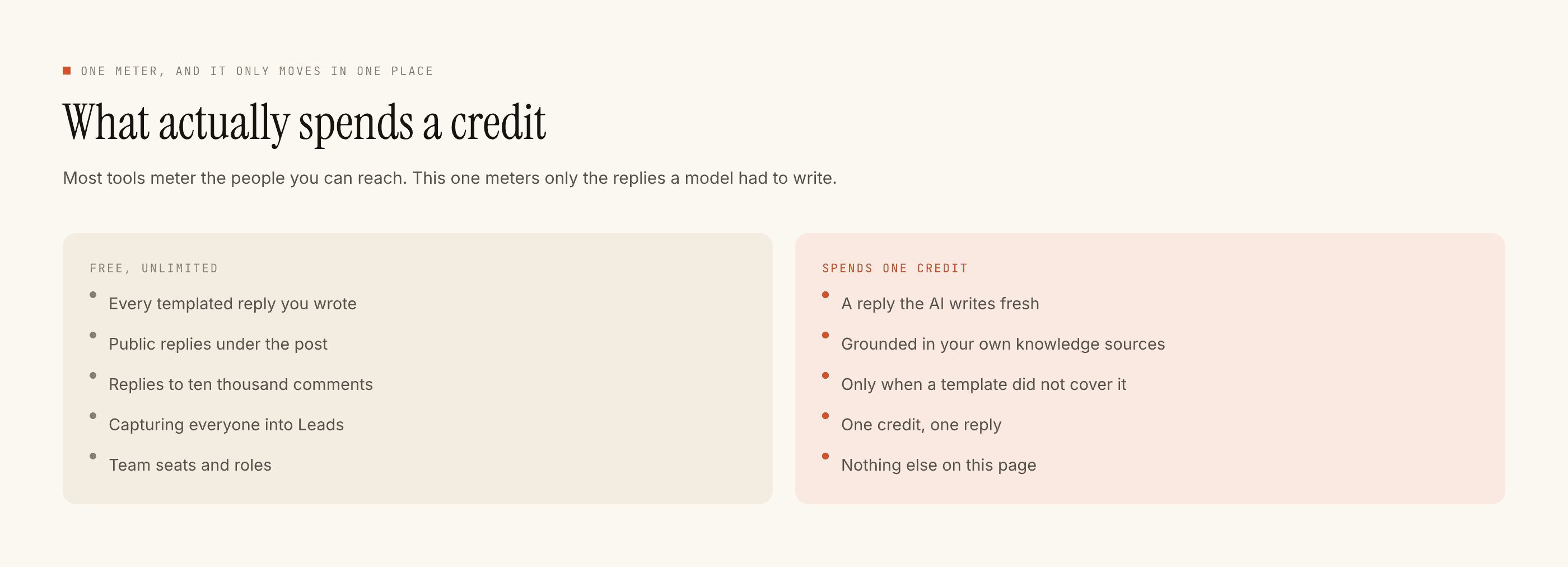
Now put that against a price-first inbox. Price, delivery time, COD or not, sizes available, where you ship from — those answers are fixed. They do not vary by sender. So the highest-volume, most tedious part of the inbox is the part that costs nothing to automate, permanently.
The free tier is 100 credits with no card. Packs start at ₹499. A single-catalogue store with fixed prices and six good templates may genuinely never buy one, and the credits it does spend go on the odd message that is unlike the others — a customer describing a specific problem, which is the message that deserved a written answer anyway.
The DM is the contact channel, not a fallback
In a lot of markets, a DM is what someone sends when they could not find your phone number. On Indian creator and D2C accounts it is frequently the first and only channel: no email, no form, no call. Data is cheap and Instagram is already open.
That is good news for reachability and bad news for your clock.
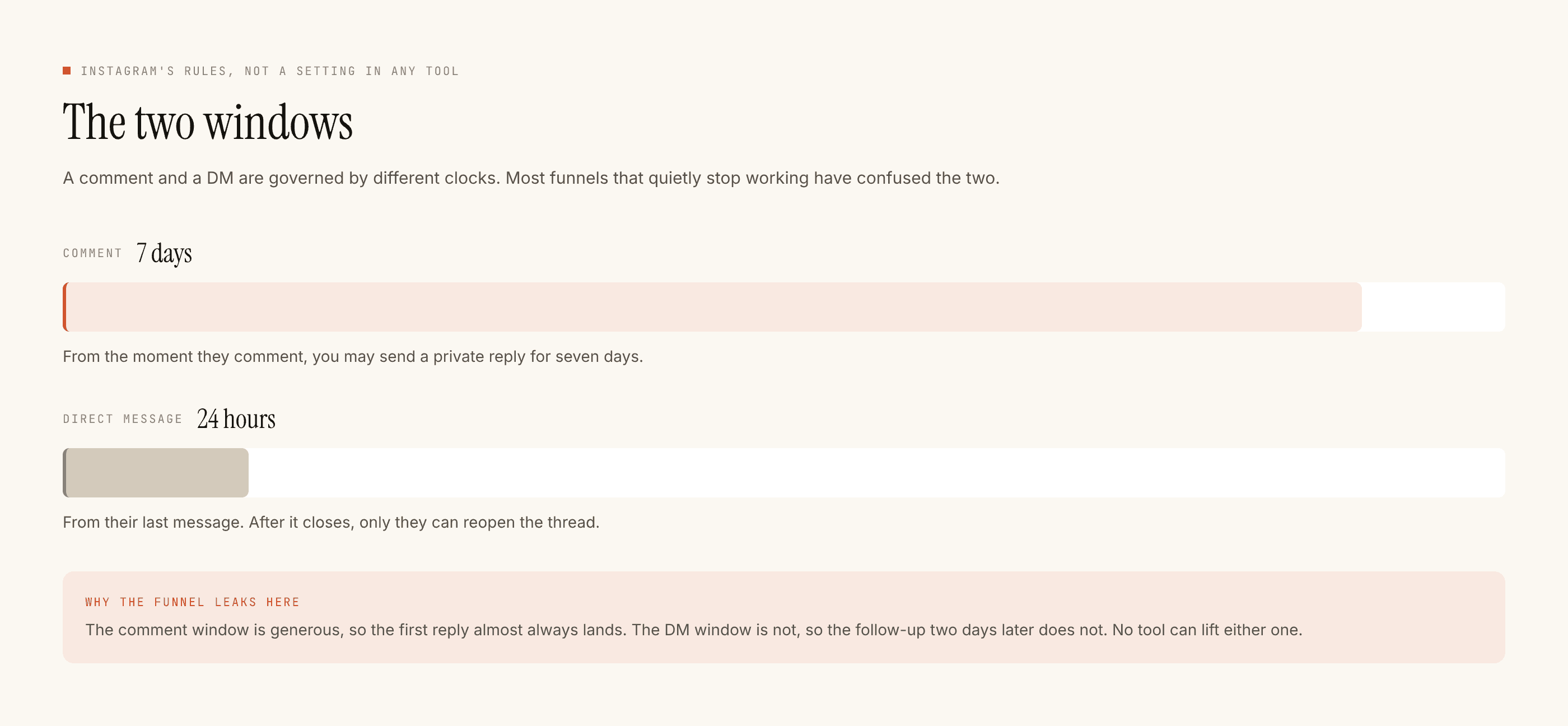
The official Instagram API gives you seven days to reply to a comment and twenty-four hours to reply inside a DM thread. The DM window is restarted only by their message, never by yours. A question that arrives at 11pm on a Friday and is noticed on Sunday afternoon is often simply unanswerable.
Which is the real argument for a template answering at 11:04pm rather than a person answering thoughtfully on Monday. Quiet hours exist and are worth using, but set them against your customers' clock, and think about whether late evening genuinely deserves to be inside them. For a lot of Indian accounts, late evening is the inbox.
An automation is not a faster reply. It is the only reply that still fits inside the window.
What is not different
The API is the same API. There is no separate Indian tier of the Instagram Graph API, no extra permission, and nothing that behaves differently because your audience is in Pune rather than Portland. Anybody claiming a special integration is describing something Meta does not offer.
There is no WhatsApp here. No UPI collection, no payment links, no invoice generation, no CRM sync. Leads captured from a conversation leave as a CSV, which you can then do whatever you like with. If you were hoping for a single tool that takes an Instagram comment all the way to a paid order in rupees, that tool is not this one and honestly is not most of the ones advertising it.
Where to start
One automation, on one post, answering the price question in both the languages your comments arrive in. Test it on yourself before it goes anywhere near a customer. Then read Activity and see what got stopped.
If you want the shopping-around version of this, the comparison for Indian D2C accounts is here, and the cost breakdown is here. Both are more useful than another list of features.