Playbooks · 5 min read
What AI Actually Adds for a Small Local Shop: Not Much

Here is a sentence a tool is not supposed to write about its own headline feature: if you run a single-location shop, salon, cafe or clinic, you should probably start with the AI switched off entirely.
Not as a trial. As the plan. Templates will handle the overwhelming majority of what arrives in your inbox, they cost nothing, and they say exactly what you wrote. The AI is a supplement for the leftovers, and for a lot of local accounts the leftovers are small enough that it stays a supplement forever.
That is worth explaining rather than asserting, because "AI for local business" is sold hard and the pitch rarely survives contact with an actual neighbourhood inbox.
What the AI half actually is
There is no mystery here and it helps to name it precisely.
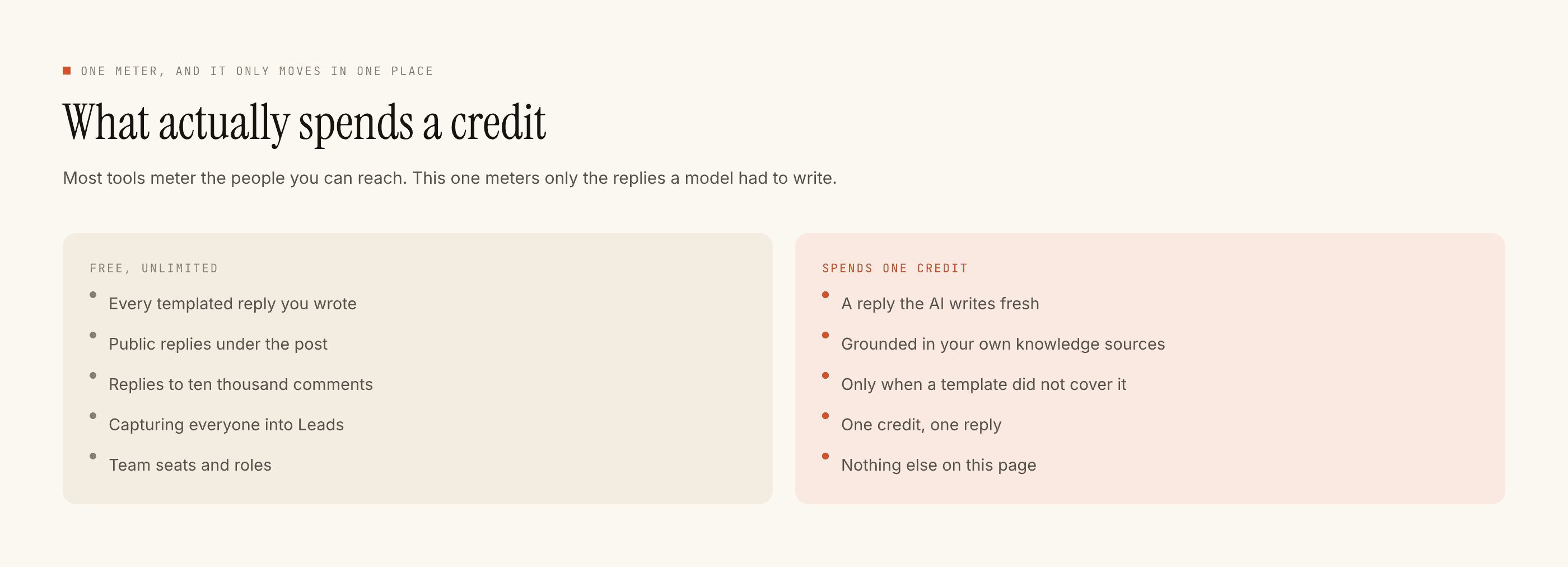
An automation matches a trigger and sends a reply. If you wrote that reply, it is a template: it goes out unchanged, free, unlimited, however many people ask. If you did not write one that fits, the AI writes a new reply for that message. That costs one credit. One credit, one reply.
That is the entire feature. It is not a personality, it is not a strategy, and it does not learn your business. It generates a sentence when there is no sentence on file.
Why templates win for a shop specifically
Because the questions repeat. A local inbox is not a stream of unique enquiries. It is the same nine sentences arriving in a different order. Generating a fresh answer to "what time do you close" is paying for variation nobody asked for.
Because the AI cannot see anything. This is the part that matters most and gets discussed least. A language model has no access to your shelf, your diary, your kitchen or your till. It knows the words that arrived. So on exactly the questions where a local business most wants help — is it in stock, is that slot free, what does that cost today — the AI is not better informed than a template. It is just more confident-sounding while being equally uninformed.
Because you can read a template. You know what it says because you typed it. A generated reply is a sentence about your business that goes out in your name and that nobody at your business has read. For most messages that is fine. For some it is not, which is why the review queue exists.
Fluency is not knowledge. A generated answer about your stock is a confident sentence written by something that has never been in your shop.
The two places a credit is genuinely well spent
Having said all that, there are two situations where the AI does something a template cannot, and both are real.
The message that is unlike the others. Someone describes a specific, slightly complicated situation — a colour correction on hair that was boxed at home, a bulk order for an office of forty with two people who do not eat onion, a repair on a model you stopped stocking. There is no template because there is no second person who will ever ask this. A generated reply that acknowledges the specifics, gives what is knowable and routes to a person is better than silence and better than a template that ignores what they said.
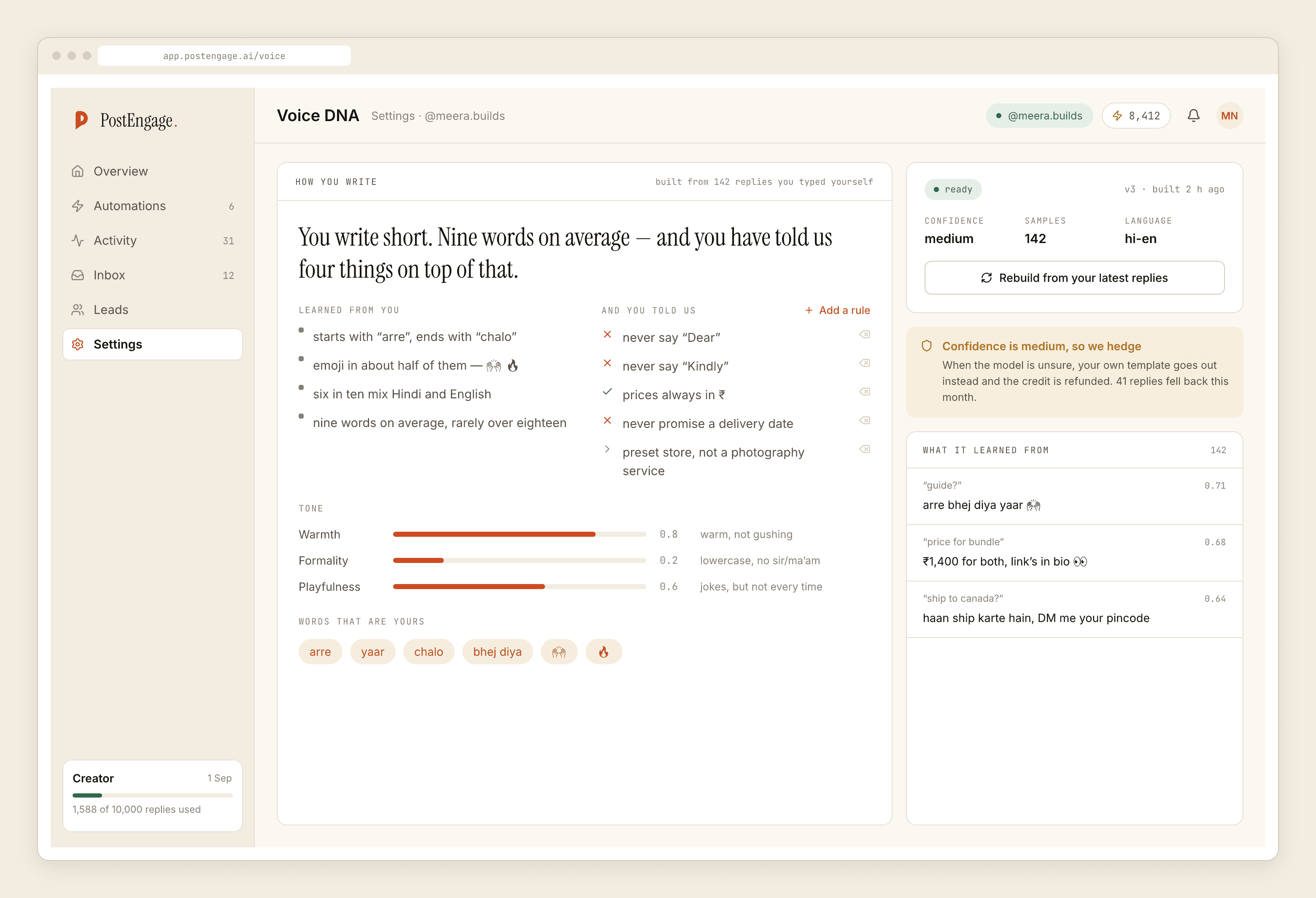
Register. Local accounts have a voice, and it is usually not corporate. If your counter would say "haan bhaiya, subah sat baje se khula hai", a polished English sentence from a shop that does not speak like that reads as a stranger. Voice DNA is built from replies you actually wrote, which is the only honest way to do this — it is imitating you, not inventing a brand voice.
Notice that both cases are the long tail. Neither is the volume.
How to decide, in two weeks, with evidence
Do not take a position on this in advance. Find out.
- Write templates for the questions you already know you get. Four to eight of them, from a tally of your own last month of messages.
- Run for two weeks with the AI off. Everything that matches gets a free reply; everything that does not, waits for you.
- Read Activity for what matched nothing. This is the whole experiment. Those messages are the only candidates the AI could possibly help with.
- Sort that list into two piles. Ones that are actually a missing template — write the template. Ones that are genuinely unique.
- Only the second pile justifies credits. If it has three messages in it, you have your answer, and it is that you do not need this.
Most single-location businesses come out of that exercise with a longer template list and a small credit spend. Some come out of it discovering that half their inbox is a question they never thought to answer publicly, which is a better outcome than any automation.
What AI does not add, whatever the pitch says
It does not know your stock. It does not know your diary — there is no calendar integration, so nothing here can confirm a booking. It does not sync to a CRM; leads leave as a CSV. It does not do WhatsApp. It does not write captions, schedule posts, pick hashtags or predict how a reel will do, because we reply to people and we do not create posts.
And it does not exercise judgement. On the messages where judgement is the whole job — a complaint, a safety question, anything clinical — the correct configuration is a negative keyword that stops the reply entirely and hands the thread to a person.
The arithmetic
Templated replies are free and unlimited. A credit is spent only when the AI writes a new reply. The free tier is 100 credits with no card, and packs start at ₹499.
Run those numbers against a local shop built the way this post describes and the honest conclusion is that many of them never buy a pack. That is not a limitation of the free tier. It is what the shape of a neighbourhood inbox looks like when you stop paying for variation you do not need.
If you want the full local build rather than the argument about AI, the playbook is here. If you are weighing automation against just answering things yourself, that comparison is worth reading too.