
Every Instagram automation tool demos the same way. A comment arrives, a DM goes out, the founder on the video looks pleased. On that surface they are genuinely hard to tell apart, which is why most D2C brands pick on price and switch within a quarter.
The differences that matter show up later, in three places: what you are charged for, what the tool refuses to do, and whether it sounds like your brand or like a helpdesk in another country. Here are the questions worth asking, and our own answers, which you should treat as a claim to verify rather than a conclusion.
One: what exactly is metered?
Not "how much does it cost". Tools meter wildly different units — contacts, conversations, messages, sends, seats — and two prices are not comparable until you know what the counter counts.
Our answer: templated replies are free and unlimited. A credit is spent only when the model writes a new reply, one credit per reply.
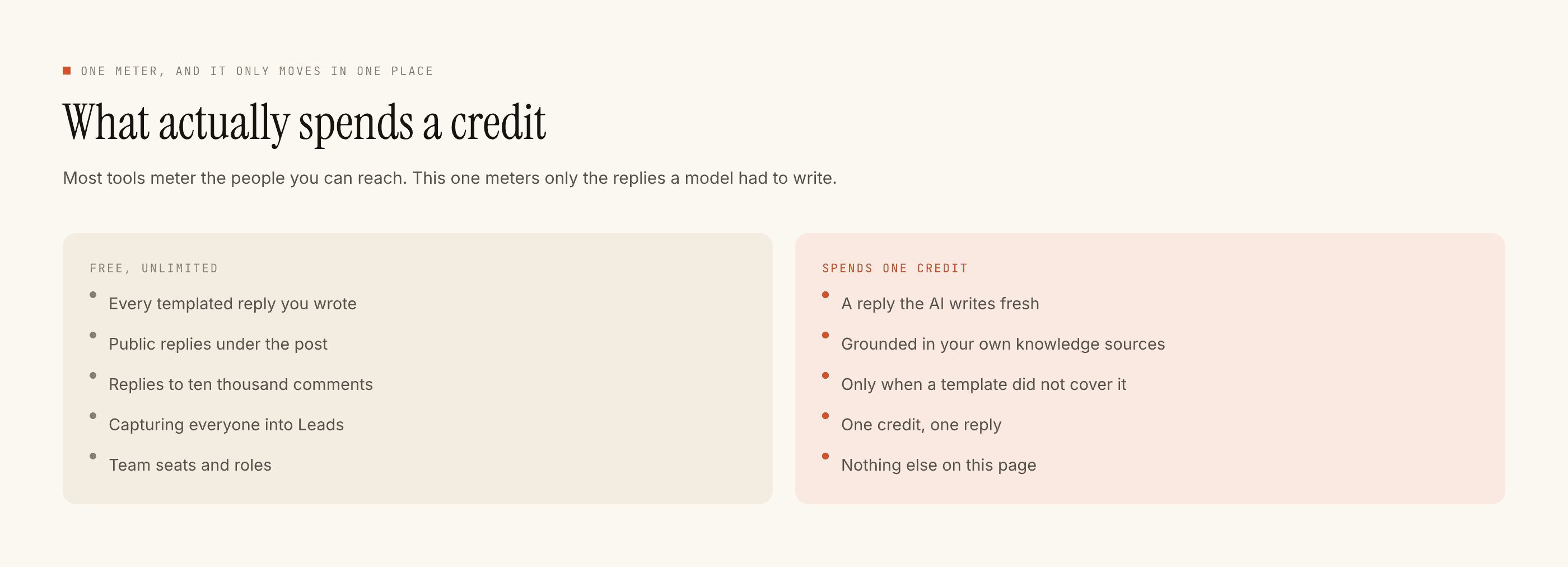
For a D2C brand this shape has a specific consequence. Price, delivery and sizing are your highest-volume questions and they are also templates, so the traffic that would dominate a per-message bill costs nothing here and the spend lands on the smaller pile of unusual questions.
Ask your shortlist how their counter behaves on the day a Reel travels. That is the day the bill is decided.
Two: does it bill in rupees, and can you actually stop?
Dollar pricing on a card is a bad fit for a brand with rupee revenue and a CA who wants a GST invoice. Worth confirming the currency at the top and the invoice at the bottom.
Ours: free tier of a hundred credits with no card, so you can read a fortnight of real replies before paying anything. Packs start at ₹499 and they are packs — you buy credits, you use them, nothing renews on you.
The related question, which people forget until they want to leave: can you export your leads. If a tool holds your list and only lets it out through an integration you must keep paying for, the price is not the price.
Three: what does it refuse to do?
This is the question that predicts whether the thing survives six months, and almost nobody asks it in a sales call.
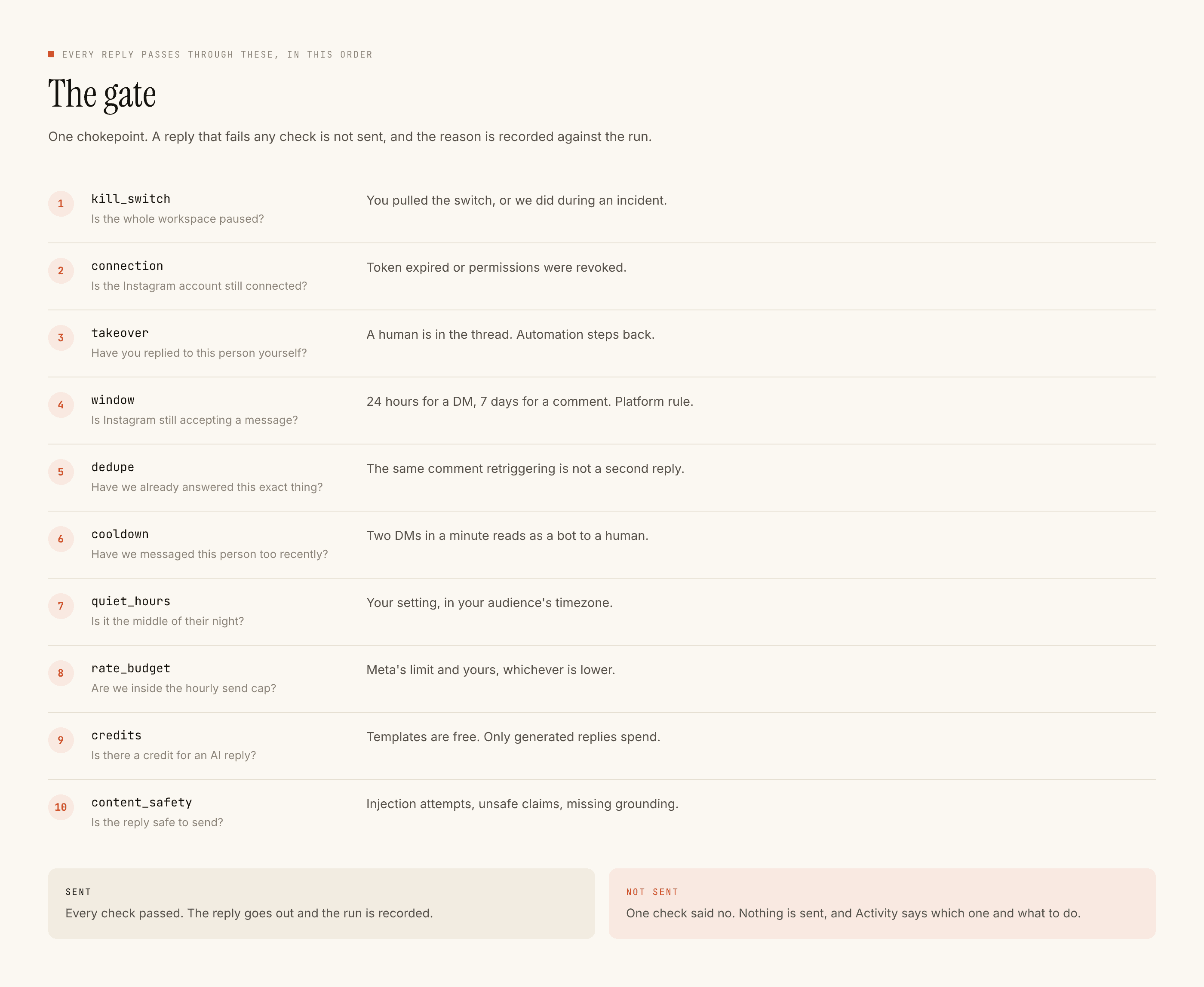
Ten checks run before every send, in a fixed order, first failure wins: kill switch, connection, takeover, window, dedupe, cooldown, quiet hours, rate budget, credits, content safety. A blocked send records which check stopped it.
The three a D2C brand feels most:
- Takeover. You reply by hand, automation leaves the thread. Without it, a customer gets your careful apology and then a cheerful bot message on top of it.
- Rate budget. A drop travels, the cap turns a burst into a queue instead of an incident.
- Quiet hours. Set in your customer's timezone. Most Indian brands settle somewhere around 9pm to 8am IST.
The operational value is not the blocking. It is that when someone asks why a customer never got a reply, the answer is a recorded field rather than a theory. The full list and why each check exists is worth reading before you commit to anything.
Four: is it on the official API?
Ask directly, and ask what happens when Meta changes something. Official Graph API access means the platform's limits are your limits — seven days to reply to a comment, twenty-four hours from someone's last DM, and no route at all to somebody who never contacted you.
Those limits are not a feature list, they are the boundary of the category. A tool promising to message people who have not messaged you is promising something the API rejects. That includes the abandoned-cart pitch every D2C founder has been sold at least once, which does not survive contact with the API for three separate reasons.
Five: does it sound Indian without being told to?
This is where most D2C brands actually lose. Your caption is Hinglish, your comments are Hinglish, and the automated reply comes back in flawless corporate English. Customers notice the seam instantly.
Voice DNA is built from replies you actually wrote — your sent messages, not a tone slider. If you have spent months typing "haan ji, M available hai, kal dispatch ho jayega", that is the register that comes back out. No language setting produces that, because the thing being copied is not a language.
A reply that is correct and sounds like nobody who works at your brand is a worse customer experience than a slow one that sounds like you.
Six: what is not built, and does the vendor say so?
We do not do WhatsApp. We do not post, schedule, or write captions — this replies to people, it does not publish for you. There is no Shopify integration; leads come out as a CSV that you upload wherever your marketing lives. There is no abandoned-cart trigger, because there is no such event on Instagram.
That list is the most useful page on any vendor's site and it is usually the one that does not exist. When you evaluate a shortlist, find the thing each tool admits it cannot do. A vendor with no such list has not been asked hard enough questions yet, or is answering them optimistically.
How to actually run the comparison
Do not run a bake-off. Pick the one whose metering matches your traffic shape, connect it, build a single automation on your best product post, test it on yourself, and read a week of blocked runs. That week tells you more than a month of feature tables, because it is your inbox rather than a demo account.
If you are shortlisting against the larger incumbents, the comparison by shape rather than by feature grid is the more useful frame, and if budget is the deciding factor, what free actually gets you in this category is worth reading with a sceptical eye, including about us.