Comparison · 5 min read
Free vs Paid Here Is One Line, and It Is Not Features
Two posts on this site already answer the free-tier question from the usual directions. What our hundred credits actually gets through in a week is the practical one. What free tiers give you across the category is the shopping one.
This is a third and narrower question that neither answers directly: what kind of line is the free-paid line here. Because the shape of it decides how you should use the product, and it is not the shape most people expect.
The usual shape, and why this is not it
The standard SaaS free tier is a feature ladder. The free plan has three automations, no team seats, basic support and a badge on your messages. The paid plan removes those restrictions. What you are buying is permission to use parts of the software that already exist and were switched off for you.
That is not what happens here. There is one meter and it measures one thing.
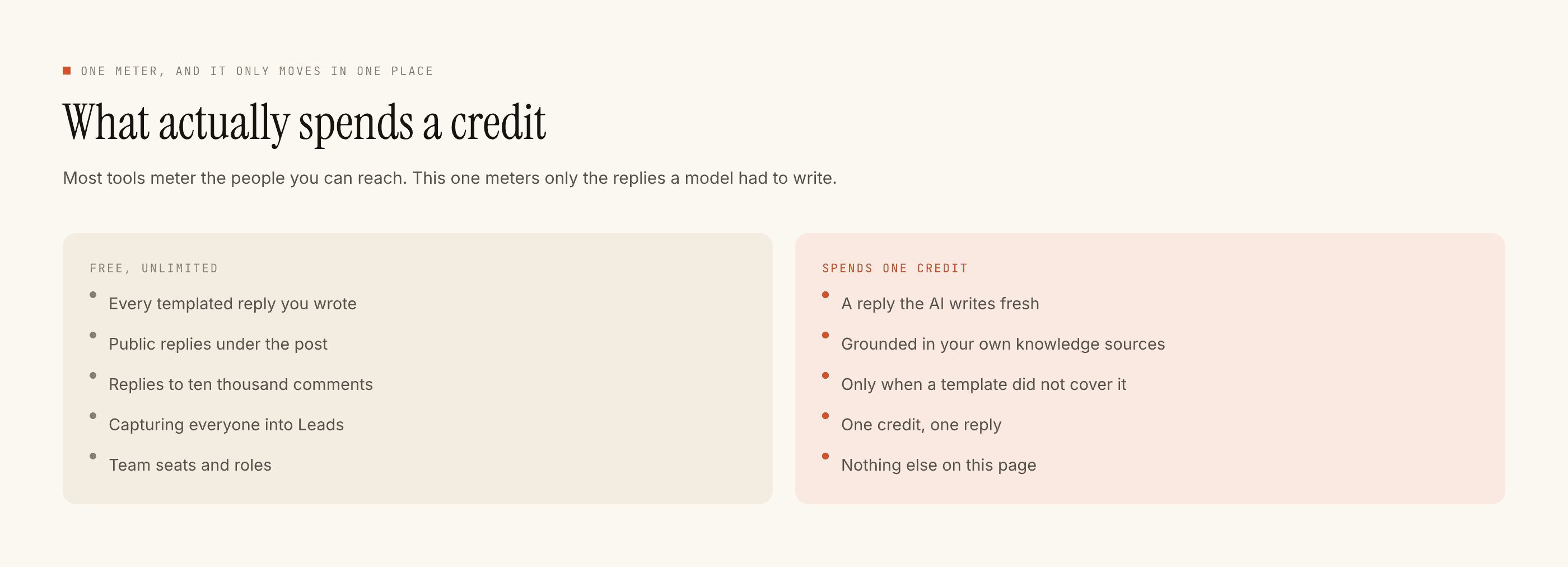
A reply you wrote is free, at any volume, forever. A reply the AI wrote costs one credit. One credit, one reply.
That is the entire line. Not the number of automations. Not the number of keywords, or posts, or leads, or conversations, or contacts stored. Not the safety checks. Not the builder.
What that means in practice
Three consequences, and the third is the one worth acting on.
The meter tracks novelty, not volume. A post that brings four hundred comments all asking the same thing costs nothing, because one template answers all of them. A post that brings forty comments all asking something different costs forty. That is the opposite of how a usage meter normally behaves, and it means a big account with a repetitive inbox can run on the free tier indefinitely while a small account with a strange inbox cannot.
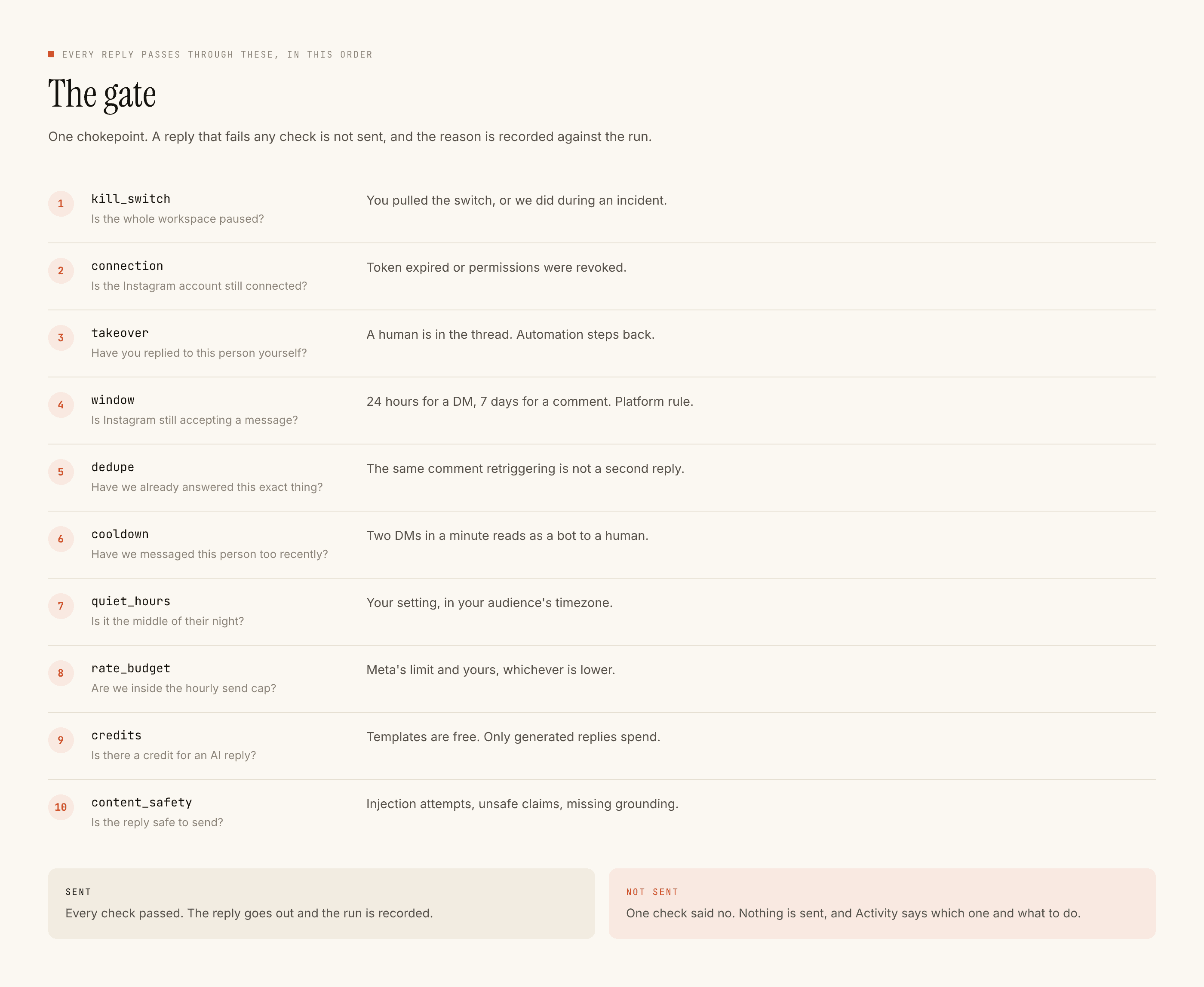
Safety is not on the ladder. All ten pre-send checks run on the free plan: kill switch, connection, takeover, window, dedupe, cooldown, quiet hours, rate budget, credits, content safety. A blocked reply is recorded with its reason either way. Gating account safety behind a plan would mean selling the risk back to you, and it is not something that becomes a paid feature later.
You can move work across the line deliberately. This is the part people miss. In a feature-ladder product, the only way to spend less is to use less. Here, the way to spend less is to write more down. Every question you turn into a template moves that traffic permanently from the paid side of the line to the free side — and it usually produces a better reply, because it is yours.
Writing a template is not a cost-saving trick. It is the product working as designed, and the credit meter is the list of templates you have not written yet.
So what does paying actually buy
Not capability. Headroom for the questions you did not anticipate.
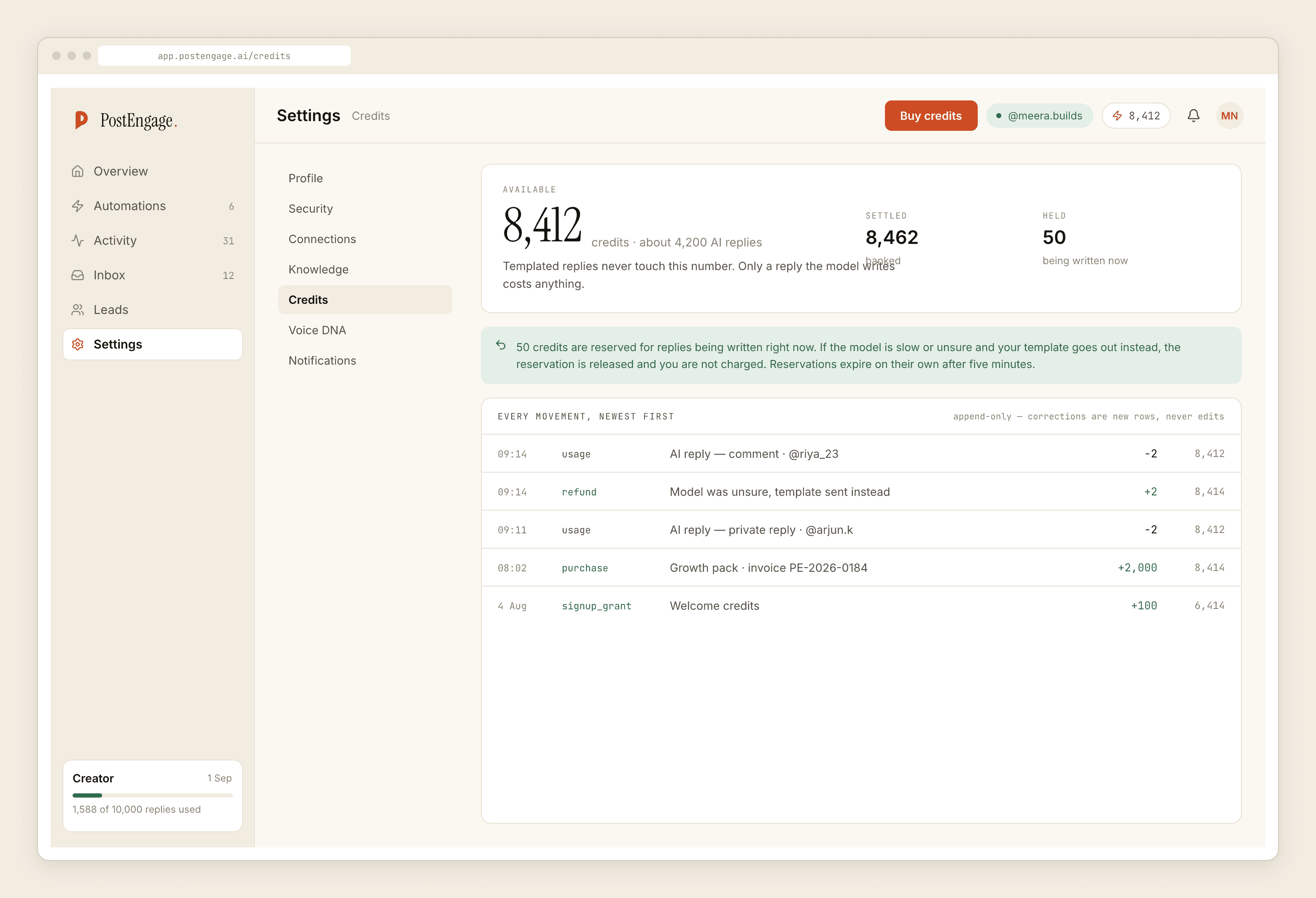
Free tier is 100 credits with no card. Credit packs start at ₹499. When the balance reaches zero, credits is the ninth check and it refuses the generated reply — so your template goes instead. The automation keeps running, keeps matching, keeps capturing leads, keeps answering the questions it always answered. Running out is a downgrade in reply quality for unusual messages, not an outage.
That is a deliberate design and it is worth knowing before a launch week, because it means an empty balance never takes your account silent.
A checklist for reading anyone's free tier, including ours
Whatever you end up using, these are the questions that separate a real free tier from a demo. Ask them of us too.
- Does it need a card? Ours does not. A free plan behind a card is a trial with a nicer name.
- What is metered — replies, contacts, or conversations? A contact meter charges you in December for someone who asked a question in March. We do not meter contacts, leads or conversations. There is nothing being held on your behalf that accrues.
- Is safety on the paid plan? If the pre-send checks, the takeover behaviour or the activity log appear on a pricing page as a paid line item, that is the vendor charging for the part that protects the account.
- Can you get your data out on the free plan? Leads export as a CSV here, on any plan. There is no CRM sync, no integration, no webhook — the file is the whole story, and it is not gated.
- What happens at zero? Ask specifically. Whether the automation stops entirely or degrades to your own templates is the difference between an outage and a quiet Tuesday.
When this shape is wrong for you
Worth saying plainly rather than having you find out in week three.
If most of your inbox is genuinely unique — a consultancy where every enquiry is a different problem, a made-to-order business where nothing repeats — then a per-reply meter is the expensive shape and a flat plan elsewhere may cost you less. We are not going to argue you out of that.
Count two weeks of your own sent replies before assuming it describes you. Most people who believe every message is bespoke find that four answers cover the bulk of it. But if you count and it does not, the arithmetic here works against you and you should know that on day one.
What is not on either side of the line
No plan here includes posting, scheduling, captions, hashtags, analytics, attribution, sequences, broadcasts, a flow canvas, WhatsApp, or a CRM integration. Those are absent from the product rather than from the free tier, and no upgrade produces them.
If you want the head-to-head against a wider platform, that comparison is written out in full. If you have not built anything yet, the three-minute setup uses only the free parts.