Comparison · 5 min read
WhatsApp Automation: What Is Free and What Never Is

"Free WhatsApp automation" is a phrase doing three different jobs, and the jobs are not compatible. One means free platform access. One means a vendor's free tier. One means the phone app that has no automation in it at all.
Knowing which one a page is selling you takes about ten seconds once you know the layers. Here they are.
Layer one: platform access, genuinely free
Meta does not charge a licence fee for the WhatsApp Business Platform. Creating a Meta Business account, getting verified, creating a WhatsApp Business Account, registering a number, generating a token, hosting on Meta's Cloud API — none of that costs money.
Receiving is free too. Inbound messages land on your webhook and are not metered. If your entire use case is "collect what people send us and route it internally", the platform bill can genuinely be nothing.
That is a narrower use case than it sounds, but it is real, and it is the honest kernel inside every "free API" headline.
Layer two: conversations, never free
Meta prices WhatsApp per conversation, in categories, at rates that vary by country and change over time. This is the layer that no free tier anywhere covers, because it is not the vendor's to give away.
Two nuances worth carrying:
- Category changes the rate. Marketing, utility, authentication and service are priced differently. Your mix matters as much as your volume.
- Inside the window behaves differently from outside it. Replying to a customer who wrote to you and initiating a conversation with someone whose window has closed are not the same event and are not treated the same way.
Layer three: software, where free tiers actually live
The API returns JSON. Everything a team touches — an inbox, agent assignment, a template manager, a builder a non-engineer can edit on a Friday, reporting — is software somebody wrote.
Vendor free tiers are real, and they are bounded by whatever the vendor is protecting: contacts, active conversations, seats, automations, retention. That is legitimate. The thing to check is only whether the free tier is bounded in the dimension you will grow in first.
What a free tier usually covers
What it does not
The fourth thing people mean: the Business app
The free WhatsApp Business app is a phone app. Catalogue, labels, quick replies, away messages, greeting messages. It is free in the way people mean the word — no bill, ever.
It also has no API. Nothing outside that phone can send a message through it, no store event can trigger anything, and it does not scale past one or two people sharing a handset. For a small business answering thirty messages a day it is frequently the correct choice, and pretending otherwise to sell software is dishonest.
The moment you need an order update fired by your store, a reminder sent without a human tapping send, or three people working one number properly, you have crossed into the Platform, and the Platform is metered.
The free app is not a smaller version of the API. It is a different product that happens to share a logo.
How the same question looks on a channel we do ship
Worth showing, because it explains why the pricing shapes differ so much between channels.
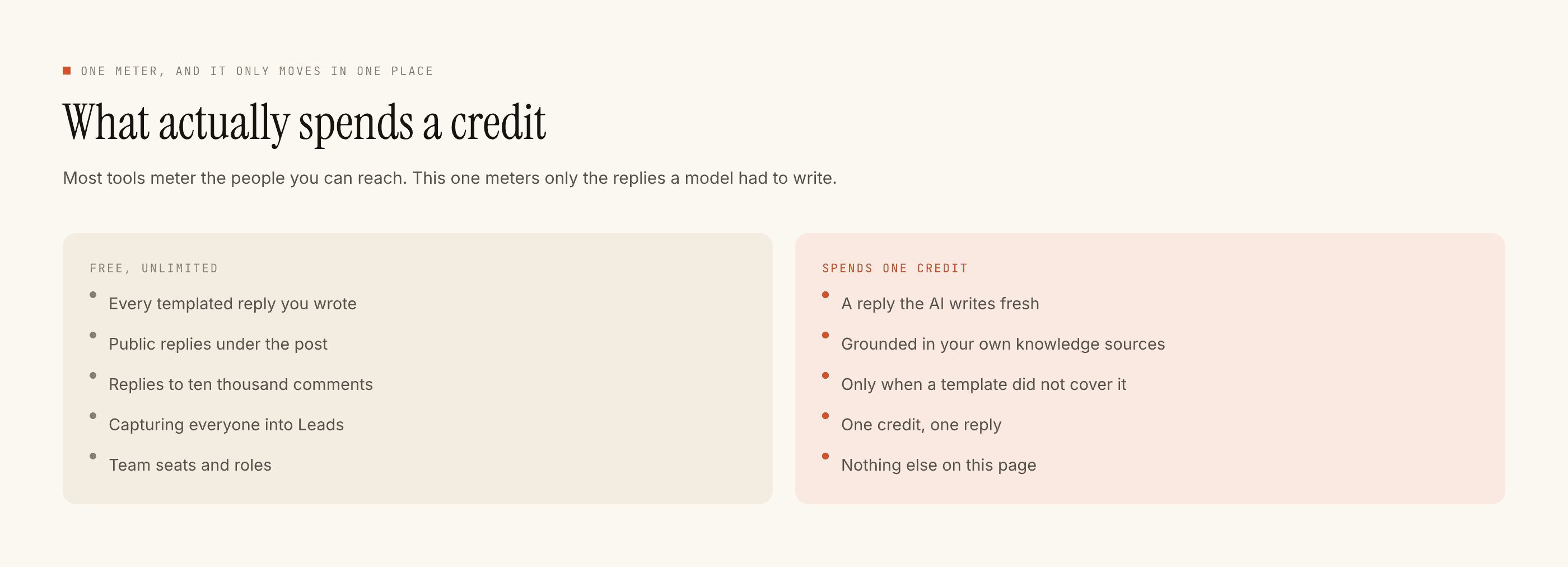
On Instagram, Meta charges nothing to deliver a reply. So there is nothing sensible to meter except the expensive part, which is a language model writing something new. Templated replies are free and unlimited. A credit is spent only when the AI writes a new reply — one credit, one reply. The free tier is 100 credits and no card, and packs start at ₹499.
That model is only available because delivery is free underneath it. On WhatsApp, delivery is the billable event, which is why nearly every tool on that channel prices per message or per conversation. It is the platform, not the vendors.
How to decide, without a spreadsheet
- Count the conversations you would start, not the messages you would send. That number, times a category mix, is the shape of your Meta bill.
- Ask whether most of your traffic is inbound. If customers write to you first, the economics are far friendlier than if you have to reach out.
- Check which dimension a free tier caps. Contacts and seats are fine limits if you are small; a cap on automations is not if automation is the point.
- Pilot before you commit. One use case, one small opted-in segment, a few weeks. Your first real invoice teaches you more than any calculator.
If you want the cost drivers rather than the layers, that is here. And if you are picking one channel to start on, the comparison between this and Instagram is the more useful decision to make first.