Playbooks · 5 min read
Instagram Automation Next to a Shopify Store, Without a Sync

Let us get the disappointing part out of the way in the first paragraph, because everything useful in this post depends on it being clear.
There is no Shopify integration. Nothing here reads your products, your variants, your inventory levels, your orders, or your customers. There is no app to install on your Shopify admin, no webhook going in either direction, and no plan you can upgrade to that changes this. If a page told you otherwise, it was v1 marketing and it was wrong.
What you get instead is two systems running side by side, one of which is very good at answering the questions the other one generates. That turns out to be most of the value, and it is worth being specific about which parts survive the missing pipe.
What a Shopify store's Instagram inbox is actually full of
Not catalogue browsing. People do not shop in DMs; they shop on your product page and then come to Instagram to ask the one thing the page did not settle for them.
Read a fortnight of your own messages and you will find the same shapes:
- "Kitne ka hai?" Price, asked under a Reel where the caption did not have it. Fully templatable, and the highest-volume thing you will automate.
- "Will L fit me?" Sizing, usually with the customer's own measurements attached. A chart handles the first half; the second half is a real conversation.
- "Delivery kitne din?" Shipping and COD. Stable for months at a time, which makes it the best template in your set.
- "Order kab aayega?" Order status. The one that cannot be automated correctly, ever, for reasons below.
- "Is this back in stock?" Availability. Automatable only if you write it honestly.
Three of those five are templates you write once. Templated replies are free and unlimited, so the bulk of a Shopify store's inbox costs nothing to automate at all.
The two that need care
Order status is not automatable. A person asks where their order is. The automation has no order table, no tracking number, no customer record beyond an Instagram handle. Any confident answer is fabricated. The correct automation here is one that acknowledges, asks for the order number, and hands the thread to a human — and then a human actually opens Shopify and looks.
There is a temptation to template a soothing "it is on the way!" for these. Do not. It is the reply most likely to end up in a screenshot.
Stock has to be written as a pointer. The reply going out today was composed weeks ago. It knows nothing. So the availability template should send them somewhere that does know:
The CSV, which is the whole integration story
Everyone who triggers an automation is captured to Leads with the keyword that caught them and the question they asked.
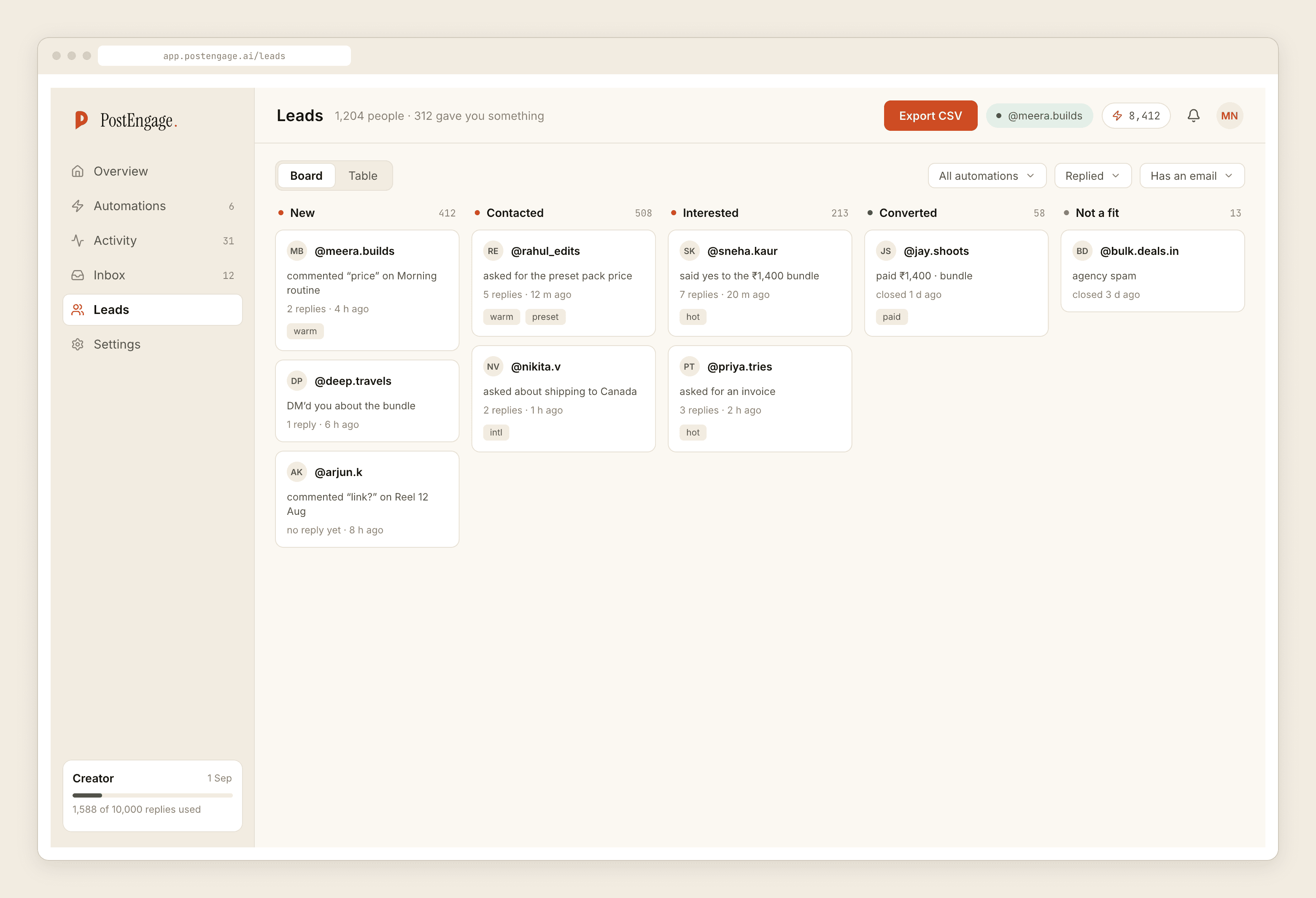
You export that as CSV. You upload it into Shopify Email, Klaviyo, your ad account, wherever your marketing already lives. It is manual, it takes about ten minutes, and I would rather describe it accurately than call it a workflow.
The reason it is worth doing anyway: these are not cold addresses. Each row is a person who typed a specific product keyword under a specific post, which is a better segment than most stores build deliberately.
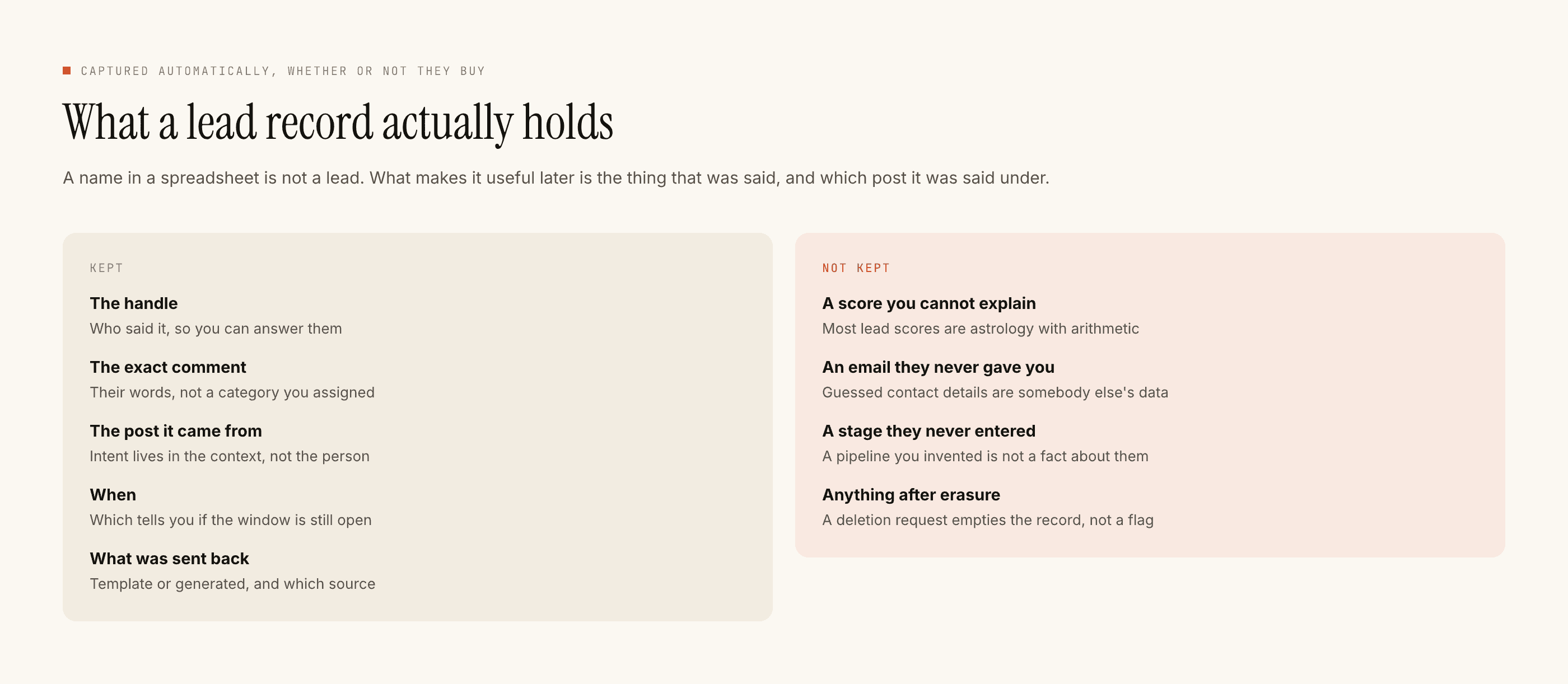
Worth knowing what is not on that record: no email unless they typed one to you, no phone number, no order history, no spend. If your plan involves matching Instagram leads to Shopify customers, that matching is you, in a spreadsheet, on handles and names.
What running them side by side actually looks like
Shopify holds
Instagram automation holds
Nothing crosses that line automatically. The person crosses it — they read your reply, tap the link, and land on your product page, which is the same journey as any other traffic source except that somebody answered them first.
The one operational habit that matters: when you change something in Shopify that a template mentions, change the template. New shipping partner, new returns window, price revision. Nothing tells the automation, so it will keep repeating your old policy indefinitely, politely, to everyone who asks.
An automation is a recording of what was true when you wrote it. Shopify is what is true now. Only one of those updates itself.
And the thing Shopify store owners ask for most
Abandoned cart DMs. The answer is no, and not for want of an integration — even with perfect Shopify data there is no route to that person on Instagram, because they never messaged you and Instagram does not let you open a conversation with someone who has not. The full explanation is here, and it is worth reading before you evaluate any tool that promises it.
What does work is narrower: the customer who DMs you about a product and then goes quiet is reachable for twenty-four hours, and that is a real recovery you can build.
For the wider scope of what this does for a store, start with the overview. If the CSV is going straight into an email tool, the list-building side is covered separately.