Product · 5 min read
Instagram Automation for Enterprises: What We Do Not Have

The enquiry usually arrives from someone who has been asked to shortlist three vendors. It contains a questionnaire, a request for a security document, a question about single sign-on, and a line about the legal team needing to review terms.
This post exists so that person can stop reading in four minutes instead of scheduling a call and finding out in forty. Most of it is a list of things this product does not do, and none of it is phrased as a plan.
The five answers
Single sign-on. No. There is no SAML, no OIDC, no directory sync, no SCIM provisioning. Access is not managed through your identity provider, which also means access is not revoked when your identity provider revokes someone.
A service level agreement. No. There is no contracted uptime, no support response time, no credits for downtime, and no status commitment you could put in front of a risk committee.
Dedicated support. No. There is no named account manager, no customer success contact, no onboarding programme, no shared channel with our team, and no escalation path that ends anywhere different from where everybody else's ends.
White-label. No. The product cannot be rebranded, resold under your name, or embedded in your own console. Agencies ask this most often; the answer does not change.
A procurement track. No. There is no enterprise tier to negotiate, no order form, no vendor onboarding call, no master services agreement to redline, and no sales team on the other end of a bid. The free tier is 100 credits with no card, and credit packs start at ₹499. That is the commercial surface, all of it.
If any one of those five is a hard requirement in your organisation, we are the wrong vendor, and the useful thing we can do is tell you now.
The seat problem, which is the real blocker
The item that most often kills this for a large organisation is not on the list above, because nobody thinks to ask it.
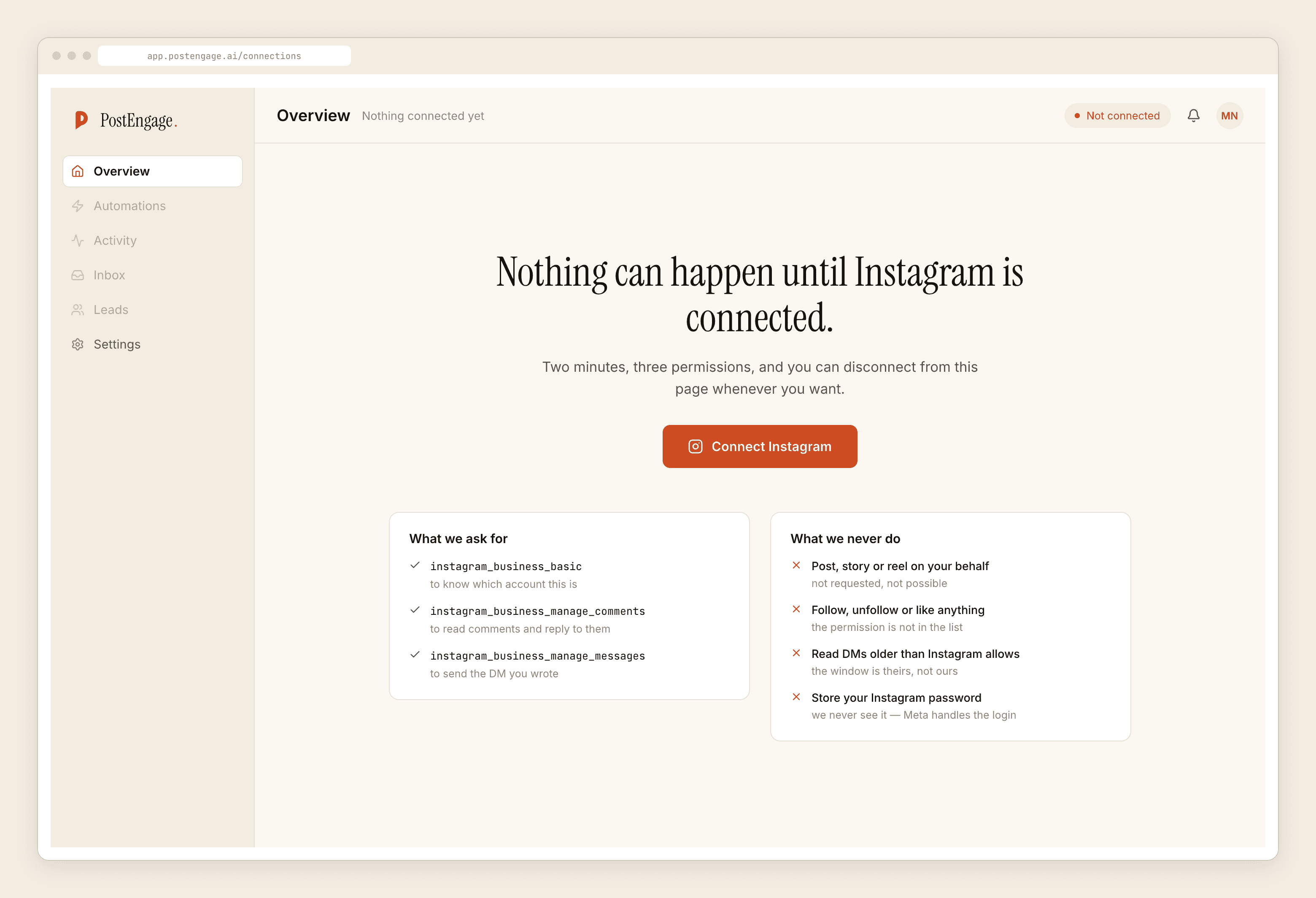
There is one connected Instagram account and everyone works through it. No per-user seats. No roles or permissions. No individual login trail showing which employee edited a template or typed a reply. An agency handling a brand and the brand's own social team are, from the product's point of view, indistinguishable.
For a team of two that is fine. For a social function with a rota, an approvals chain, an offboarding process and an internal audit that expects to attribute actions to named humans, it is a structural mismatch rather than a missing feature. Nothing about it improves with a bigger plan, because there are no bigger plans.
What does hold up, if you get past that
Some of what an enterprise reviewer actually worries about is present, and it is worth naming because it is the reason a brand-safety conversation can be short.
Nothing sends without passing a fixed sequence of checks. Kill switch, connection, takeover, window, dedupe, cooldown, quiet hours, rate budget, credits, content safety — in that order, every time. The first failure stops the send.
A refusal is recorded with its reason. Activity shows what went out and what did not, and why. For a reviewer asking "how would we know if this misbehaved", that log is the answer.
A human always wins. The moment anybody replies by hand, automation stands down in that thread permanently. Nothing generated appends itself underneath something your team wrote.
One switch stops everything. The kill switch is the first check in the gate. In an incident, somebody presses it and the account goes quiet immediately.
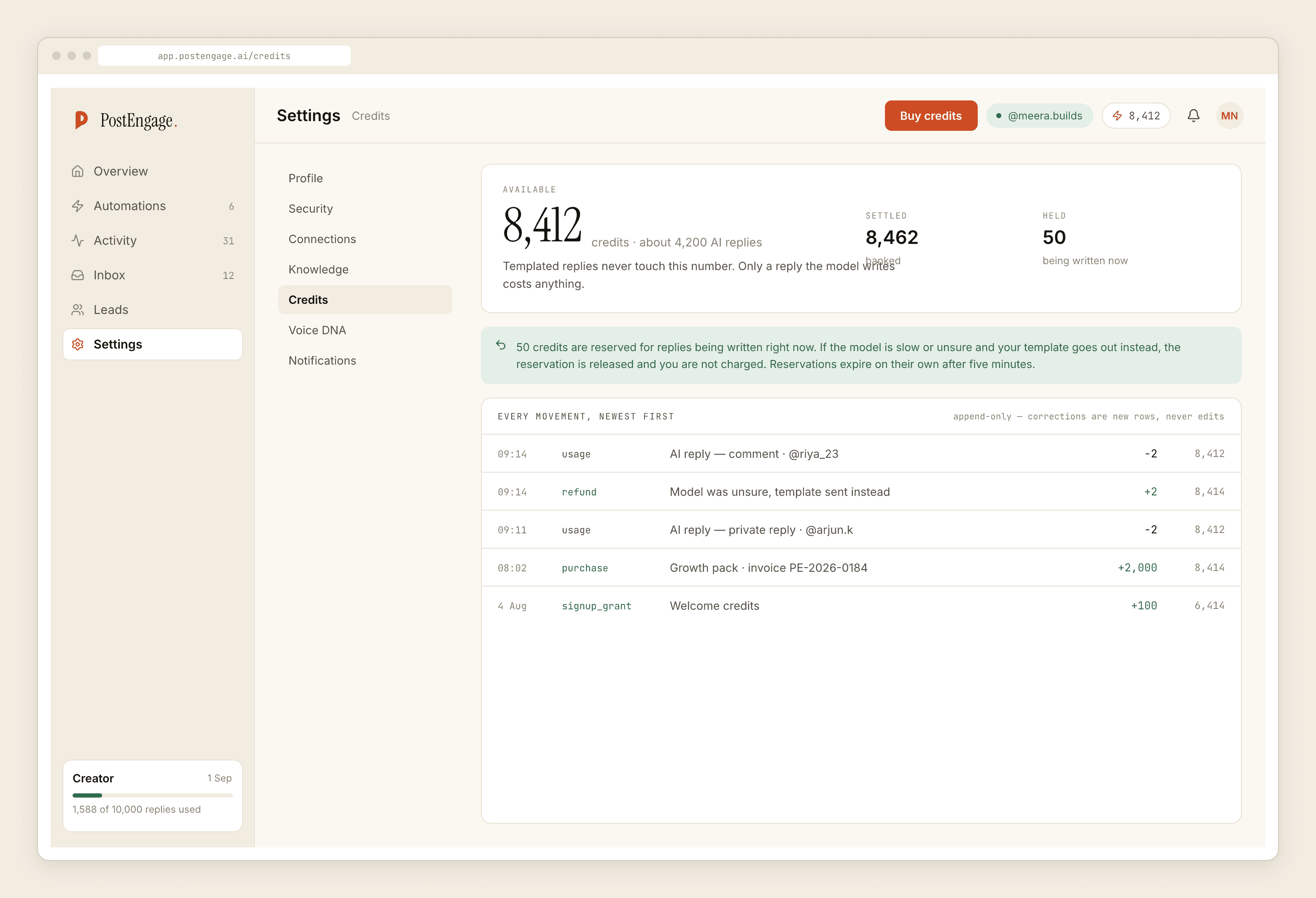
Templated replies are fixed text. They are also free and unlimited, and a credit is spent only when the AI writes a new reply. A brand that wants only approved wording going out can run a build where the AI never composes anything at all, which is the configuration most legal teams end up asking for once they understand the distinction.
The question your legal team will actually ask
In our experience it is never about features. It is: who approved this sentence, and how would you prove it.
The honest answer is that the proof lives with you, not with us. There is no approval workflow in the builder, no draft state, no version history, no record of who changed a template. Anyone with account access can edit live wording.
Organisations that handle this well keep the approved copy in whatever system already governs published communications, with a version and a named approver, and treat pasting text into a template as the act of publishing that version. That is a process you run. Nothing in the product enforces it, and a review that assumes the tool provides governance will be wrong.
Where this does fit a large organisation
Not as a platform decision. As a tool for a specific handle.
One brand account, a small team who all know each other, a market where the inbox is mostly repeat questions, a campaign that needs comment-to-DM for six weeks. That shape works, costs very little, and can be switched off cleanly. Several teams inside big companies run it exactly that way without it ever touching a procurement process, because at that scale it does not need to.
What does not work is adopting it as the standard tool for forty handles across eleven markets with a compliance function attached. There is no multi-account console, no consolidated reporting, no analytics product, no CRM or data-warehouse sync — leads leave as CSV — and no WhatsApp. Agencies running many client accounts should read the honest version of that setup before assuming otherwise.
What we are not going to say
We are not going to say any of these are coming. The list at the top is a description of the product, not a gap analysis, and a roadmap hint in a blog post is the kind of thing that ends up quoted back in a renewal conversation two years later.
If the five answers rule us out, they rule us out. If they do not, what stops a send and why is the document to hand your reviewer, and the supervision and record-keeping post covers the same ground for a regulated team.