Compliance · 6 min read
Instagram DMs at a Financial Firm: Routing and Records

A firm's Instagram account is not an individual adviser's account with more people standing behind it. It is a different object, and the difference shows up the first time a message goes out at two in the morning with the firm's name on it and nobody can say afterwards who signed off the wording.
The companion post to this one covers what an individual adviser must never automate — advice, returns, product suitability, anything that reads as a recommendation. All of that applies here too and this post will not repeat it. What follows is the part that only exists once there is more than one of you: routing, supervision, and what survives as a record.
Every automated reply is a communication your firm made
That sentence is worth sitting with, because the tooling makes it easy to forget. In the builder a template is a text field. In your compliance file it is an outbound communication to a member of the public, published at scale, repeated hundreds of times, in the firm's voice, with no human present at the moment of sending.
Which means the interesting question about a template is never "does it read well". It is: who approved this sentence, when, against what, and what would we produce if somebody asked.
Routing, described honestly
Here is what this product does not have, said plainly so nobody builds a process on top of a thing that is not there. There is no thread assignment. No round-robin. No per-adviser queues. No internal notes, no @-mentions, no escalation states, no SLA timers. Nothing hands a conversation to Priya because Priya covers pensions.
What exists is coarser and still useful. You can run several automations, each scoped in Advanced to specific posts, each with its own trigger words. Because a lead record carries the trigger that matched and the post it came from, the shape of the enquiry is visible before anybody opens the thread — the retirement-explainer post produces one kind of message, the first-job-savings reel produces another.
So routing at a firm is a human rota informed by that signal. The desk reads the inbox, sees which automation fired, and picks up accordingly. If your process needs a message to land in a named adviser's queue automatically, this is not the tool that does it, and pretending otherwise is how firms end up with enquiries nobody owned.
Template approval is your process, and the tool does not run it
There is no approval workflow in the builder. No draft state a compliance officer signs off, no version history, no audit of who edited what. Anyone with access to the account can change a template, and the new wording is live.
Firms that handle this well treat the builder as a publication surface rather than a document store. The approved wording lives in your own system — a document, a ticket, whatever compliance already uses — with a version, a date, and a named approver. Pasting it into a template is the act of publishing that version. Changing a live template without going back to that document is publishing an unapproved communication, and nothing in the product will stop you.
Then a standing quarterly job: open every live automation, read every template out loud, and check it still matches the approved text and still describes a service you actually offer. Templates rot quietly. The one announcing a webinar is still cheerfully announcing it in June.
What actually constitutes a record, and what does not
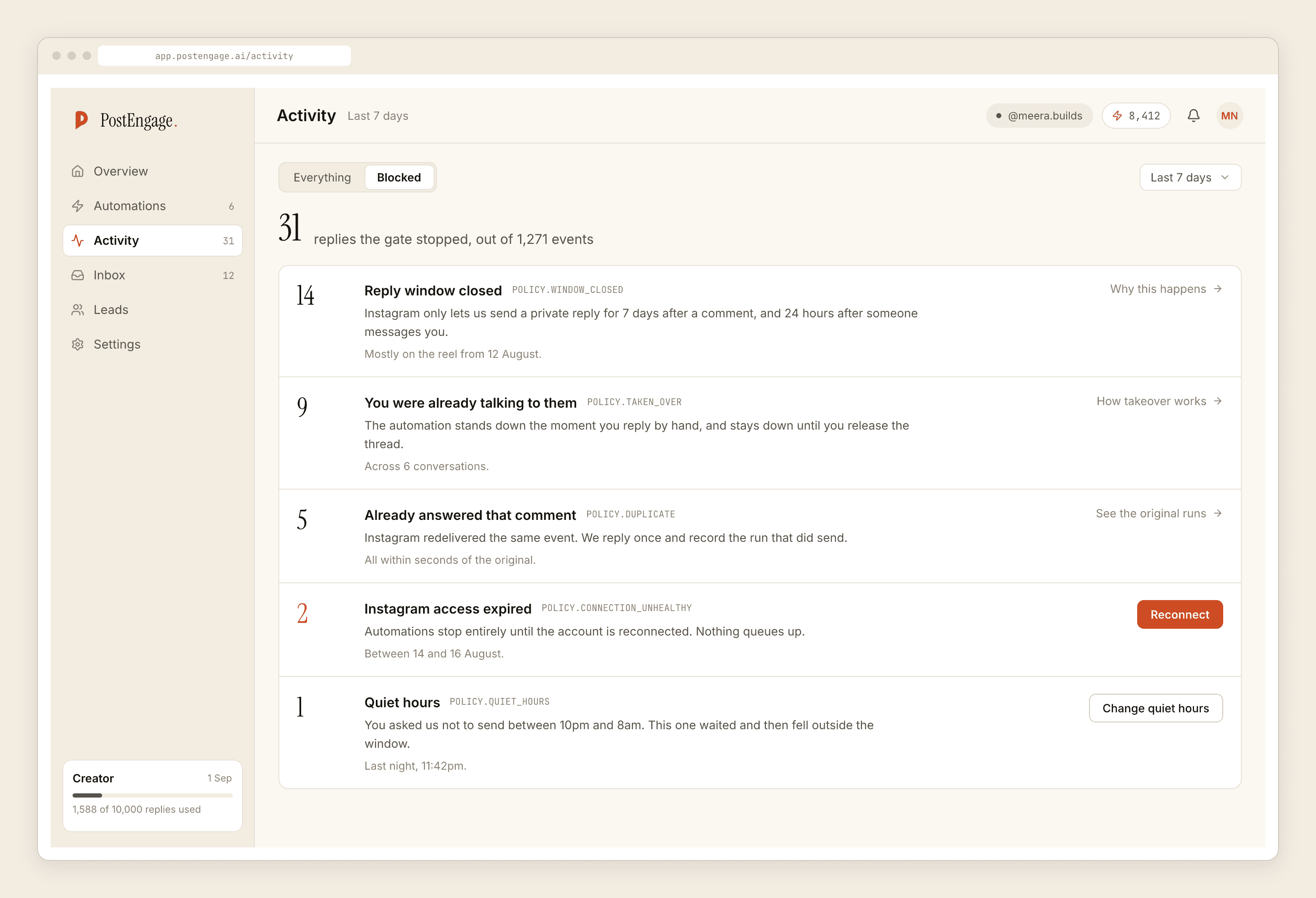
Ten checks run in a fixed order before anything goes out, and a blocked reply is written down with the reason it was blocked. Activity holds what was sent and what was stopped. Leads hold the enquiry, the trigger, and the timestamp, and export as CSV.
That is a useful operational log. It is not, and should not be treated as, your archive of record.
We do not publish a retention guarantee, and a firm subject to record-keeping obligations should not discover its position by testing it. Export on whatever cadence your policy requires, store it wherever your policy says client communications live, and reconcile it with the rest of your correspondence. If your obligations cover inbound social messages — and whether they do is a question for your compliance officer, not for this post — the safe assumption is that keeping them is your job.
One login, several humans
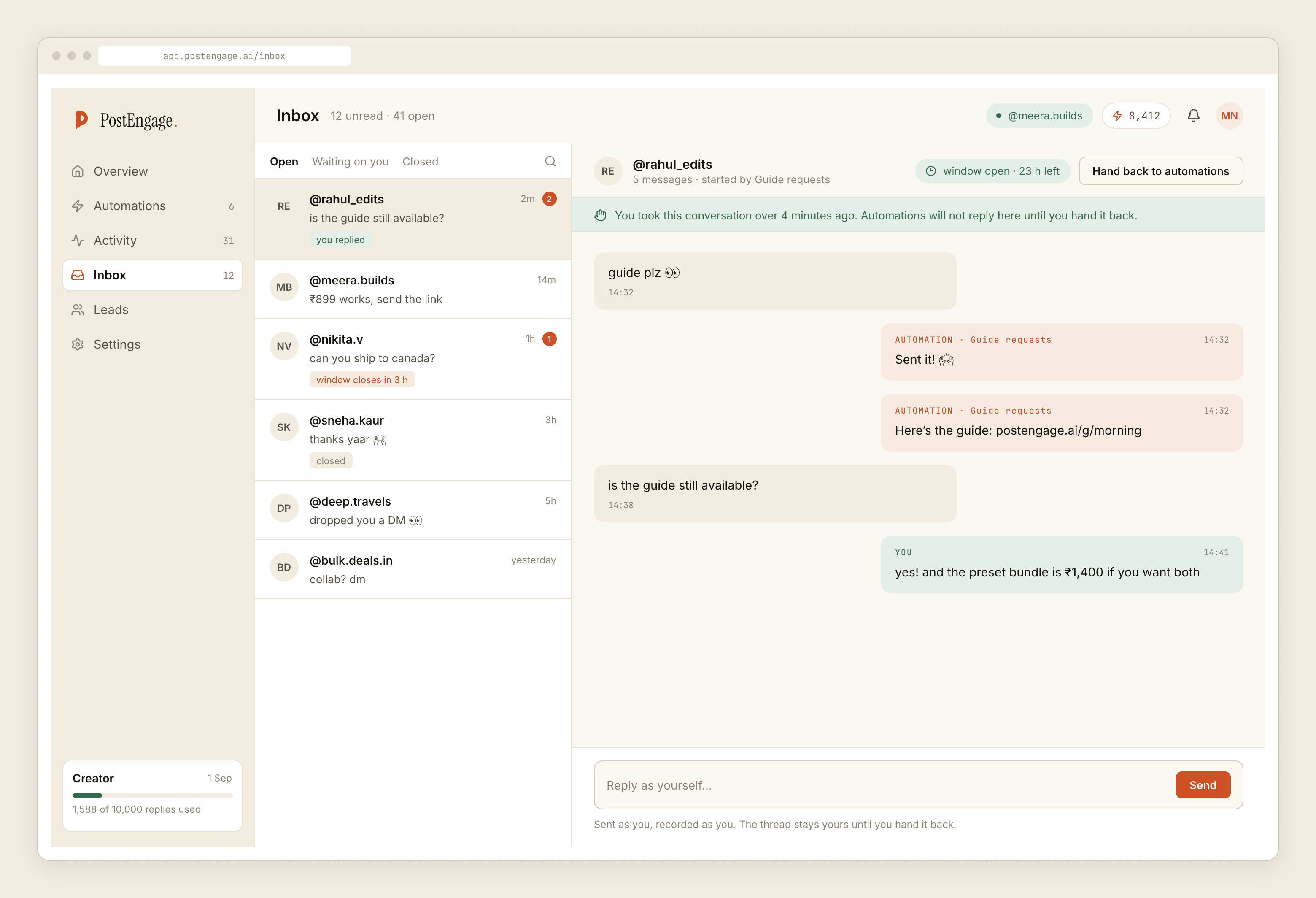
Takeover works the way you want it to: the moment anybody replies by hand, automation stands down in that thread permanently. That is the boundary between a supervised communication and an unsupervised one, and at a firm it should be crossed early and often.
What it does not give you is identity. There is no single sign-on, no per-user seats with individual audit trails, no way to prove which member of staff typed which reply. Everyone works through the connected Instagram account. If your security team's model requires named users and centrally managed access, read the honest version of what a larger organisation gets before you plan around this.
The out-of-hours holding reply
The one automation almost every firm should run is the least exciting one: a fixed, approved acknowledgement outside desk hours that promises nothing, states plainly that this is an automated message, does not engage with anything the person wrote, and points at the intake route.
It is legitimate because it is honest. It stops being legitimate the moment it says "one of our advisers will get back to you shortly" and nobody does until Tuesday.
Templated replies are free and unlimited; a credit is spent only when the AI writes a new reply. Free tier is 100 credits with no card, packs from ₹499. A firm running fixed approved wording barely touches the meter, which is the correct outcome rather than a happy accident. What stops a send and why is the next thing to read.