Playbooks · 5 min read
Selling Instagram Automation: What Agencies Can Charge For

An agency called us last year asking for a reseller tier. There isn't one. There is no white-label, no partner discount, no agency dashboard, no multi-client billing. Your client will see our product with our name on it, and they can sign up for it without you in about four minutes.
That is not a gap we are apologising for in this post. It is the premise of it, because an offer built on being the gatekeeper to a tool was always going to fail the moment the client googled the tool. The free tier is a hundred credits with no card. Packs start at ₹499. Nothing about that is a moat, and if your pitch deck is quietly assuming the client cannot find the pricing page, the pitch has a short life.
So the useful question is not how to resell software. It is what the client is actually buying when they pay you.
Why "we automate your DMs" loses
Three reasons, and they compound.
It describes a mechanism, not an outcome. The client does not want automation; they want to stop losing the person who commented "price?" at 11pm. Selling the mechanism invites them to compare mechanisms, and mechanisms are cheap.
It is priced against a subscription. The instant the offer is "we set up a tool", the client's mental anchor is the tool's price, and every rupee above that needs defending. You have volunteered to be a markup.
And it promises something you cannot fully control. Automation is a thing that refuses. Ten checks run before every send. Windows close, dedupe collapses repeat commenters, quiet hours hold overnight questions. An agency that sold "your DMs are handled" spends month two explaining the blocked list. An agency that sold something else spends month two doing the work.
The client is not buying a tool they could buy. They are buying the answers you wrote and the discipline of someone reading what got refused.
The deliverable is a written answer set
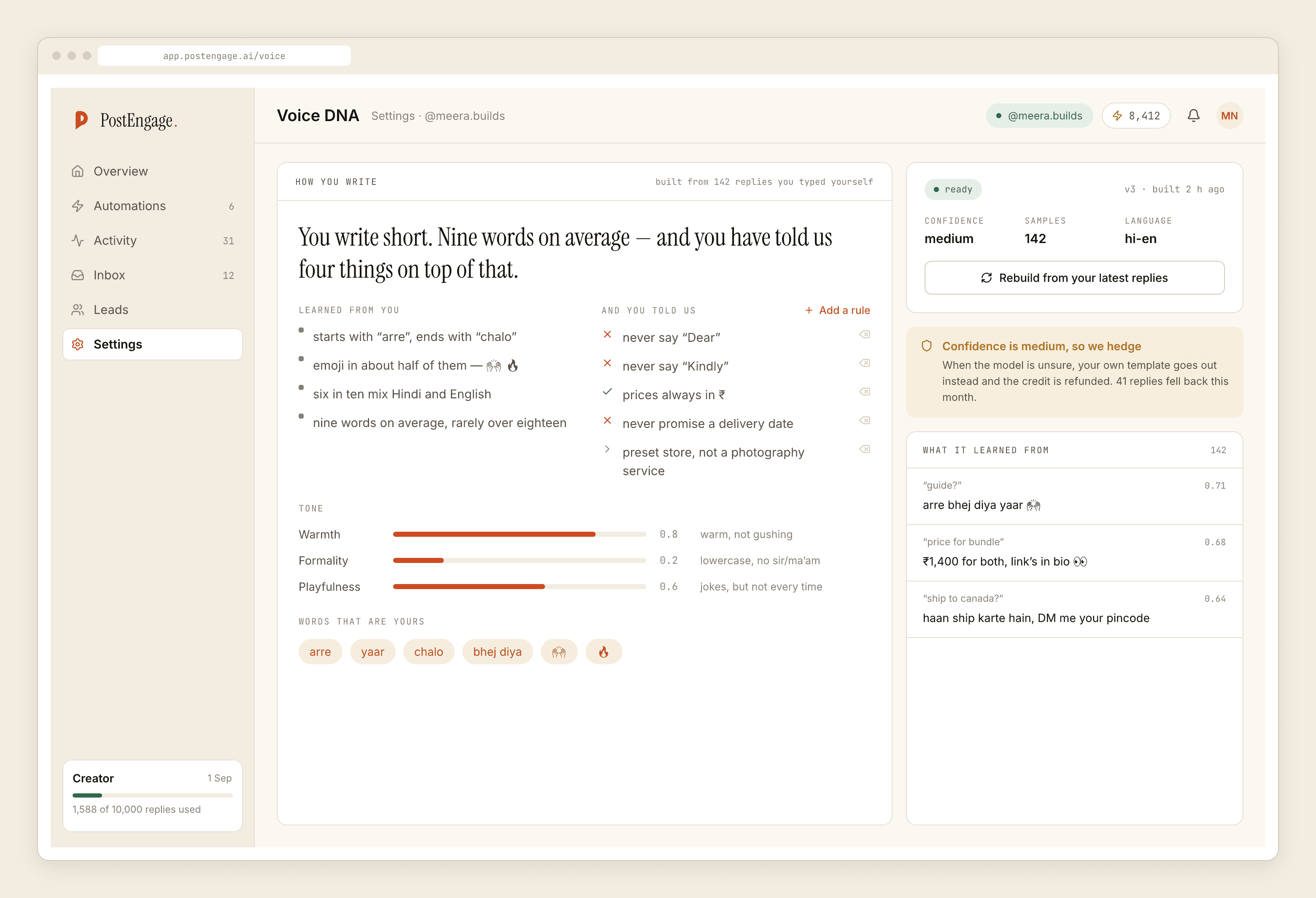
Here is the thing that has actual value and is genuinely hard: four to six answers, in the client's own register, that cover the majority of their comment section, plus the negative keywords that stop the automation replying to people it should not.
That is a copywriting artefact. It survives a tool change. It is specific to their business, their pricing, their delivery reality and the way their founder types. And most clients cannot write it themselves, not because it is long but because it requires reading two weeks of your own sent messages and admitting what you actually say.
What is billable, monthly
Setup is obviously billable: the audit of their inbox, the answer set, the negative keywords, the test pass, the go-live on one post before all posts. That is project work with a start and an end.
The retainer is the harder sell, and it should be, because a lot of agencies bill a retainer for nobody looking at anything. What genuinely deserves recurring money:
- Rewriting the reply set when the offer changes. Clients change prices, launch things and end promotions without telling you. A public reply quoting last season's price is worse than no automation, and preventing it is real work on a real schedule.
- Reading the refusals. A weekly pass through blocked activity, looking for the connection that quietly expired and the takeover pile that means the client's team is fighting the automation. Nothing pages you when a token dies.
- The lead handover. Leads leave as CSV. There is no CRM sync and no one-click connector. Somebody has to export, dedupe and tell the client which of these people are worth a call, and that somebody is a person with judgement, not a webhook.
- Teaching their team takeover discipline. Automation stands down the moment a human replies by hand. A client whose intern types "hi" into every thread has effectively switched the product off, and only you will notice.
The bit about credits, said plainly
Templated replies are free and unlimited. A credit moves only when the model writes a new reply. So the cost shape is not per contact and not per conversation; it tracks how much of the inbox is genuinely novel.
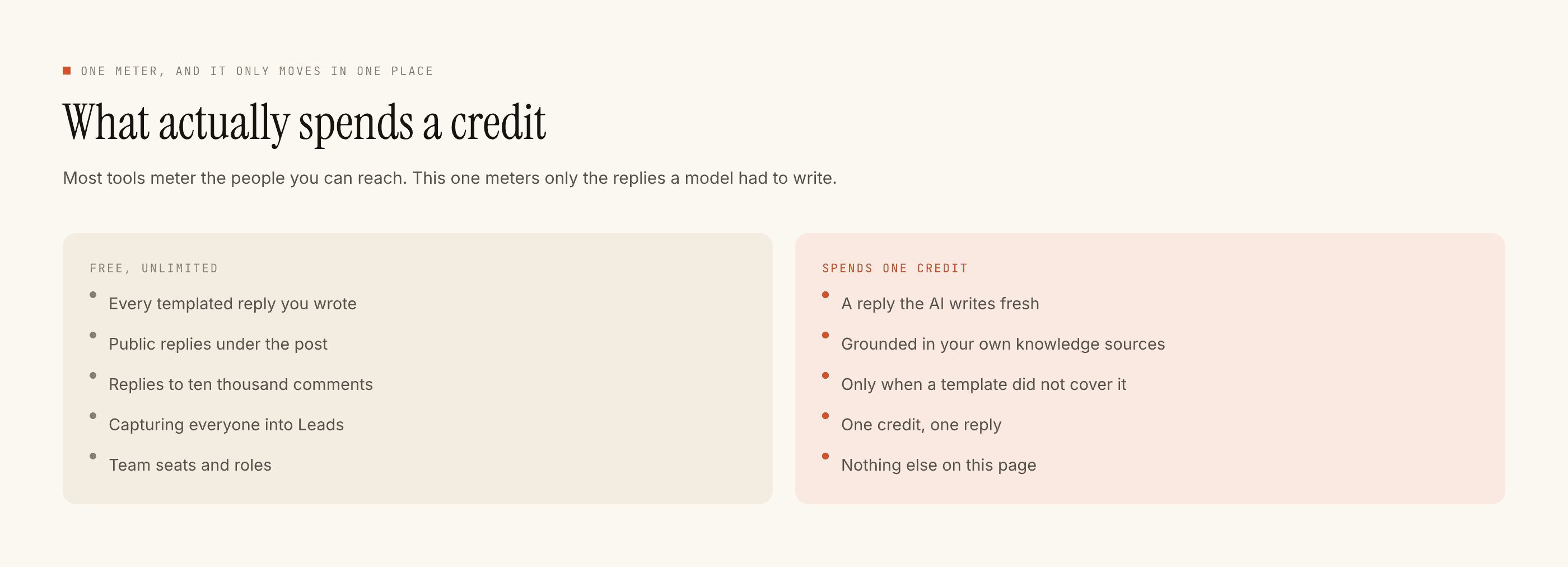
Whether you mark this up or pass it through is your business decision, and both are defensible if you say which one you are doing. What is not defensible is quoting a monthly software figure to a client whose usage you have not looked at. You will be wrong in one direction and it will surface in month three.
The offer that gets undercut
The offer that holds
The right column is smaller. It is also the one that survives the client's procurement person, because every line of it is a thing a human did that they can see.
If the question underneath this is how the operations hold up once you are running this for a dozen accounts at once, that has its own set of failures. And the concessions we make to agencies generally are worth reading before you build a service line on top of us.