Playbooks · 5 min read
Instagram Automation for Creators: An Honest Overview
A creator account that has started earning has a different inbox from a shop. A shop's DMs are transactions. A creator's DMs are transactions mixed in with people who feel they know you, which is the thing that makes the account work and also the thing that makes the inbox impossible.
This is an overview of what automation can honestly do about that. It starts with what it cannot, because for creators the list of absent features is longer than most people assume.
What this is not
It does not grow your account. There is no follower feature, no engagement pod, no auto-follow, no auto-like, no commenting on other people's posts.
It does not make content. No caption generator, no hashtag tool, no content calendar, no scheduling, no publishing, no Reel performance prediction.
It does not measure anything. No analytics, no attribution, no click tracking, no revenue reporting.
It does not message anyone who has not messaged you first. No broadcast, no sequences, no drip, no WhatsApp.
What it does is reply to people, on the official Instagram API, in your words. That is a narrower job than most creator tool lists imply and for a monetised account it is the one that is currently eating your evenings.
The four piles in a creator inbox
Sort a week of your DMs and comments and they land in four groups. Each wants completely different treatment, and knowing which is which is most of the setup work.
Automate these
Never automate these
The left column is the bulk of the volume and almost none of the emotional weight. It repeats endlessly, the answers never change, and every one of them is a template. Templated replies are free and unlimited, so answering "which camera" four hundred times costs nothing.
The right column is why creator automation has a bad reputation. A template landing on a message from somebody who was being sincere is the failure people screenshot, and it is entirely preventable with a negative keyword list you write on day one.
The voice is the asset, so it is the thing to protect
For a shop, an off-key automated reply is a slightly awkward message. For a creator it is a crack in the only thing you are actually selling.
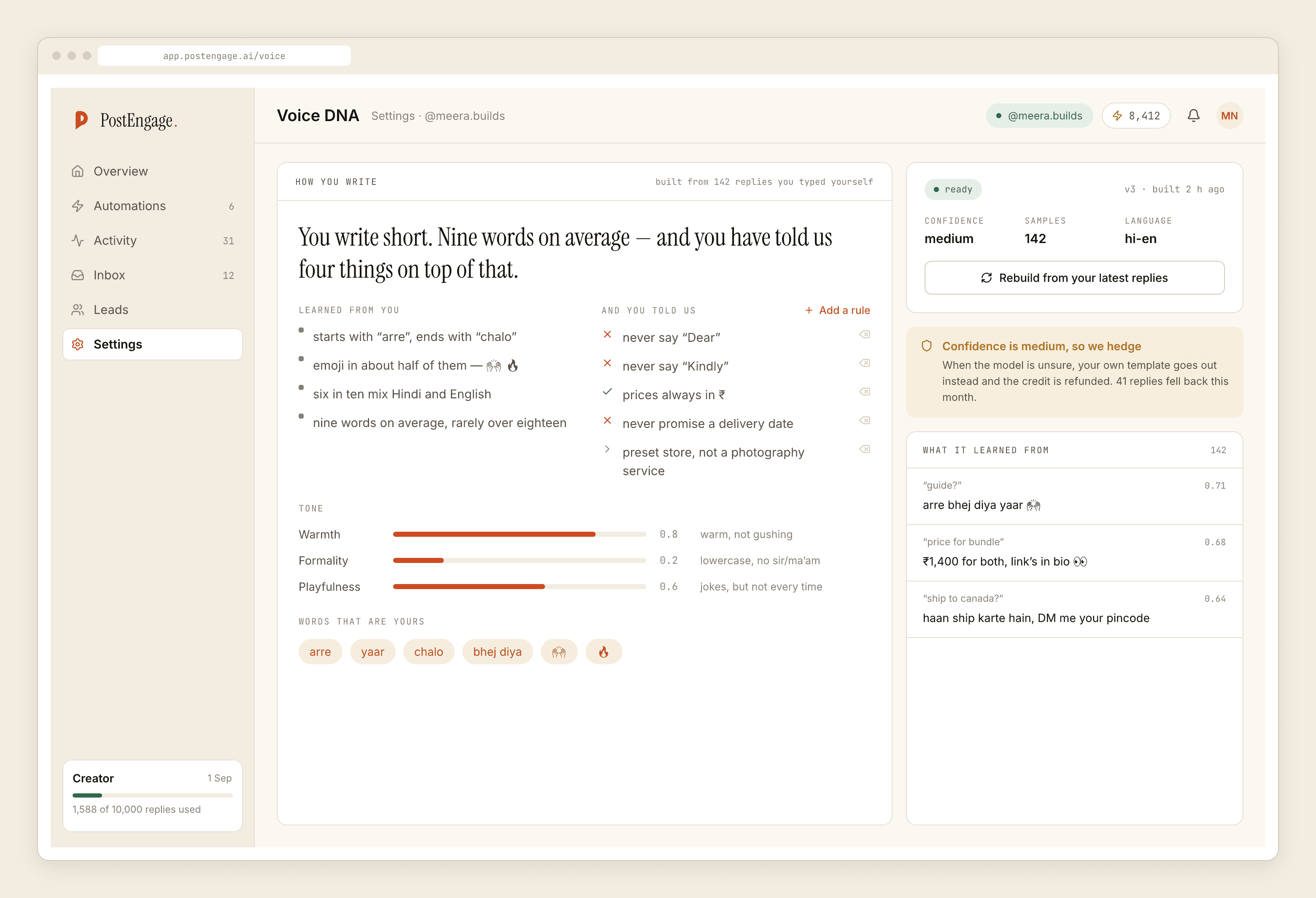
Voice DNA is built from replies you actually wrote. Not from a tone slider, not from a personality preset, not from a sample of the internet — from your own sent messages. Which means two practical things.
First, the more of your real replies exist, the closer a generated reply lands. Writing templates in your own words is not a chore you do to save credits, it is the input to everything else. What the voice profile is built from is worth reading before you rely on a generated reply in public.
Second, if somebody else answers your DMs, you are training the profile on their writing. That is fine if you meant it and a problem if you did not.
Your audience can tell. They have read thousands of your sentences, which is more training data than any model has.
The three automations to start with
Not ten. Three, and read what each one does for a week before adding the next.
- The product question on your best-performing post. Whatever people ask under it constantly — the price, the link, the brand. Scope it to that post specifically, under Advanced, so it does not start answering strangers on your back catalogue.
- The "where do I buy" catch-all.
link,where,buy,shop,kahan se,price. Matching folds case and punctuation, so you are listing words rather than spellings. One template, one link, one closed question at the end. - The refusal list, which is really an automation even though it looks like a field. Every word that must produce silence:
refund,payment,collab,rate,sponsor,not received, plus whatever your particular audience says when something has gone wrong. This is the one that protects the account.
Then press Test on myself, which sends the whole pipeline to your own account and changes nothing publicly. Test the refusals rather than the sends. Confirming that a negative keyword produces nothing is worth more than confirming a template arrives.
The part that actually reduces the burnout
Creators usually expect the relief to come from volume — fewer messages to answer. It comes from somewhere else: from not having to be available.
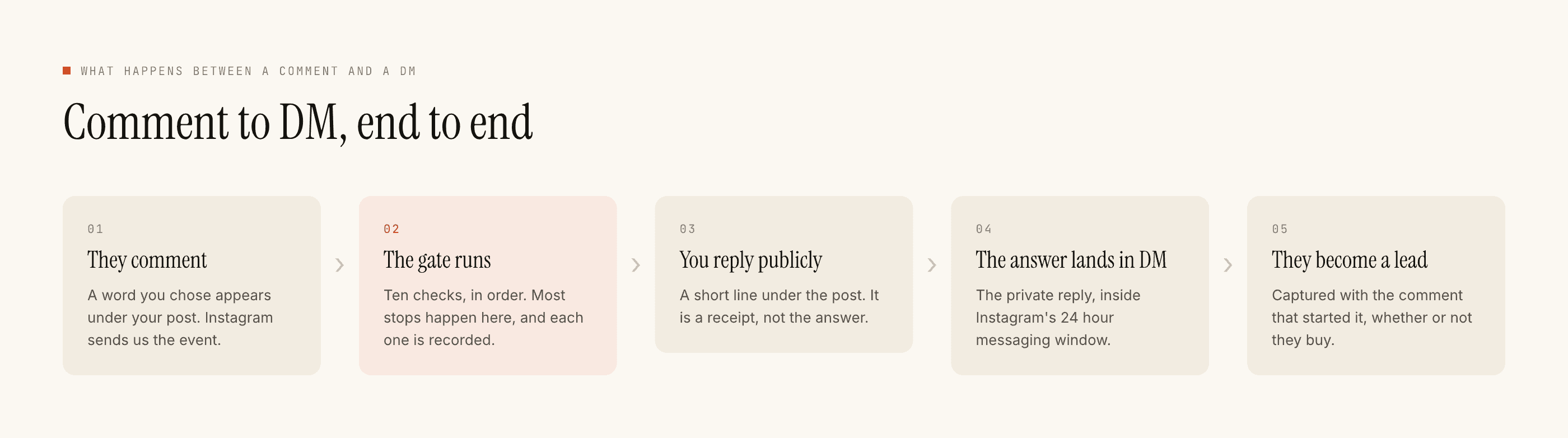
The seven-day comment window means a comment left on Tuesday's reel is still answerable at the weekend. Quiet hours mean a 2am question waits until morning rather than pulling you in. Takeover means the automation stands down for a thread the instant you reply by hand, so the conversations you do want are entirely yours with nothing talking over you.
That combination is what makes it possible to close the app. The burnout post argues this properly and is the one to read if the inbox is the reason you have stopped enjoying the work.
What it costs
Free tier is 100 credits with no card. A credit is spent only when the AI writes a new reply — one credit, one reply — so a well-templated creator account can run on the free tier for a long time. Packs start at ₹499 when the unusual questions outgrow it.
Leads export as a CSV. There is no CRM sync and no integration, so if the list needs to go somewhere, it goes as a file.
If brand deals are part of your income, the micro-influencer inbox post covers which collab DMs deserve your own words and which honestly do not. If you are setting up from scratch, the paced guide goes in the order that keeps each piece debuggable.