Playbooks · 5 min read
Automation Removes One Load. It Does Not Fix Overwork.

There is a version of this post that is easy to write. Creator was drowning, creator installed automation, creator is now free. You can find it on every tool's blog, usually with a number in the headline that nobody sourced.
We are not going to write that one, because it is a claim about a person's life made by a company that sells software, and the claim does not hold.
The one thing it removes, named precisely
Not "your DMs". Not "admin". One thing: typing an answer you have already typed.
That is a real and specific load. It is the fifth "what mic do you use" of the day, the third "is the discount still on", the reply you compose from memory while your attention is somewhere else. Repetition of that kind has a peculiar quality — each instance is trivial, so it never feels worth solving, and the total is not trivial at all.
Software is genuinely good at this and at almost nothing else in the vicinity. A templated reply goes out in seconds, in words you chose, and you never see that message again unless the person writes back with something new.
Notice what that does not include. It does not reduce how many people want something from you. It does not make the messages stop arriving. It does not turn your phone off. The notifications are unchanged; only the obligation to compose the same sentence is gone.
The test that tells you whether this will help you at all
Before you install anything, do this, because it takes twenty minutes and it will save you from a disappointment.
- Open the last seven days of your inbox and read it in order. Not skim. Read.
- Mark each message with one of two letters. T if you could have answered it with a template you had written earlier. M if it needed you specifically — because of who it was from, or what it said, or the fact that a stock answer would have been an insult.
- Look at the shape of the two piles.
If the T pile is large, automation removes something real, and you will feel it within a week.
If the M pile is large — if most of what arrives genuinely needed you — then automation removes very little, and installing it will mostly give you a new dashboard to check. That is a worse outcome than doing nothing, and it is a common one. An inbox can be exhausting because it is heavy rather than because it is repetitive, and those two problems do not share a fix.
When the inbox is the symptom
Here is the part the easy version of this post leaves out.
The inbox is frequently not the load. It is the load you can see. Deadlines you agreed to, a posting cadence you set when things were smaller, money that depends on continuing, sponsors with deliverables, an audience relationship that has changed shape — none of that is in your DMs, and none of it is touched by a reply tool.
Installing software in that situation has a specific failure mode: it feels like action. You spend a Saturday building automations, the inbox gets faster, and on Monday the actual weight is exactly where it was. If anything you now have one more system to maintain.
If the thing wearing you down is the volume of what you have agreed to, no tool that answers messages is going to touch it.
We would rather say that than sell you a plan.
Two ways automation makes things worse
Both are common enough to name.
Spending the freed time on more output. The hours come back and go straight into another posting slot, another format, another platform. The load is unchanged and now it is compounding. Whether that happens is a decision you make, not something the software does, but it is worth knowing that the decision arrives.
Automating the good part. This one is the real risk. The messages that say the work mattered to somebody are repetitive in shape — they look, to a keyword matcher, exactly like the low-value ones. They are also, for a lot of people, the reason the job is still worth doing. Automating them is a straightforward way to remove the last thing giving the work meaning, and it happens by accident, because they were in the repetitive-looking pile.
Keep them out. Put the words those messages use on the negative-keyword list so nothing goes out automatically, and read them yourself, late, whenever you get to them. Slow is fine for those. Slow is arguably correct.
What is honest about the settings
Quiet hours hold our replies until morning, in whatever timezone you set. They do not silence your phone and they are not a Do Not Disturb; that is your device's job, not ours.
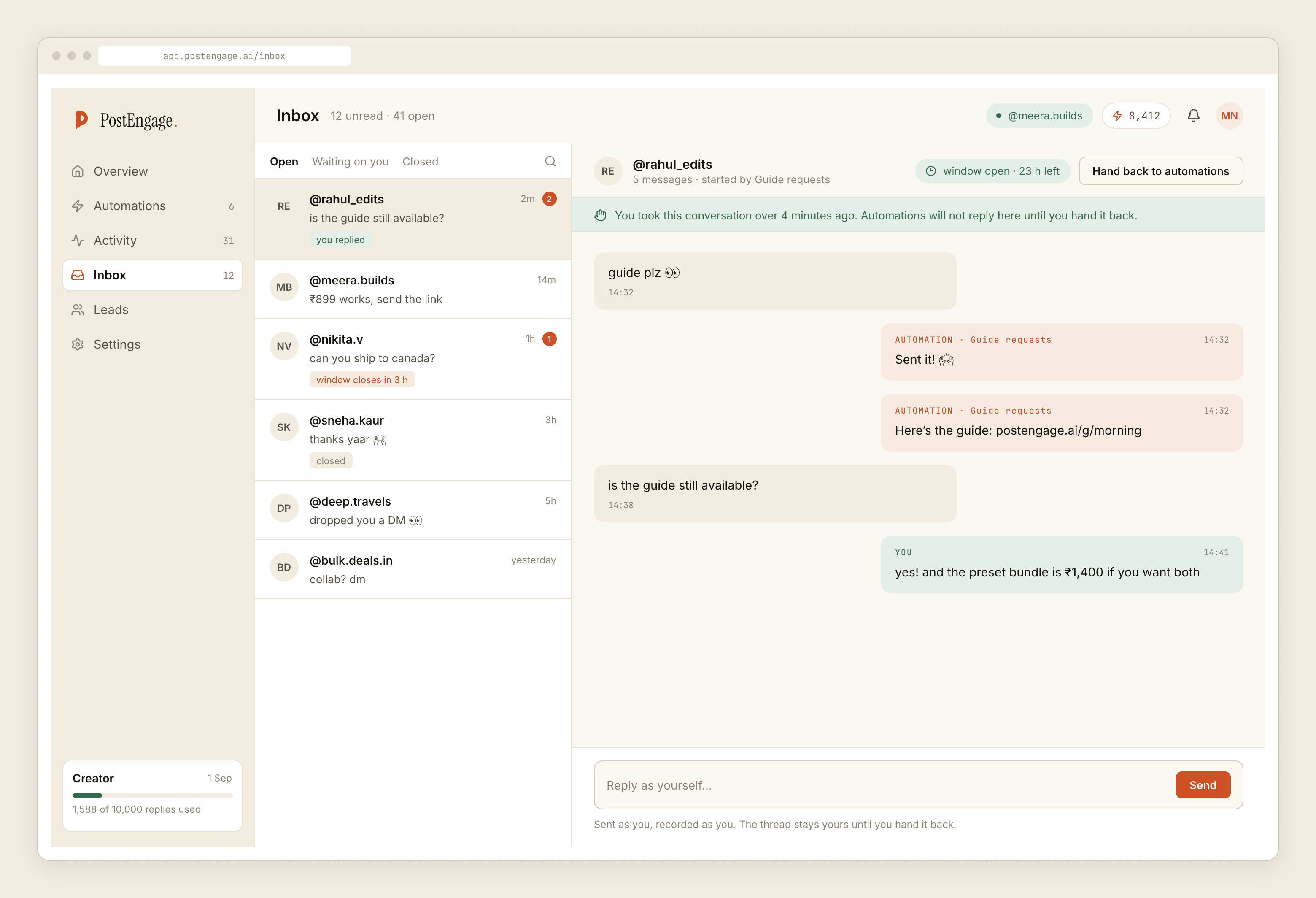
Takeover means the moment you reply by hand, the automation stands down for that conversation — so nothing you set up is a commitment. You can answer anything personally, at any time, and nothing will land on top of you.
And the cost of finding out whether any of this helps is nothing. Templated replies are free and unlimited, the free tier is 100 credits with no card, and credits move only when the AI writes something new. Packs start at ₹499 if you get there. If you run the T-and-M test, build two templates, and conclude after a fortnight that it changed very little, you have lost a Saturday and no money.
If you do want to try, the paced setup guide is deliberately slow, the VA comparison covers the version where the answer is a person rather than software, and speed of first response is the narrow thing this genuinely does well.