Playbooks · 5 min read
The Course Support Inbox: Route It, Never Automate It

The sales half of a course inbox gets all the attention. The half that comes after the money moves gets none, and it is the half that decides whether anybody recommends you.
"Got charged but no access." "Never got the login link." "Missed yesterday's session, where is the recording?" "I want a refund." These arrive in the same Instagram DM thread as "is this good for beginners", and to a keyword matcher they are indistinguishable from a sales enquiry.
Start from what we cannot see
There is no integration with your course platform. Not Teachable, not Kajabi, not the LMS your developer built, not the Drive folder. We cannot look up an order, confirm a payment, resend a login, extend access, check whether a recording was uploaded, or issue a refund. There are no one-click integrations at all; captured leads leave as a CSV.
That is not a limitation to work around. It is the reason the whole post has one instruction: the automation's job in the support inbox is to send nothing and make sure a human sees it.
The related structural point — that a course account is holding two populations who look the same on arrival — is argued in full in the sibling post, and the launch-versus-evergreen split is a separate build problem. This one is only about what happens after the card is charged.
Support messages carry a clock that sales messages do not
A prospect who waits six hours for an answer is mildly annoyed. A buyer who has been charged and cannot get in is doing something else entirely: they are deciding, hour by hour, whether they have been scammed.
That is the real reason a cheerful automated reply is so damaging here. It is not that the words are wrong. It is that an instant, confident, on-brand message that does not solve the problem is read as evidence that nobody is actually there — and the person now has a story about your business, formed at the exact moment they were most anxious about the money.
An automated reply to "got charged but no access" is the single worst message this product can send on your behalf.
The refusal list, sorted by what has gone wrong
Negative keywords are the mechanism. When one matches, nothing is sent and the person waits for you rather than getting a template on top of a bad day.
Build the list in three groups, because writing it as one long list is how words get missed.
- Money.
refund,payment failed,charged twice,double charge,invoice,receipt,chargeback,cancel. Anything here is a conversation with financial consequences and no correct template. - Access.
login,password,access,not received,never got,link not working,expired,otp,can't open. These look mundane and they are the most urgent messages in the inbox. - Delivery.
recording,missed the class,slides,certificate,assignment,no reply from team. Slower burning, still not automatable, because the honest answer depends on a fact you have to go and check.
Matching folds case and punctuation, so you write the word once and Refund! matches too. It matches whole words, so refund will not catch refunded — put both in. And it does not translate, so if some of your students write in Spanish, reembolso is its own entry next to refund. Most panicked messages arrive in lowercase shorthand anyway, which is where your list should be thickest.
Routing is a human commitment, not a setting
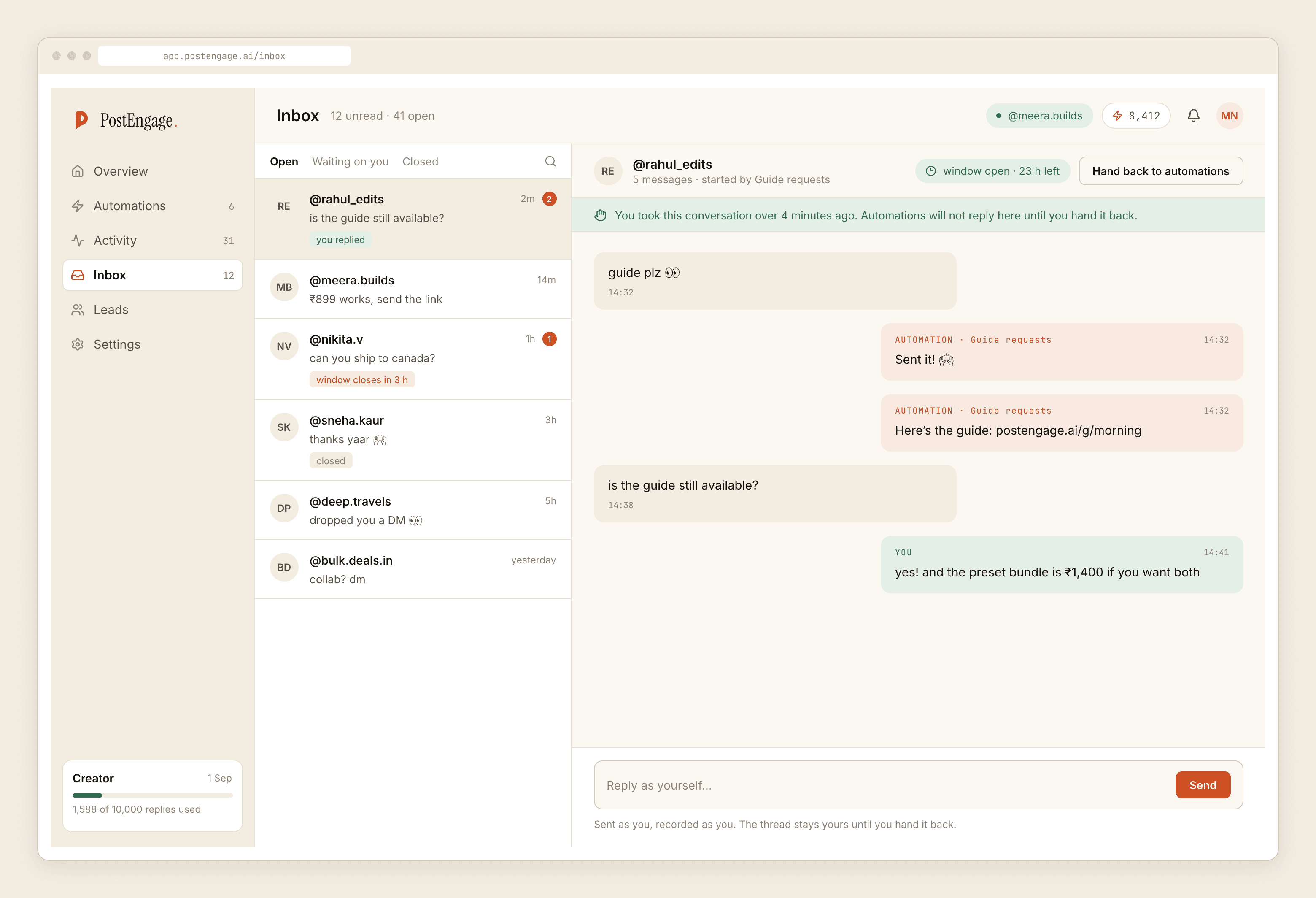
Here is the part nobody wants to hear. Turning the automation off for support messages does not answer them. It just stops you sending the wrong thing. Somebody still has to open the inbox.
So decide the two facts before you build anything: who reads the routed messages, and how often. For a solo creator that might be twice a day, morning and evening, and that is fine as long as it is real. For a small team it needs a name attached, because "the team checks it" means nobody does.
The twenty-four hour DM window makes this concrete rather than aspirational. You can reply inside a thread for twenty-four hours after their last message, and only their next message restarts that clock. A buyer who wrote on Friday night and got nothing by Sunday is not just neglected — the thread may have closed on you, and you cannot reopen it from your side. They have to write again, and by then they are writing somewhere less polite.
The one support-adjacent thing that is safe to automate
There is exactly one, and it is worth building because it removes a chunk of the pile.
A templated reply on your enrolment confirmation post, or triggered by a word you put in the welcome caption, that says where the course lives, which email address the login comes from, how long it takes to arrive, and where to write if it has not. No lookup, no personalisation, no claim that anybody has read anything. Purely the address of the information.
That is not answering a support message. It is preventing one, which is the only leverage available when the tool cannot see your platform.
Takeover, and why it matters most here
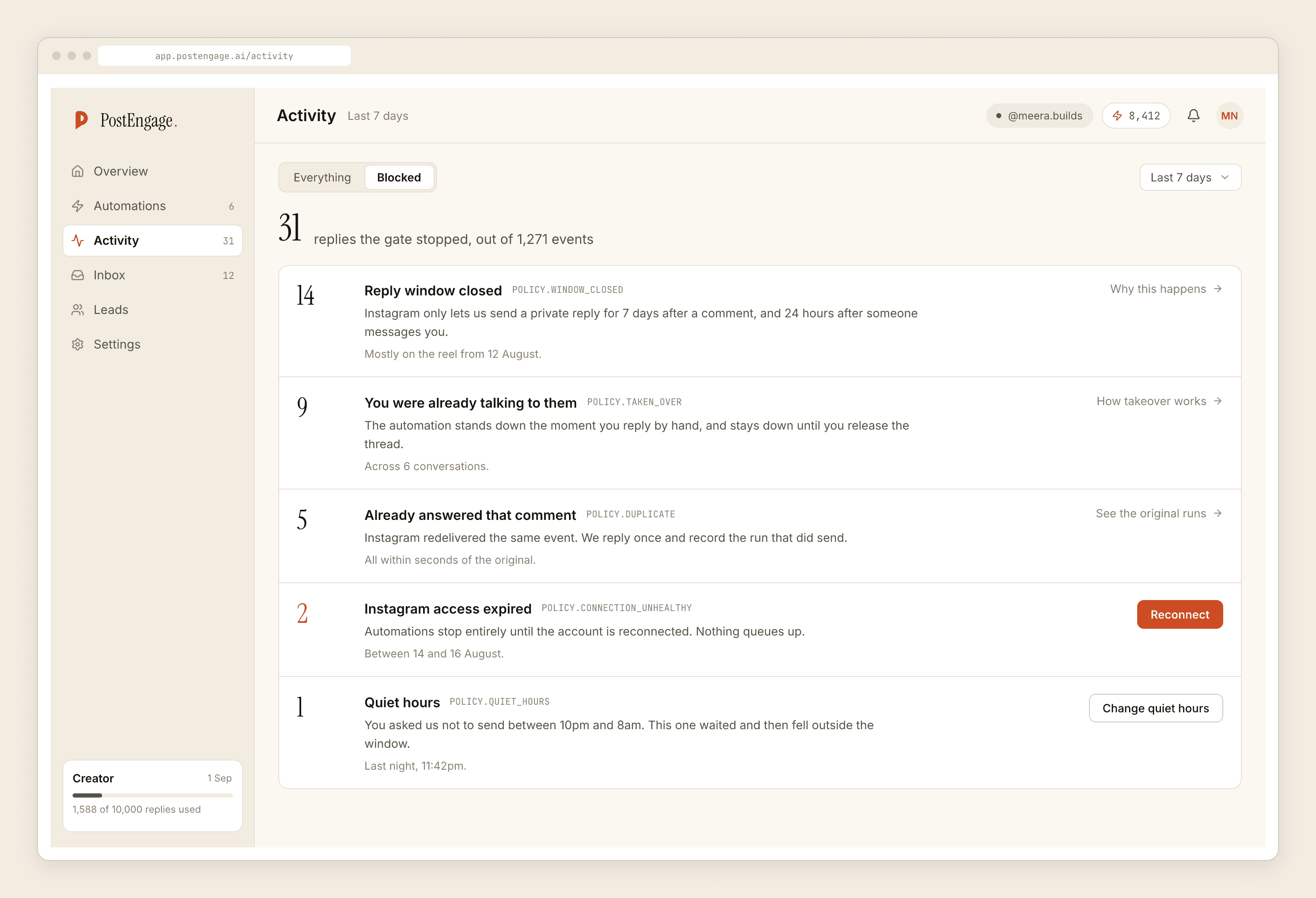
Once you press Take over in Inbox, or reply from Inbox, automation stays out of that thread until you hand it back. Nothing lands underneath your considered answer about a refund. Nothing follows up two days later with a cheerful pitch to someone you are in the middle of making whole.
Templated replies are free and unlimited; a credit is spent only when the AI writes a new reply. Comment replies stay uncapped on every plan; DMs on Free are capped at 1,000 every rolling 30 days, gone on Lite and up. Free tier is 100 credits with no card, packs start at $3.99 (₹299 in India). A well-built support posture spends nothing at all, because its whole design is not sending things.
No payment links, no refunds, no CRM sync, no WhatsApp, no broadcasts, no sequences. Official Graph API only. If you want the sixteen checks that sit in front of every send, they are documented here.