Lead generation · 5 min read
B2B Sales on Instagram: What Happens After the Capture

This ground is genuinely covered, and covering it a third time would be padding.
B2B lead generation on Instagram is founder to founder makes the strategic argument: the person writing to you is one owner with a phone, not a buying committee, and everything about triggers, replies and the lead record follows from that. The one-afternoon build sheet is the practical companion — which post to pick, which fields to fill, what to check the morning after.
Read those two and you have the enquiry side. What neither of them covers is the part that carries the word sales rather than lead gen: what happens between the captured enquiry and the money, which in B2B is measured in weeks and sometimes quarters.
That gap is where this product's honest limits live, so it is worth one short post.
The deal is six weeks long and the window is a day
Two clocks, both Meta's. A comment stays answerable for seven days. A DM thread stays open for twenty-four hours from the other person's last message to you, and only their next message restarts it. Nothing you do reopens it.
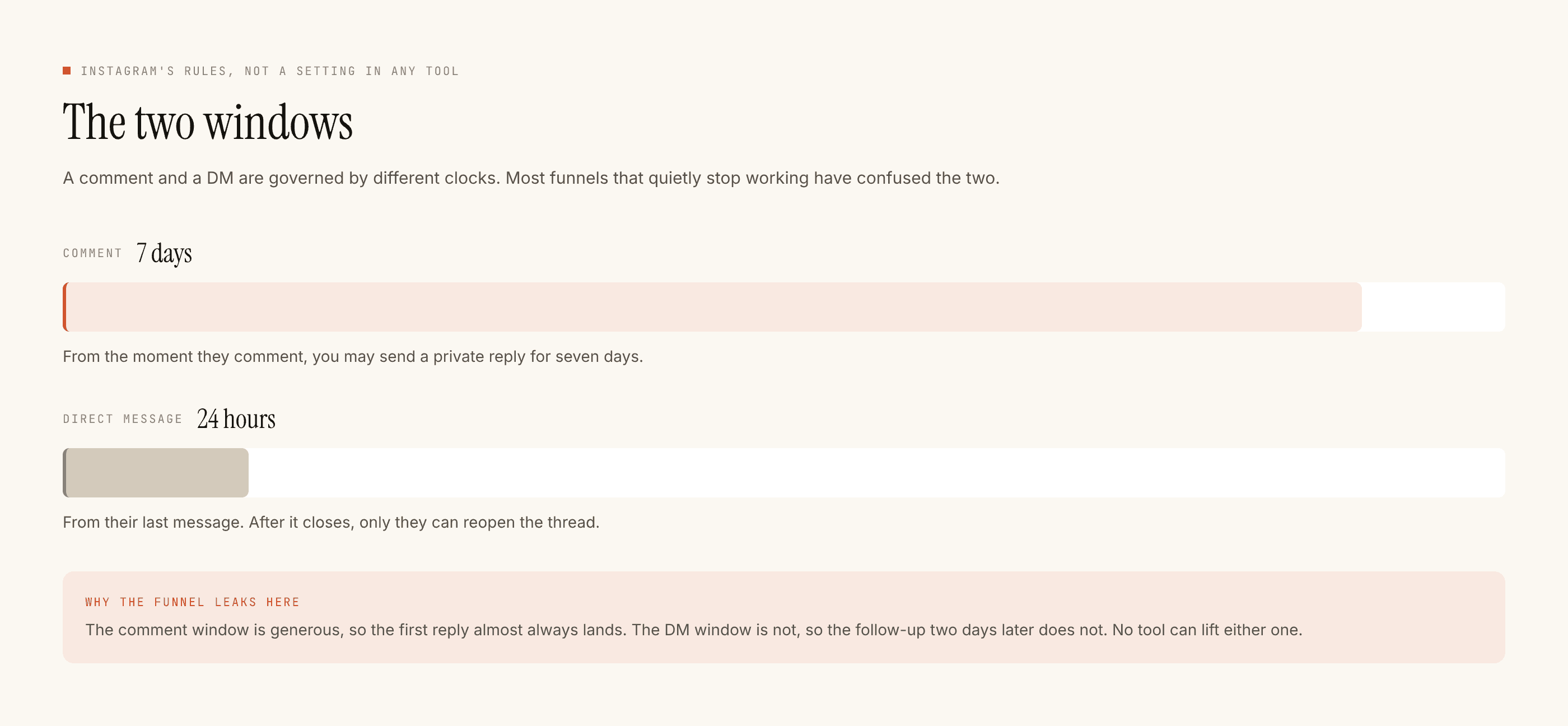
Now put a normal B2B motion against that. An ops lead messages on a Tuesday night, gets your reply, forwards it to a partner, hears nothing for a fortnight, comes back after a budget meeting. That fortnight of silence is entirely normal and entirely outside the window.
There is no drip here. No sequence builder, no nurture flow, no scheduled follow-up, no broadcast, no re-engagement campaign. Not as a gap we intend to fill — those things do not exist in this product, and inside a DM thread the platform would not carry most of them the way people imagine anyway.
In a B2B DM thread you do not own the follow-up. The buyer does, and your only lever is making their next message easy to send.
Three things that actually follow from it
Front-load the reply. Whatever the buyer needs in order to keep deciding while you are not in contact has to be in the message they got while the window was open. The pricing shape, the case study link, the thing that answers their partner's objection. Not "happy to send more detail" — send the detail.
End on one closed question. Not to be clever. A message they can answer with a thumb is a message that restarts the clock, and their reply is the only thing that does. One question, answerable in four words, is worth more than three thoughtful ones they will save for later.
Move the conversation off Instagram, on their terms. Ask for the email, or send them somewhere they can book time with you. That is a link in your reply going to a system we have nothing to do with — there is no calendar and no booking here — and it is the correct design rather than a workaround. A B2B deal should not live inside a channel with a twenty-four hour clock on it.
There is no pipeline object, and pretending otherwise is the failure
A captured lead is a handle, the words they typed, which post caught them, and whatever you type into the note. That is the whole record.
No stages. No deal value. No forecast. No probability, no ageing report, no owner field, no activity history beyond the thread itself. No enrichment: no company name, no employee count, no domain lookup, no firmographics. No attribution — nothing here will tell you which reel produced the contract.
The list leaves as a CSV. That file is the handoff, and the honest version of what that handoff involves is worth reading before somebody in your team promises a pipeline view. There is no HubSpot sync, no Zoho, no Pipedrive, no Zapier-free one-click anything.
The workable arrangement is the boring one: your CRM stays the system of record and Instagram is a doorway into it. Export weekly, import, and write the note the same day you got the enquiry, because in six weeks that note is the difference between a warm conversation and starting over.
The sales team problem, which is small and real
Takeover stands the automation down in a thread the moment a human replies by hand. On a one-person account that is simply correct behaviour. On a shared account with two or three people selling, it introduces the same hazard every shared inbox has: the automation gets out of the way for whoever typed first, and that might be the wrong person.
Write the rule down before it happens. Whoever replies first owns that conversation until they hand it over deliberately. The automation is not what causes two sellers to pitch the same buyer forty minutes apart, but it will happily get out of the way while they do.
The word "sales" implies outbound, and there is none
Worth saying plainly because the search term carries it. Nothing here can message a company, a follower, or a person who has not messaged your account first. No prospecting, no list upload, no scraped-audience DM, no connection requests. That is not a feature held back — cold outreach on Instagram is not a permission that exists to apply for, and the enforcement side of that is a separate post.
So the entire motion here is inbound: something you posted made a peer recognise their own problem, and they typed a word. The automation catches that, quickly, at eleven at night, and hands you a named person in an open thread who is expecting to hear from you.
At six enquiries a week, that is a genuinely useful thing and a small one. Templated replies are free and unlimited; a credit moves only when the AI writes something new. Free tier is 100 credits with no card, packs from ₹499. Most B2B accounts never leave the free half, because the volume is low and the good replies are templates you wrote once.
Start with the build sheet. This post only exists to tell you where it stops.