Playbooks · 6 min read
Amazon Sellers: Instagram Cannot See Your Orders
On this page
- There is no Amazon integration. There is no marketplace integration at all
- The identity gap, which no integration would fix anyway
- What genuinely works: the link
- You will not know which DM produced a sale
- Reviews are the other thing to keep automation away from
- Claims about the product
- What it will not do

A product reel travels. Not viral, just further than usual, and by the next morning the DMs have three shapes in them.
"link?"
"ordered on 22nd, still not delivered"
"is this original or first copy?"
Only one of those is a question this product can help with, and it is the short one.
There is no Amazon integration. There is no marketplace integration at all
Said plainly at the top, because a lot of pages on this subject are vague about it in a way that costs somebody an afternoon.
Nothing here connects to Seller Central. There is no order lookup, no tracking, no inventory sync, no returns flow, no FBA anything, no product feed, no way to read a listing, and no way to write to one. Nothing in this product has ever spoken to a marketplace, and nothing is planned to. What it does is reply to comments and DMs on an Instagram account through the official Graph API. That is the whole surface.
If your requirement is a bot that answers "where is my order" with a real status, this is not that, and neither is anything that only has Instagram permissions.
The identity gap, which no integration would fix anyway
Worth understanding, because it is the deeper reason and it does not go away with a better tool.
The person messaging you is an Instagram handle. Your order is a row in a marketplace with a name, an address and a phone number you often do not fully see. Nothing links the two. @shreya.designs.94 and the order placed by S. Sharma to a Pune pincode are the same person only in the sense that you might reasonably guess so, and "reasonably guess" is not a basis on which to disclose where somebody's parcel is.
So the correct behaviour for an automated system asked about an order is not to try. It is to say, clearly and in a fixed template, that order status is not visible from this account and point at the marketplace's own order page and support route — the place where the person is actually authenticated as the buyer.
What genuinely works: the link
Here is the flow that is worth building, and it is the only one most sellers need.
You post a reel about a product. The caption asks people to comment a word. The automation replies publicly with something short and sends the listing link in a private DM.
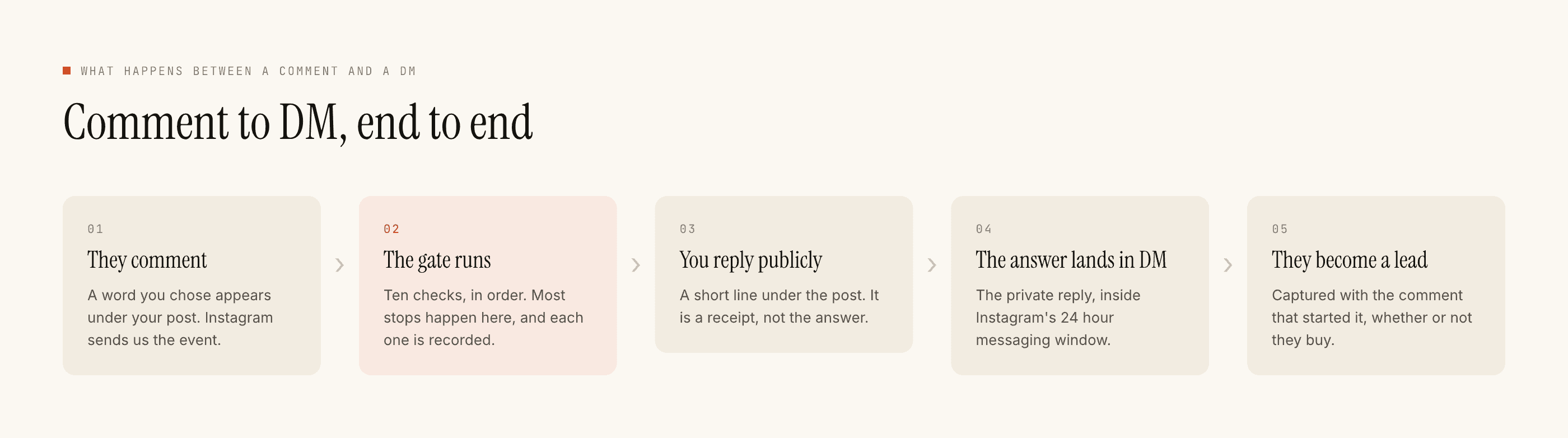
Two details that matter. Use one automation per product post, scoped to that specific post, so the link is always the right link — a single account-wide rule sending one URL will be wrong the moment you post about something else. And when a listing goes out of stock or the ASIN changes, switching that automation off is a manual job. Nothing expires by itself and no scheduled send exists.
You will not know which DM produced a sale
This is the adjustment that marketplace sellers find hardest, so it is better to hear it now than to discover it at the end of the month.
There is no attribution here. No pixel, no UTM handling, no click tracking, no conversion reporting, no analytics product of any kind. When somebody comments, receives your link and buys, the purchase happens on a marketplace that will not tell you where the buyer came from, and this tool is not watching either end.
What you get instead is coarse: how many people triggered which automation, and a CSV of who they were. That is enough to know whether a post produced interest. It is not enough to build an ROI model on, and any page telling you otherwise about an Instagram-to-marketplace path is describing something the platforms do not hand over.
Reviews are the other thing to keep automation away from
Marketplace sellers get two review-shaped messages. Somebody who has left a bad one and is now in your DMs about it, and the temptation to ask happy customers for a good one.
Do not automate either. What a seller may say to a buyer about a review, what may be offered, and how a seller may contact a buyer at all are governed by the marketplace's own policies, they are enforced with account suspensions rather than warnings, and they differ by marketplace and by country. This post is not going to summarise what Amazon permits — read the policy you are actually bound by, and assume that an automated message at scale gets looked at more harshly than a one-off note.
The DM from an unhappy reviewer needs a person for the ordinary reason as well: a template landing under somebody's complaint is a screenshot waiting to happen.
Claims about the product
"Is it original?" "Does it come with warranty?" "Is it BIS certified?" "Will you give a GST invoice?"
These look like FAQs and they are statements about the product's legal status. Answer them with fixed wording you have written and checked, or do not answer them automatically at all. Never let a generated reply improvise here — a fluent sentence about certification or warranty is a claim your business has made in writing, and the AI has no idea what is on the box.
What it will not do
No Seller Central, no order status, no inventory, no returns, no refunds, no payment links, no shipping updates. No CRM sync — leads leave as CSV. No WhatsApp, no email, no scheduled sends, no broadcast, and no way to message anyone who has not messaged you first.
Official Graph API only: seven days to reply to a comment, twenty-four hours inside a DM thread, and that DM clock restarts only when the customer writes again.
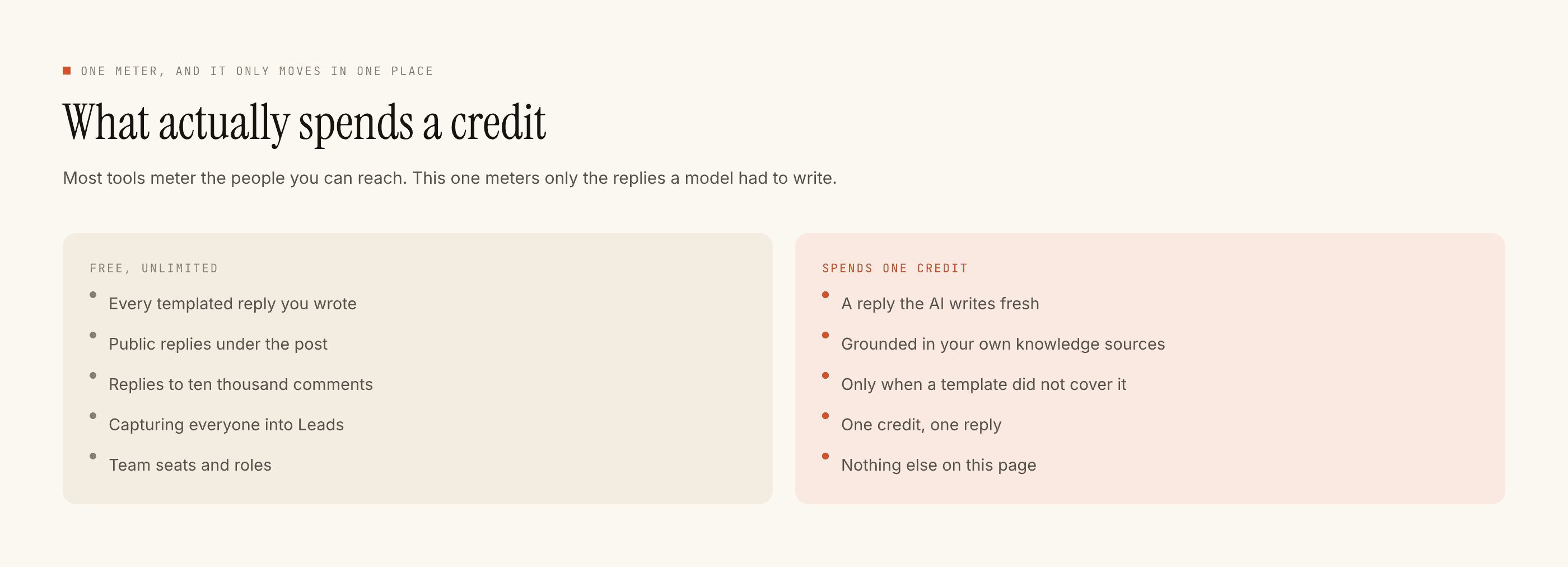
Templated replies are free and unlimited; a credit is spent only when the AI writes a new reply. Free tier is 100 credits with no card, and packs start at ₹499.
If you also sell on your own storefront, the Shopify version of this post covers a setup with more of the pieces connected, Etsy sellers face a similar marketplace gap, and the wider ecommerce build is the one to read for the funnel side.