Compliance · 5 min read
Financial Advisers: An Instagram DM Is Not Yet a Client
On this page

The message comes in at 9:20 on a Sunday night. A screenshot of a portfolio — actual holdings, actual amounts, not blurred — and one line underneath it.
"sir ye theek hai? 8 lakh FD mein pada hai, shift karun?"
They have not asked for a meeting. They have handed you their financial position and asked you to react to it, in a channel where the reply goes out in under a second if you let it.
They gave you facts. That did not make them a client
This is the difference between an adviser's inbox and almost every other inbox in this series.
For a bakery, a DM is an enquiry that becomes an order. For you it is an unsolicited disclosure that arrives before any of the work that makes a recommendation possible has happened. Nobody has taken a fact-find. Nobody knows their income, their dependants, their existing cover, their debt, their horizon, their tax position, their tolerance for a bad year, or whether the eight lakh is an emergency fund that must not move.
Suitability is not a step in your process. It is the process. And a keyword match has completed none of it at the moment it is deciding what to send.
The automation is holding a number, a question, and no context whatsoever. Every reply that engages with the number is a recommendation made in that state.
What it must never say, in descending order of how harmless it looks
A direction. Shift, hold, book profits, wait for a dip, SIP kar do. Naming an action is advice regardless of how it is hedged.
A product or an asset class. Even generically. "Debt funds are usually better for that horizon" is a sentence with a person's eight lakh attached to it.
A return. Historical, expected, indicative, "usually around", or a screenshot of one. A number that describes performance is a claim, and claims about performance are governed almost everywhere, in ways that differ everywhere.
Anything that reads as a recommendation without being one. This is the category people miss. "Most people in your situation…" is a recommendation. "I'd look at…" is a recommendation. A helpful list of three options is a recommendation with extra steps.
And one more that sounds like ordinary politeness: "yes, I can help with that." Said before you know their circumstances, their jurisdiction, or whether they are already advised elsewhere, that is a statement that your service is appropriate for them. It is the same mistake as the rest of the list, wearing a friendlier face.
The sentence that saves you the most trouble
Do not let the automation repeat their figures back to them, summarise their position, or ask a follow-up question about their money. People will keep going if you do — they are being helpful, and the thread turns into a fact-find conducted in a place with no controls on it.
The most valuable thirty words in an adviser's template are the ones asking them to stop: that account numbers, statements, PAN, and screenshots should not be sent here, and that whatever they need to share will be taken properly at the next step. Then the route — a call, an intake form, whatever you actually staff — and nothing else.
The public reply is the part people forget
Comment automations post in public, and the comment threads under a market-panic reel are where an adviser's most tempting replies live. Somebody asks, publicly, what to do now.
A DM at least goes to one person whose message you have. A public reply is a statement to an audience you cannot see: existing clients, people in countries you are not authorised in, journalists, and the fifteen thousand people who watched the reel and never commented. Whatever the DM rules are where you are, the public field is the higher-stakes one, and the safe content for it is close to nothing — an acknowledgement and a nudge to write privately.
Capture the least you can live with
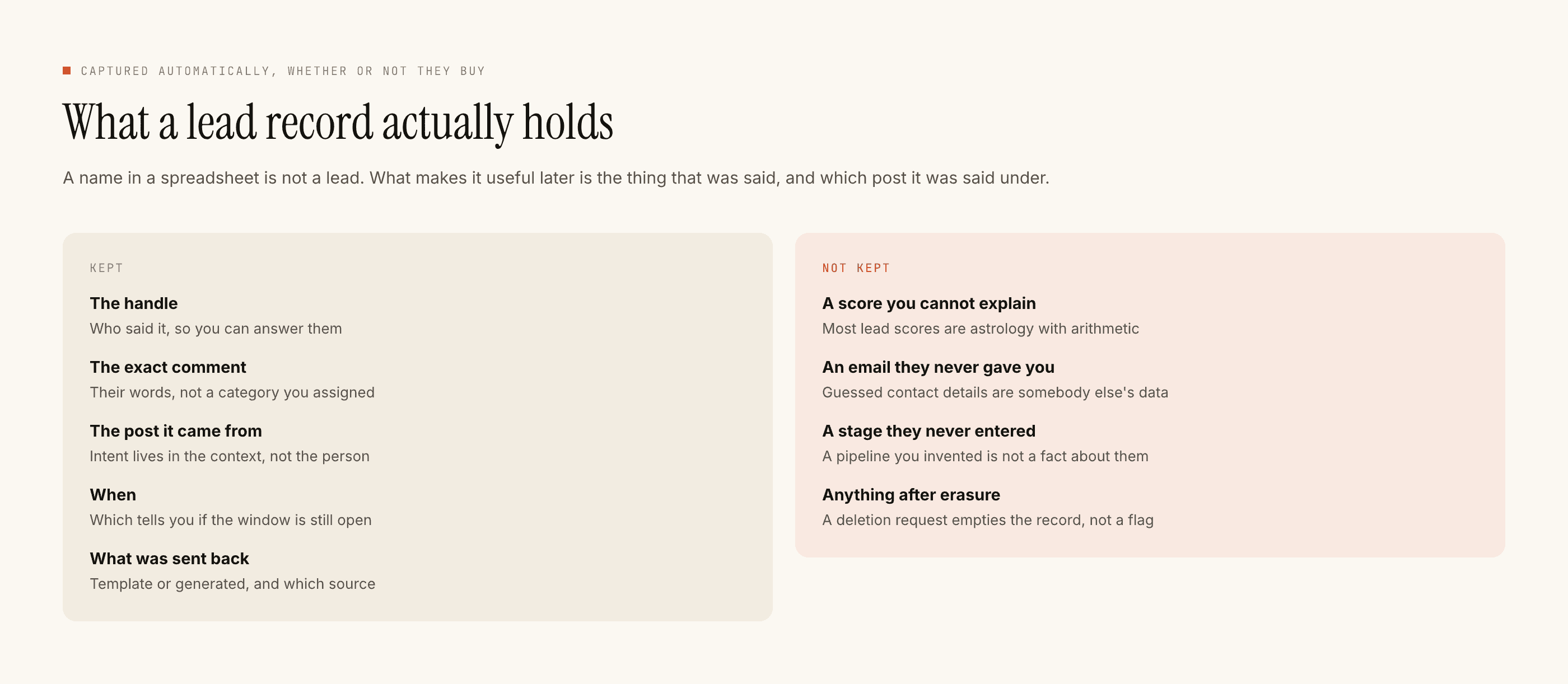
The instinct with a serious enquiry is to grab everything while they are typing. Resist it here, because everything you capture is now data you hold about a person's finances, sitting in a marketing tool.
Name, that they enquired, when, and which post they came from. That is enough to return the call while they still remember writing. Amounts, holdings, goals and documents belong in whatever system your firm actually uses for client records, entered after a conversation, not scraped out of a DM by a trigger.
Takeover, and the small inbox problem
The moment you reply by hand, automation is out of that thread for good. No generated sentence lands under something you wrote carefully.
An adviser's inbox is usually small and heavy — a handful of real enquiries a week, each worth more than a month of a restaurant's DMs. That inverts the usual trade-off. Speed is worth little; not being wrong is worth almost everything. The automation's job is to hold the door open politely until you are in the thread, which for most advisers is within the hour anyway.
What it will not do
No advice, obviously, and after the sections above that should read as the feature it is. No calendar, so nothing confirms a meeting. No CRM sync — leads leave as CSV. No WhatsApp. No scheduled follow-up. It cannot message anyone who has not messaged you first.
Official Graph API only: seven days to answer a comment, twenty-four hours inside a DM thread, and that DM clock restarts only when they write again.
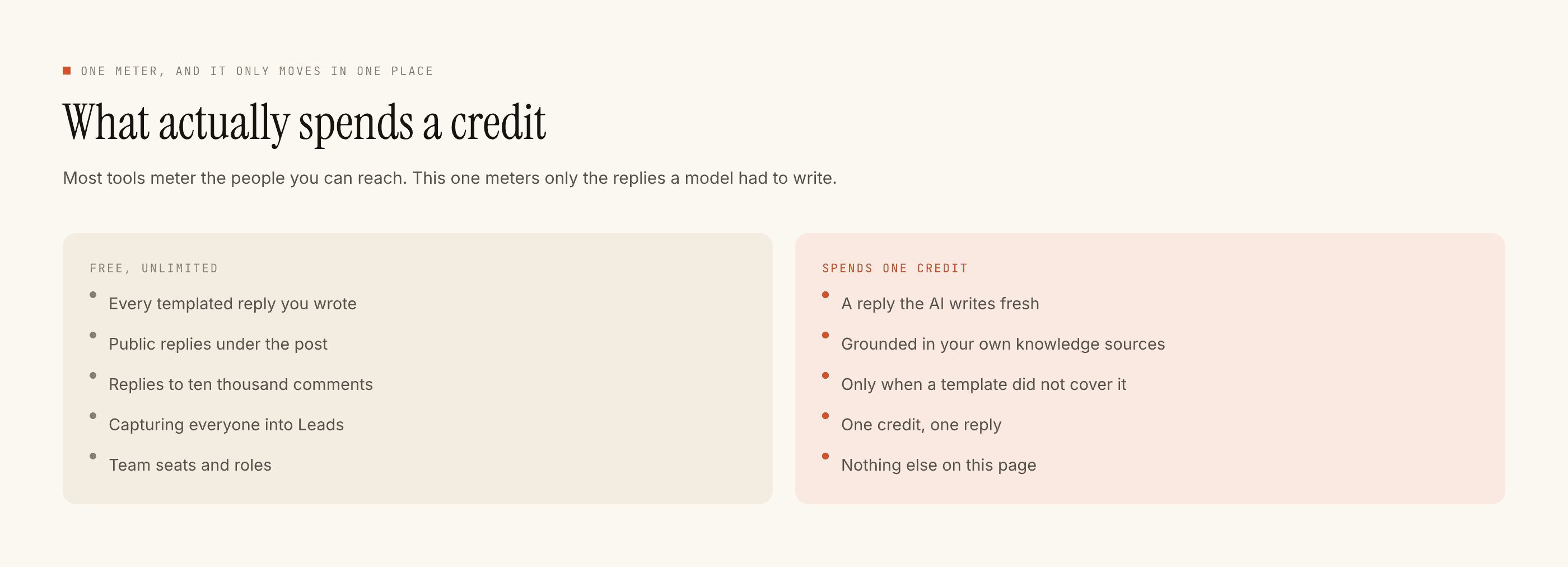
Templated replies are free and unlimited; a credit goes only on a newly written reply. Free tier is 100 credits, no card, and packs start at ₹499. Most advisers running this properly never reach a pack, because the correct build is almost entirely fixed wording.
If you are the firm rather than the individual, supervision and records are the harder half. The broker version of the same refusal is worth reading, and what stops a send explains the checks underneath all of it.